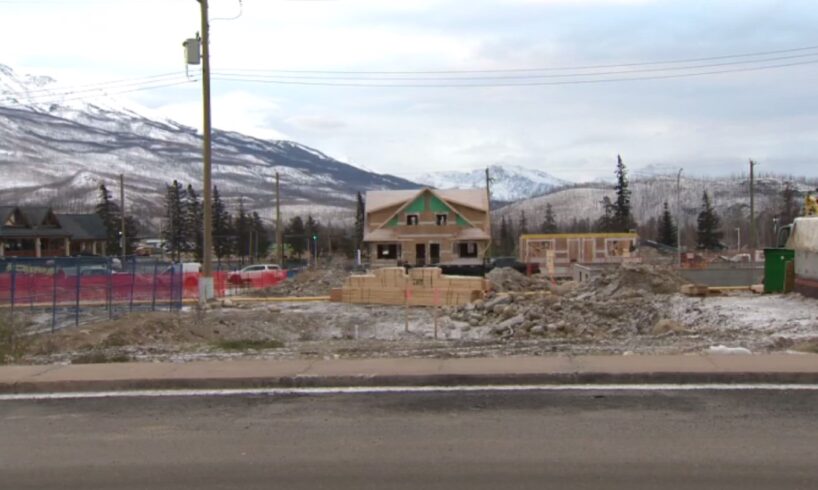
Diana Donat looks at the construction site where her house once stood, across the street from her restaurant.
She’s not sure whether some of the construction workers she sees are here on temporary visas.
“I think some of them are. The ones that are helping the contractors.”
Her house burned down in the fire that ravaged the community of Jasper, Alta., in July 2024, but she didn’t lose the restaurant she had just opened the year before.
Diana Donat. OMNI News
“Temporary foreign workers – they work hard, they commit to their job,” she says, as a former temporary foreign worker herself. “They help businesses in Jasper, like the restaurants.”
The Rocky Mountain town relies heavily on foreign workers, especially during the busy summer season, when up to 3,000 seasonal employees are required.
Jasper, Alta.
Joseph Francisco says tourists flocked back to Jasper soon after last year’s devastating wildfire, keeping businesses afloat.
But while he’s been busy working as a cook for a couple of restaurants in town, sometimes he gets lonely.
“I tried to move here in Canada to bring my family with me,” he says, adding that he hasn’t hugged his daughter in almost four years. “Times are getting tough nowadays.”
Joseph Francisco.
The federal government is aiming to slash Canada’s temporary resident population, promising additional changes to the Temporary Foreign Worker Program (TFWP), which requires employers to submit a labour market impact assessment (LMIA) before they can hire a foreign worker.
Ottawa already tweaked the program, for example, by imposing caps in regions with high unemployment and limiting the percentage of temporary foreign workers that can make up an employer’s workforce.
However, as unemployment remains high, particularly among younger Canadians, the debate around the impact of the TFWP continues. But as newcomers weigh in, their thoughts on the program are split.
‘Labour markets move more quickly than the government’
A recent poll conducted by Leger exclusively for OMNI News found that 36 per cent of immigrants believe temporary foreign workers are taking jobs away from young people, while 47 per cent say the program helps fill jobs many Canadians don’t want to do.
Catherine Connelly, professor and business research chair at McMaster University, says there are many common misconceptions about the TFWP, but the program has changed significantly over the past few months, and many companies are no longer able to hire foreign workers for low-wage jobs.
According to the OMNI-Leger poll, a majority of newcomers think Ottawa should only allow temporary foreign workers in specific sectors of the economy or in areas where unemployment is low, but Connelly argues that finetuning the TFWP is not a realistic approach.
“Labour markets move much more quickly than the government can even hope to,” she explains. “It’s unlikely that the government would be able to keep up with those changes.”
‘Everyone hopes I stay’: Changes to the TFWP are already impacting immigrants
Irene Bloemraad, the Co-Director of the Centre for Migration Studies at the University of British Columbia, says another common misconception is that all foreign workers in Canada are here under the TFWP, when in reality, there are a number of ways for temporary residents to live and work here.
“If the Temporary Worker Program was cancelled tomorrow, there would still be hundreds of thousands of people with temporary work visas in Canada,” she tells OMNI.
Since 2023, Marco Calabretta has been working as a technician for a Montreal company through a program called International Experience Canada.
He tells OMNI News that after two years at his job, his coworkers are like a second family, but his plans to continue to build a life in Canada have been upended by recent changes to work permits at the provincial and federal levels.
“Everyone hopes I stay,” he says. “They are trying to do everything to help me.”
Marco Calabretta. OMNI News.
A small but equal share wants the TFW program either ended or kept as is
The OMNI-Leger survey found that immigrants are evenly split over whether to keep the TFWP as it is or to end it altogether.
Federal Conservative Party Leader Pierre Poilievre has called on Ottawa to scrap it entirely, and instead create a “standalone program for legitimately difficult-to-fill agricultural labour.”
But Bloemraad believes that reducing the number of temporary pathways for immigrants should mean going back to a system where coming to Canada is a long-term investment for both the country and the newcomer.
“It’s not very fair to think that we can just bring in people for our economic growth and then treat them like robots in a factory,” she tells OMNI. “Like, if the economy goes bad, I turn off my robot, or send the immigrant back.”
“If we think they are good enough to work for us, they might be good enough to stay.”
—
The poll was completed between Oct. 2 and Oct. 15, 2025, among 1,510 respondents who were all born outside Canada, using Leger’s online panel. No margin of error can be associated with it.
This story is part of a series from OMNI News with data being released throughout the month.