When Keir Starmer was mounting the case for the prosecution against Boris Johnson for his Partygate antics, it took almost two months and a police investigation for him to formally call for the prime minister to resign. He was of the view there was no point calling for things until they were likely to happen.
This is not the philosophy of the current leader of the opposition. Since October, Kemi Badenoch has called on Starmer to sack his chancellor three times, once over a mishap with her rental licence, then for considering raising income tax, and finally because she did not in fact raise income tax.
It is unclear whether Badenoch genuinely believes Reeves may be forced out because of how she spun the forecasts from the Office for Budget Responsibility to help her step back from the brink of a manifesto breach. Resignations have been coming thick and fast, from Angela Rayner to Peter Mandelson, and now the departure of Richard Hughes from the OBR over an embarrassing shoddiness in their cybersecurity, which meant the whole budget was leaked early.
Starmer defends Reeves: has she been economical with the truth? | The Latest
But the reality is that prime ministers almost never sack their chancellors – and when they do it almost inevitably leads to their own downfall. The most recent chancellor to have that experience, Kwasi Kwarteng, told Liz Truss this obvious truth to her face that if she sacked him, her own premiership was over.
After this budget, Starmer knows the same is true of him and Reeves. The decision not to proceed with a manifesto breach on income tax cannot be understood without the context of needing to preserve Starmer’s own political survival.
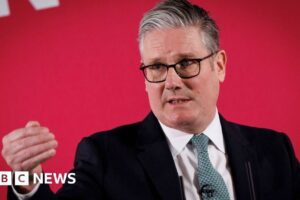
Starmer assembled journalists at a community centre in Southwark on Monday morning to try to bring attention back to the fundamentals in the budget – the cut to energy bills, the lifting of the two-child benefit cap, and to promise more investment, deregulation and reform.
But in the room it was most striking how he called the press conference not to pass the buck, but to bind himself even closer to Reeves. “There was no misleading – I simply don’t accept it. And I was receiving the numbers,” he said.
He took the unprecedented step of revealing that he himself had been the one to consider a manifesto breach by raising income tax. “I didn’t want to get to that place, but I recognised we might have to,” he said as he defended Reeves against the charges that she had misled the markets and the public.
“As the process continued, it became clear to me and others that we might be able to do what we needed to do with our priorities without the manifesto breach.”
During the hour-long speech and questions Starmer underlined again and again how the choices in the budget were his own. And he also turned his own fire on the OBR – with barely concealed fury about how he was “bemused” at the timing of the productivity downgrade and the “serious error” of the leaked forecast.
Some in Westminster believe that Hughes’ resignation has left Reeves even more exposed – after a weekend of counter-briefing when the OBR left it in no doubt that the decision on income tax was not made because of suddenly improved forecasts. Hughes has taken responsibility after the body’s cybersecurity has been found wanting. Perhaps Reeves should do the same because the spin has been found out.
But Starmer made it pretty plain on Monday that this was unthinkable. And if he were to break with his chancellor now, it would put the spotlight back on the real context for that decision to ditch the idea of breaching the manifesto on income tax – in a week where Starmer’s leadership was under renewed threat in the furious aftermath of allies briefing against the health secretary, Wes Streeting.
Scratch the surface and that is the most worrying thing for some of the more thoughtful and economically literate Labour MPs – that this was a budget with self-preservation at its heart, without ambition, where living standards for ordinary voters continue to stagnate.
Much of the parliamentary Labour party is happy enough with the end of the two child-limit. But there is precious little there to give any of the more growth-minded MPs room for hope, amid predictions of the worst parliament on record for living standards. Once again, it is the restless PLP, not Badenoch, that is the real risk to the future of Starmer and Reeves.