Keir Starmer’s Labour government’s preparation for an assault on the historic right of trial by jury in Britain was exposed last week in a leaked Ministry of Justice internal briefing from Justice Secretary David Lammy.
According to the document, Lammy, who is also the deputy prime minister, aims to introduce legislation to end jury trials for all cases carrying a maximum sentence of less than five years.
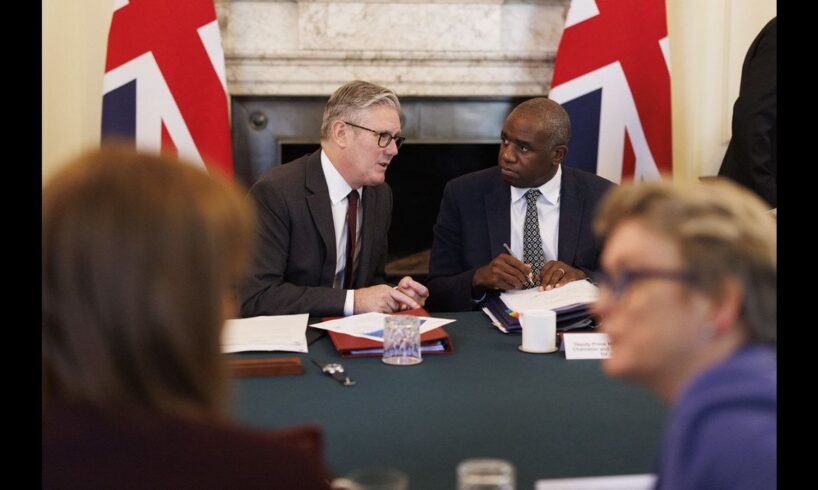
Prime Minister Keir Starmer speaks with Deputy Prime Minister David Lammy as he hosts his weekly Cabinet in 10 Downing Street, September 9, 2025 [Photo by imon Dawson / No 10 Downing Street / CC BY-NC-ND 4.0]
The proposals must be understood alongside the Labour government’s accelerating preparations for war abroad and for major conflict with the working class at home.
Courts Secretary Sarah Sackman claimed the measures are aimed against “career criminals” supposedly “gaming the system” by having the temerity to opt for their democratic right to a jury trial. One of the central targets of the legislation, however, is what is called “jury equity” or “jury nullification”. This refers to the right of a jury to determine whether a crime has been committed at all, regardless of the opinion of the trial judge.
Jury equity was famously exercised in 1985 by the jury in the case against civil servant Clive Ponting, who leaked details of the then Tory government’s misinformation over the circumstances surrounding the 1982 sinking of the Argentine cruiser General Belgrano by the Royal Navy, with the loss of 272 lives.
Ponting was acquitted after a two-week trial, despite admitting that he had leaked the documents in question and the trial judge’s insistence that he had no defence in law. Ponting claimed, and the jury agreed, that releasing the documents, which exposed government lies over the circumstances of the sinking, was in the public interest.
The principle has become an irritant to governments ever since, particularly following a series of cases in which members of climate and anti-genocide protest organisations such as Extinction Rebellion and Palestine Action have been acquitted despite instructions from the bench.
In 2023, retired Walthamstow social worker Trudi Warner held up a sign, for 30 minutes, outside the court at which activists for the Insulate Britain climate activist group were to be tried over their protest actions in blocking the M25 London orbital motorway. Warner’s sign read, “Jurors, you have an absolute right to acquit according to your conscience.”
Warner was arrested and sent for trial at the Old Bailey where, extraordinarily, the same message is displayed on a plaque commemorating the 1670 jury in the case of Quakers William Penn (later founder of Pennsylvania) and William Mead, accused of unlawful assembly. The plaque celebrates the stand of “Thomas Vere, Edward Bushell and ten others” who refused to give a verdict against Penn and Mead “although they were locked up without food for two nights and were fined for their verdict of Not Guilty.” The case established the jury’s authority to judge both the facts and the law, with a November 1670 ruling by Lord Chief Justice Vaughan upholding the principle that juries could not be punished for their verdicts.
Warner was informed by then Solicitor General Michael Tomlinson that he was minded to commit her to prison. Her stance was taken up by what became the group Defend Our Juries, which organised protests in Warner’s defence outside every Crown Court in England and Wales.
In the end the Solicitor General’s case was thrown out and was finally dropped in 2024 by Labour’s new appointee to the office, Sarah Sackman.
Subsequently, however, hundreds of people have been arrested for opposing the Palestinian genocide by holding up signs opposing the proscription of the peaceful direct action group, Palestine Action. Once again, Labour wants to aggressively push forward the repressive measures prepared by its Tory predecessor.
Should the plans be enacted, instead of jury trials, a new tier of courts, the Crown Court Bench Division, would be created between magistrates courts and Crown Courts, to hear cases that did not involve murder, rape or manslaughter charges. The proposals are based on those floated earlier this year in a report from retired judge, Sir Brian Leveson, and are being presented as a response to backlogs in the legal system meaning that cases can wait four or five years before going to court. Some 78,000 cases are reported as currently awaiting trial.
Commissioned in 2024, Leveson’s report complained that reduced numbers of courts and court staff, poorly maintained court buildings, disorganisation in the justice system exacerbated by the COVID-19 pandemic, “pro-active policing” policies of successive governments, along with greater complexity of cases and new forms of evidence all combined to make jury trials take twice as long as in 2000. The years long backlog of cases meant that “justice delayed is justice denied.”
Leveson’s recommendations included a series of pragmatic measures, such as more “Out of Court Settlements”, streamlined digital processes to facilitate those, further investment in drug and alcohol misuse rehabilitation services, more encouragement towards rehabilitation, out of court resolutions for minor offences and similar measures.
Leveson also proposed restricting the “right to elect” for a jury trial to cases with maximum sentences of over three years. The right of appeal would also be curtailed to a more restrictive “permission” to appeal.
Lammy’s proposals go further. The justice secretary is seeking to increase the jury trial threshold to cases carrying sentences of five years imprisonment or over. Leveson also proposed that juries would be replaced by a trial judge and two magistrates. This token safeguard, it is reported, has also been abandoned by Lammy who is suggesting a single judge could preside over most cases, with juries being reserved only for the most serious crimes such as murder and manslaughter.
Lammy’s measures were denounced from within the legal profession itself, with comments warning of the threat to the legitimacy of the legal system itself.
The Law Society warned, “Our society’s concept of justice rests heavily on lay participation in determining a person’s guilt or innocence. Allowing a single person to take away someone’s liberty for a lengthy period or decide a potentially life changing complaint would be a dramatic departure from our shared values.”
Riel Karmy-Jones KC, chair of the Criminal Bar Association, told the BBC, “The consequences… will be to destroy a criminal justice system that has been the pride of this country for centuries, and to destroy justice as we know it.”
Commenting on the government pretext of a case backlog, Karmy-Jones noted, “Juries are not the cause of the backlog. The cause is the systematic underfunding and neglect that has been perpetrated by this government and its predecessors for years.”
In 2022, criminal barristers took strike action demanding an increase in fees for legal aid work to prevent an exodus of trained barristers moving into more lucrative areas of work. Barristers noted the £2 billion slashed from legal aid and the repeated concerns raised over the escalating backlog. In March 2020, the awaiting trial backlog was 40,000. It is now nearly double that.
According to the BBC, Lammy’s proposal is in the process of being given approval by cabinet ministers and Whitehall departments before a planned December announcement of legislation being introduced early in 2026.
In a parallel expression of the Labour government’s anti-democratic clampdown, the Guardian reported on the removal of the judge presiding over a judicial review challenging the ban on Palestine Action.
Justice Martin Chamberlain, described by Defend Our Juries as “widely respected for his fairness and independence,” will be replaced by Dame Victoria Sharp, Justices Karen Steyn and Sir Jonathan Swift.
According to Novara media, Chamberlain has no scheduling conflicts, and the judiciary press office refused to offer any comment when approached by the Guardian. Swift is most known for his 2023 rejection of Julian Assange’s appeal against extradition, and his 2022 ruling in favour of the then Tory government’s brutal plan to deport failed asylum seekers to Rwanda.
Steyn ruled in June in favour of government exports of F-35 fighter jet components to Israel amid the ongoing genocide. Sharp’s twin brother is a former banker, adviser to Boris Johnson and a multi-millionaire Tory donor. The judicial review began November 26.
Join the fight for socialism!
Fill out the form to be contacted by someone from the WSWS in your area about getting involved.