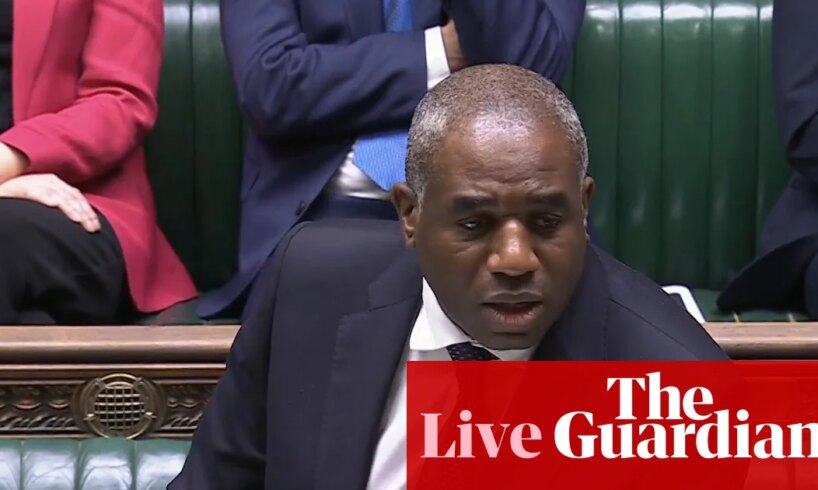
Lammy says jury trials will be restricted to cases where offenders likely to get sentence of more than three years
Lammy says he is going to follow Leveson’s recommendations.
Cases where a sentence is likely to be three years or less will be heard by a judge, he says.
And he says he will remove the right defendants have in some cases to choose what sort of trial they can. He says other judicial systems do not let defendants choose a jury trial, as people can do in England and Wales.
He says Leveson thinks this will lead to cases being processed 20% more quickly.
He says that he will give magistrates longer sentencing powers. He says they will be able to sentence people for up to 18 months.
He says he may extend that to two years, if necessary.
And, for trials that are likely to be long and complicated, judges will hear them without juries.
But juries will continue to be “the cornerstone of the system for the most serious offences”, he says. Cases likely to attract a sentence of more than three years will go before a jury, including all indictable-only offences.
Share
Updated at 14.33 CET
Key events
Show key events only
Please turn on JavaScript to use this feature
Andrew Mountbatten-Windsor is unlikely to receive any compensation for giving up his Royal Lodge home because of the repairs that will be needed to the 30-room mansion, PA Media reports. PA says;
In a briefing to MPs on the public accounts committee, the crown estate said:
Our initial assessment is that while the extent of end of tenancy dilapidations and repairs required are not out of keeping with a tenancy of this duration, they will mean in all likelihood that Andrew Mountbatten-Windsor will not be owed any compensation for early surrender of the lease … once dilapidations are taken into account.
The crown estate said “before this position can be fully validated however, a full and thorough assessment must be undertaken post-occupation by an expert in dilapidation”.
Mountbatten-Windsor gave the minimum 12 month’s notice that he would surrender the property on 30 October.
If no end-of-tenancy repairs were required, Andrew would have been entitled to £488,342.21 for ending his tenancy on 30 October 2026.
Share
Commons public accounts committee launches inquiry into Andrew’s lease arrangements at Royal Lodge
The Commons public accounts committee is set to launch an inquiry into the crown estate following questions over its lease of Royal Lodge to Andrew Mountbatten-Windsor.
The PAC announced the inquiry as it published the unredacted lease given to Mountbatten-Windsor, and letters about the arrangement from the Crown Estate and from the Treasury.
Geoffrey Clifton-Brown, the PAC chair, said:
We would like to thank The crown estate commissioners and HM Treasury for their considered responses to our questions.
In publishing these responses, the public accounts committee fulfils one of its primary purposes – to aid transparency in public-interest information, as part of its overall mission to secure value for money for the taxpayer.
Having reflected on what we have received, the information provided clearly forms the beginnings of a basis for an inquiry. The National Audit Office supports the scrutiny function of this committee.
We now await the conclusions the NAO will draw from this information, and plan to hold an inquiry based on the resulting evidence base in the new year.
The PAC will consider what witnesses it wants to call to give evidence once it has considered all the written submissions.
In theory it could summon Mountbatten-Windsor to appear. But there is no precedent for a member of the royal family giving evidence in person to a parliamentary committee in modern times and, if the committee were to invite Mountbatten-Windsor, given his approach to public scrutiny, he would probably refuse to appear. The committee does not have the power to force him to attend.
Share
I have beefed up the post at 1.10pm with the full quote from Diane Abbott. I missed the start of her question, and thought she was referring to black and minority ethnic defendants, not female defendants. I’m sorry for the error.
Share
Crown court backlog – how many cases are there, how backlog has grown, and who waits longest?
The Lammy statement is over.
PA Media has filed a good explaining giving more details of the backlog in crown court cases in England and Wales that has led to David Lammy proposing to limit access to jury trials. PA says the backlog is at a record high, with sexual offences accounting for a growing proportion of cases with the longest delays.
Here is the PA explainer.
How large is the overall backlog?
There were 78,329 outstanding cases in the crown court system in England and Wales as of 30 June 2025.
This is a record high and is up 10% from 70,893 a year earlier.
The backlog has more than doubled in the past six years, having stood at 34,184 in June 2019.
How long have cases been in the backlog?
There were 19,164 cases in June 2025 that had been open for at least a year, up 17% from 16,378 a year earlier.
It is the highest number of cases open for at least 12 months since current data began.
Some 5,913 cases had been open for at least two years.
This number peaked at 6,298 in April-June 2023, since when it has fallen slightly.
How long are defendants waiting for cases to be completed?
The median average time from charge to completion for defendants dealt with at crown courts stood at 179 days in April-June 2025.
This is up slightly from 176 a year earlier, but is below the peak of 222 days in October-December 2021.
Before the pandemic, this figure stood at about 140 days.
In cases sent to trial where a not guilty plea was entered by the defendant, the median duration from charge to completion in April-June was 392 days.
This is down year on year from 414 and is below the peak of 448 days in April-June 2023.
But it is well above the pre-pandemic level of around 250 days.
How does the backlog of cases break down by type of offence?
Nearly a third of the crown court backlog at the end of June were cases involving violence against the person (31%), with around one in six being sexual offences (17%) and around one in seven drug offences (14%).
What offences make up the cases with the longest delays?
Sexual offences account for a growing proportion of cases with the longest delays in crown courts in England and Wales.
Nearly one in five (18%) backlog cases that had been open for at least two years as of the end of June 2025 were for this category of offence.
Some 431 rape cases had been open for at least two years as of June, compared with 273 12 months earlier and 261 in 2023.
Share
Iqbal Mohamed (ind) asks about concerns that there will be more racial discrimination in sentencing without jury trials.
Lammy says, as Mohamed knows, he conducted a review for the David Cameron on the treatment of black, Asian and minority ethnic people in the criminal justice system. He says at the time there was no special training in this area, but that changed as a result of his review. He says there is more diversity now in the judiciary and among magistrates. And he says juries do not have to give their reasoning, but judges do.
Share
Jim Allister (TUV) says, whatever the intellectual capacity of a judge, they do not have the life experience of 12 jurors.
Lammy says judges make life-changing decisions the whole time. He says he has an adopted daughter; there is no greater decision than having to approve a child being taken away from its parents. He says judges are used to taking these decisions.
Share
Will Forster (Lib Dem) says he is would be willing to accept these plans, if the government can show it is putting victims first. He asks the government to publish a an impact statement.
Lammy says victims welcome these plans. He says an impact assessment will be published.
Share
Lammy rejects call for law restricting access to jury trials to be subject to sunset clause
Martin Vickers (Con) says the Tony Blair government tried to bring in plans like this, but had to abandon them. He urges Lammy to apply a sunset clause to these plans. That might be the only way the government can get them through the Commons.
After Lammy earlier said these plans would be permanent (see 1.14pm), he dismissed a subsequent suggestion, from the Labour MP Kim Johnson, for the law to be subject to a sunset clause (a time limit, after which the law would lapse). Lammy told Johnson he did not think that would be appropriate.
And he tells Vickers that the situation is “vastly different” from the Blair era.
Share
Lammy dismisses Labour MP’s call for jury trials to be retained for offences relating to right to protest
Sarah Russell (Lab) says she is particularly worried about people being denied trial by jury if they are charge in relation to the right to protests, where the law has been tightened a lot by governments of both parties. She says juries should continue to be involved in these cases, even if they are “either way” offences (where, under Lammy’s plans, cases would not go to a jury).
Lammy says it should be up to magistrates and the judiciary to decide.
Share
Saqib Bhatti (Con) says: “The idea that you have to scrap jury trials to save jury trials is simply farcical.”
Lammy says the law changes all the time. He says it was only relatively recently what marital rape was outlawed. The system has to modernise, he says.
Share
Here is the Ministry of Justice’s news release on the Lammy announcement.
Here is the MoJ’s summary.
-New ‘Swift Courts’ will see cases with a likely sentence of three years or less heard by a judge alone – estimated to take 20% less time than a jury trial.
-Handing courts the power to decide where cases are heard no longer allowing criminals to game the system and torment their victims.
-Guaranteed jury trials for the most serious and almost all indictable offences – including rape, murder, aggravated burglary, blackmail, people trafficking, grievous bodily harm and the most serious drug offences.
-Judge-only trials for particularly technical and lengthy fraud and financial offences freeing up jurors who have to give up months of their lives to hear particularly burdensome cases;
-Giving magistrates the power to hand down sentences of up to 18 months so more cases can be heard by magistrates, freeing up crown court time for the most serious offences. This could go up to two years if needed.
Share
Ashley Fox (Con) asks Lammy to publish the modelling by his department on what impact these plans will have.
Lammy says an impact assessment will be published alongside the legislation.
Share
Source