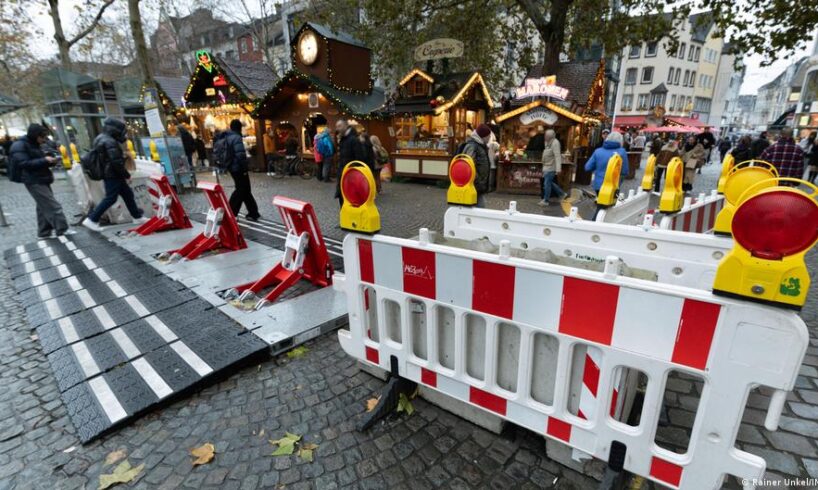
The final barriers are being set up at Bonn’s Christmas market. Concrete blocks now seal off the streets in the western German city leading into the central square, where visitors are already enjoying mulled wine and gingerbread hearts.
Market manager Kathrin Krumbach is making her way through the crowd, checking security measures for which she’s also responsible.
While speaking with DW, she points to a rubber mat that covers electrical cables running across the pathway.
“You might not even notice, [but] that’s part of the security concept too,” she says, adding that the mat is meant to smooth the bump so no one trips, and wheelchair users can “exit quickly without obstacles in an emergency.”
The security bollards at the Bonn market can stop a truck from running into visitorsImage: Rainer Unkel/IMAGO
After a number of deadly attacks on Christmas markets in recent years, municipal authorities have been forced to step up security measures at Germany’s more than 3,000 such markets.
According to the DSBEV trade association, representing the interests of some 5,600 mostly family-owned showmen businesses in Germany, these markets draw about 170 million visitors each year and generate annual revenue of “several hundreds of millions of euros.”
Christmas markets in Germany have a long tradition and much to show for during the festive season Image: Aline Spantig/DW
Kathrin Krumbach’s security concept for the Bonn Christmas market is “dozens of pages” thick, she says, and is designed to provide for “all scenarios that can happen.”
Apart from the concrete blocks that are to stop trucks from running into visitors, Krumbach’s less visible measures include training her staff for emergencies, coordinating with the local fire brigade, and making preparations for other dangerous situations like a power outage.
“Much of the safety work happens out of sight,” she told DW.
More security ‘good for business’
Till is a vendor of aromatic candles and decorations at the Bonn market. He thinks the heightened security measures are actually good for his business.
“If people feel safe here, more of them will come — and no one has to worry,” he told DW, while turning a handcrafted ornament on display so it better catches the light. “Customers’ feedback is great, and I think we’re going to sell a lot.”
Swathi, a visitor from India who’s experiencing a German Christmas market for the first time, is standing close to Till’s stand.
She plans to spend about €25 ($29) at the market this evening, she says, which is roughly the amount visitors to such markets spend on average per day. Food, gifts, and mulled wine are on her wish list.
Sauntering through the rows of stalls with their blinking lights and jingling bells, she finds it “lovely” here, but adds: “Though I was hoping to see more police … but then, I’m sure they’re prepared.”
Who is to pay the extra cost?
At the Bonn market, police are running a clearly visible presence by patrolling the walkways in uniform and staffing a security container together with municipal authorities.
In addition to that, Bonn city authorities have hired a private security firm and installed surveillance cameras to make visitors feel safe — measures that have come at a cost.
While total security costs for the Bonn Christmas market haven’t been made available, the city of Bremen in northern Germany, for example, reported security spending for its market to reach €3 million this year, including massive costs for protective bollards and vehicle barriers.
Security worries mar festive season in Germany
To view this video please enable JavaScript, and consider upgrading to a web browser that supports HTML5 video
Albert Ritter, the president of the DSBEV lobby group, says some municipal authorities would “prefer to charge the organizers” for security. “But the costs cannot be passed on to small market vendors,” he told DW, demanding that “public security must remain publicly funded.”
Ritter was also eager to dispel fears that Christmas markets would be canceled due to rising security costs. Rumors about this have recently gone viral on the internet in Germany.
While some markets have reduced their size to accommodate security measures, there were no reports of closures, a DW investigative report has shown.
“Unfortunately,” says Ritter, a lot of things are being “misused for political purposes on social media.”
Edited by: Uwe Hessler