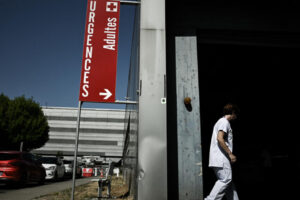
He had a history of mental health problems dating back to 2019
The coroner concluded Mr Haidhar died ‘as a result of deliberately walking into traffic'(Image: GettyImages)
“Missed opportunities” by a mental health trust and police call handlers may have altered the outcome for a teacher killed on the M1, a coroner has ruled. Shafiqul Haidhar, 39, walked into traffic near Lutterworth and was struck by a lorry after his desperate brother’s warnings to police were not properly acted upon.
The married father of four, from Barking in East London, whose wife was expecting another child, died from head injuries at around 7.46am on Wednesday, August 23, 2023. He had been working as a maths teacher at a secondary school in East Ham, London.
An inquest at Leicester’s City Hall, which concluded on Wednesday, November 26, heard Mr Haidhar had a history of mental health problems dating back to December 2019. He had previously deliberately caused a road traffic collision in the Rotherhithe Tunnel whilst suffering from cannabis-induced psychosis, the coroner was told. He sustained serious physical injuries and was treated successfully with medication, appearing stable for more than two years.
But in June 2023, his psychotic symptoms returned. On 1 June, Mr Haidhar visited his GP requesting to restart his olanzapine prescription due to recurring paranoia and hearing voices, the inquest heard. A referral was sent to North-East London Foundation NHS Trust on Thursday, June 8, but was incorrectly marked as routine rather than urgent, contrary to standard operating procedures.
Area Coroner Ivan Cartwright said this was the first “missed opportunity”. The trust had “conceded that there was a missed opportunity to intervene” and if Mr Haidhar had been given the opportunity to engage with services, “he likely would have done so and there was recent history of successful treatment”, the coroner said. An appointment was made for September 2023, after Mr Haidhar’s death.
On the night of Tuesday, August 22, Mr Haidhar’s brother, Kaisor Ahmed, became so concerned about his behaviour during a 12-hour period of strange actions that he slept outside his room to monitor him. At around 4am the next morning, Mr Haidhar left his home, telling his brother he was going to the mosque, the inquest heard.
Instead, he drove his Mazda northbound on the M1 where he deliberately steered into the central reservation between junctions 20 and 21 at around 6am, causing significant damage to his car but no apparent injuries to himself.
Highways officers moved the damaged vehicle to the hard shoulder, arranged recovery services and left at around 6.50am. Mr Haidhar was told to wait behind the safety barrier, the coroner heard.
As his brother waited by the roadside, Mr Ahmed made three increasingly desperate calls to the police:
At 6.24am, he called Metropolitan Police but the handler mistakenly thought the incident was in Hertfordshire, the inquest heard.At 6.55am, he called again and told a second Met Police handler, “I would call it an emergency”, but was not asked to explain why.At 7.12am, he called Leicestershire Police and told the handler his brother was vulnerable and had previously tried to take his own life, but the handler did not probe further.
Mr Cartwright found one Metropolitan Police call handler and one Leicestershire Police call handler “failed to adequately collate most relevant and useful information” during the calls. This was the second “missed opportunity”, the coroner said, representing failures “to gather and pass useful or vital information to police or other agencies, which may possibly have altered the outcome for the deceased”.
While Mr Haidhar waited by the roadside, other Highways officers were dealing with a separate collision on the southbound carriageway opposite. They became concerned for his welfare when they saw him fall to the ground on a grassy embankment, witnesses told the inquest. They were getting into their vehicle to drive around and check on him when, at around 7.46am, he walked quickly into lane one.
The HGV driver attempted to take evasive action but was unable to avoid striking Mr Haidhar. He was seriously and fatally injured and his death was confirmed at the scene by an attending paramedic, the inquest heard.
The coroner concluded Mr Haidhar died “as a result of deliberately walking into traffic” but said it was not possible to determine “on the balance of probabilities” that he intended the action to cause his own death at the precise moment he stepped into the carriageway. Police investigation found no mechanical defects and no suspicious circumstances.
An Independent Office for Police Conduct (IOPC) investigation found a case to answer at the level of misconduct for the Leicestershire Police call handler, who “failed to carry out their duties and responsibilities to the standard expected, by not checking relevant police logs, not probing concerns raised and failing to create an incident”.
A misconduct meeting in April resulted in a written warning, the IOPC said. The IOPC also recommended reflective practice for two Metropolitan Police call handlers “so that they have a clearer understanding of the process for handling calls relating to matters outside of the force area”.
A Leicestershire Police spokesperson said: “We cooperated fully with the IOPC’s independent investigation, which led to a misconduct meeting. The call taker received a written warning and additional training. The role of a contact handler is an extremely complex job requiring quick-time decision-making in often stressful situations. Our deepest sympathies remain with Mr Haidhar’s family.”
A Metropolitan Police spokesperson said: “We fully engaged with an investigation by the Independent Office for Police Conduct. The IOPC recommended reflective practice for two call handlers to help them better understand the process for assisting people with matters happening outside the Met area. This has taken place.”
A North-East London Foundation NHS Trust spokesperson said: “We recognise how vital timely support is for mental health and have redesigned our referral process so that every case is reviewed by a multidisciplinary team the next working day. We have also introduced emergency appointment slots to ensure people in urgent need are seen within 72 hours.”
Victoria Lazenby, National Highways Regional Director for the Midlands, said: “Any death on our roads is one too many and this was a terrible tragedy. Our deepest sympathies remain with the family and friends of Mr Haidhar.”
The Samaritans is available 24/7 if you need to talk. You can contact them for free by calling 116 123, email [email protected]. You matter.