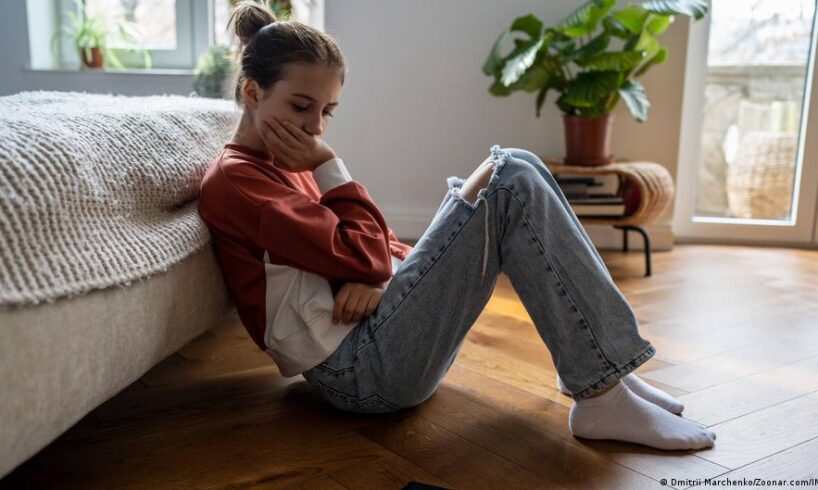
At least one child in every class in Germany is affected by sexual abuse perpetrated by teachers, other school staff, or fellow students, often with serious consequences for their lives and careers.
That’s the estimate put forward by Independent Commission for the Investigation of Child Sexual Abuse. A study by the Commission shows that students who suffer sexual abuse in schools are routinely failed by the school system.
“Often there were bystanders who prioritized collegiality over the protection of the children, ignoring or even covering up abuse to protect the school’s reputation,” members of the investigating commission explained in a press conference on Wednesday. “They found that the victims developed their own strategies to escape the violence, such as skipping school or repeating a grade.”
Sent to South America: Did German Catholics hide abusers?
To view this video please enable JavaScript, and consider upgrading to a web browser that supports HTML5 video
The authors of the study evaluated 133 reports and hearings from survivors who experienced sexual abuse at a school between 1949 and 2010. Nearly 80% of the victims were female. The vast majority of perpetrators were male, in both cases of abuse by peers and by teachers.
Nearly 70% of the victims whose cases were evaluated in the study suspect that other people at the school were aware of the sexual abuse. “But what all of the those affected told us is that it was extremely difficult for them to get competent help and support,” Julia Gebrande, chair of the Independent Commission told DW.
Schools more concerned about reputation than justice
The study includes one exemplary case from the 1990s: A teacher received complaints from sixth-grade girls about a PE teacher who kept entering their changing room. When he decided to investigate, he witnessed his colleague entering the girls’ changing rooms without knocking.
When he reported this to the school administration, he was told that he must be mistaken and that his fellow teacher “would never do something like that” and that he was “just oversensitive about this issue.” He was also accused of “ruining the reputation of our school.”
The perpetrator was never investigated and the teacher who reported him was even asked to apologize to him personally. “It’s a tactic of abusers to present themselves as highly engaged and willing to lend a hand. They make themselves indispensable. You just couldn’t imagine that such a likable colleague abuses children,” Gebrande said.
Many victims said that even when they did speak out about abuse, they received little or no supportImage: Jan Woitas/dpa/picture alliance
Odenwaldschule: Hundreds of cases of sexual abuse
The issue of sexual abuse in German schools came to widespread public attention in 2010 when the Berliner Morgenpost newspaper reported on cases of child sexual abuse at Canisius-Kolleg Berlin, a private Catholic prep school.
This prompted hundreds of victims from other institutions, most prominently the Odenwaldschule, a private boarding school in the state Hesse, to come forward.
In response to the scandal, the German government appointed the country’s first Independent Federal Commissioner Against Child Sexual Abuse in 2010 and later the Independent Commission for the Investigation of Child Sexual Abuse was established in 2016.
The German Youth Institute, one of Europe’s largest social science research institutes, conducted a study in 2023 and 2024 and found that one in two of the 1,600 teenagers polled had experienced sexual violence in the past year.
However, there is no comprehensive empirical data on sexual abuse in schools and investigations into sexual abuse have only been carried out at two state schools in Germany.
“There are still no structures in place for dealing with this issue in schools or in the school supervisory authorities,” Gebrande said. “That’s why we want it to be a key element of teacher training.”
‘I felt abandoned, vulnerable, and helpless’
Another big problem highlighted by the new study is that many victims lack the words to describe what happened to them and are often unable to recognize sexual abuse as such.
In one case from the 1970s, a woman named Julia told the commission about a sexual relationship she had with the 32-year-old art teacher over several years beginning when she was 13.
It was only when she read a newspaper article about a similar case much later in life “that it became very clear to me that what happened to me was sexual abuse.”
The abuse of power in academia
To view this video please enable JavaScript, and consider upgrading to a web browser that supports HTML5 video
In another case from the 1990s, Lea, a trans woman then living in her old gender identity as a boy, was repeatedly verbally, physically and sexually abused by groups of boys in tenth grade.
She mustered the courage to confide in a teacher she trusted, but felt ashamed and did not know how to describe the sexual abuse she suffered. Rather than offering support, the teacher told her that it was something that the kids should sort out amongst themselves and that it would only get worse if adults got involved.
She was told that a certain amount of “roughhousing and conflict” was normal at that age — particularly among boys.
“I felt abandoned, vulnerable, and helpless,” Lea told the commission. There were never any consequences for the perpetrators: “Their behavior was even reinforced by the fact that nothing stood in their way.”
A new law to fight sexual child abuse
A new law to strengthen federal structures against sexual child abuse came into force in July this year. Under the law, an advisory council of survivors will be appointed. There will also be an annual study into the prevalence of sexual abuse among 14 and 15-year-olds to begin in 2026.
As well as the planned institutional changes, Gebrande hopes that the new study will encourage people to address child sexual abuse in their local communities, to come to terms with their own school history, and to listen to those affected.
“In our experience, investigations are only ever undertaken when victims put pressure on institutions through the media,” she said.
Edited by: Rina Goldenberg
While you’re here: Every Tuesday, DW editors round up what is happening in German politics and society. You can sign up here for the weekly email newsletter, Berlin Briefing.