First up, defence deals. India is expecting the last two S-400 air defence systems from Russia.
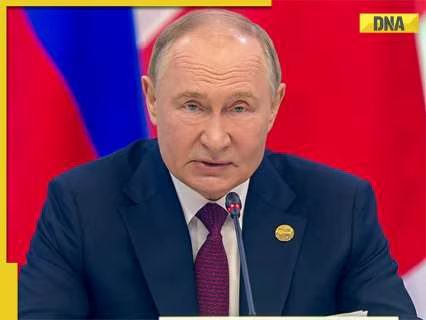
Russian President Vladimir Putin’s upcoming visit to India isn’t just another diplomatic trip. It’s a moment where two old friends sit down to discuss everything from advanced missiles to fighter jets, from nuclear submarines to cooking oil. Think of it as a massive shopping list mixed with strategic planning for the future.
First up, defence deals. India is expecting the last two S-400 air defence systems from Russia. These are like super-advanced shields that can shoot down enemy aircraft and missiles from very far away. But there’s a payment issue that needs sorting out. Beyond this, India wants more S-400 missiles and possibly five additional units. There’s even talk about the even more powerful S-500 system, which is basically the next generation of air defence technology.
Then there’s the BrahMos missile programme, a joint venture between India and Russia that produces some of the world’s fastest cruise missiles. Both countries want to speed this up and expand it. India is also interested in the R-37M missile, a Russian air-to-air weapon that can hit targets 300 to 400 kilometres away while flying at six times the speed of sound. Imagine an arrow that travels faster than anything you’ve ever seen and can strike from incredible distances.
The Su-30MKI fighter jet discussion gets even more interesting. India recently ordered twelve more of these aircraft for about thirteen thousand five hundred crore rupees, plus 240 engines worth another twenty-seven thousand crore. These engines are actually being built in India using Russian technology, though some parts will still come from Russia. There are even reports about selling Indian-made Su-30MKIs to other countries, which would be a big win for India’s defence manufacturing ambitions.
But here’s where it gets really serious. The Indian Air Force needs to add thirty-five to forty fighter jets every year for the next twenty years just to maintain adequate strength. India is developing its own fifth-generation fighter called AMCA, but that will take time. The problem is India cannot afford to run two fifth-generation aircraft programmes simultaneously. So Russia might offer to build its Su-57 fighter jet in India as an interim solution, especially since Pakistan is getting China’s J-35 fighter soon. This is about maintaining balance in the region.
According to defence experts like Air Marshal Anil Chopra (Retd.), whose detailed analysis appeared in Firstpost, these discussions reflect the evolving nature of India-Russia defence cooperation in a changing global landscape.
Russia might also put the Tu-160M strategic bomber on the table. This is a massive supersonic bomber with swing wings that can carry heavy weapons deep into enemy territory and launch cruise missiles from far away. India has nothing like this in its arsenal. Some experts believe it could be important given the China situation. Think of it as a flying fortress that can strike targets thousands of kilometres away.
There’s also the Ka-226T helicopter joint venture that Russia wants India to reconsider. This Russian helicopter has two rotors stacked on top of each other, which makes it very stable in mountains. Nuclear power is another big topic. The Kudankulam Nuclear Power Plant has six units planned, but only two are running. Russia supplied the first two reactors and can help speed up the remaining four by providing technical support and faster equipment delivery.
Underwater, there’s Chakra III, India’s third leased nuclear submarine from Russia. Its delivery has been delayed to 2028. Unlike Indian submarines that carry nuclear missiles for deterrence, Chakra III is an attack submarine designed to hunt enemy submarines and ships. Russia also wants to join India’s conventional submarine programme, though India is leaning toward Germany.
On the shipbuilding front, Russia recently built two frigates for India and is looking to expand cooperation. Two Indian shipyards might build four icebreakers for Russia. Russian officials have even offered to design a nuclear-powered aircraft carrier for India’s Navy. Meanwhile, Goa Shipyard will build twenty-four cargo ships for Russian clients by 2027 at half the cost of Russian shipyards.
The AK-203 rifle production in India needs to ramp up, and this will likely be discussed. India and Russia recently signed the RELOS agreement, allowing both militaries to use each other’s bases for logistics. This gives India potential access to Arctic facilities. Both countries are also promoting new transport corridors connecting Chennai to Vladivostok and routes through the Arctic.
Energy and trade matter too. India buys significant amounts of Russian oil, and both countries want a long-term energy plan that works even under sanctions. This includes expanding LNG and LPG trade, dedicated shipping routes, and rupee-rouble payment systems. They’re also discussing partnerships on critical minerals like lithium and rare earths for India’s semiconductor and electric vehicle industries.
There’s even talk about a labour mobility agreement letting skilled Indian workers take jobs in Russia’s construction and infrastructure sectors, similar to agreements India has with Japan and Israel.
Behind the scenes, Moscow is calling this visit “extremely grand.” Russia wants to show it has strong partners beyond China, while India wants to maintain its strategic independence without getting caught in great-power games. This visit will send clear messages to Washington, Beijing, and Europe about India’s autonomous foreign policy.
The bottom line? India’s military will depend on Russian equipment for years to come, and Russia needs partners as Western sanctions tighten. As Russia’s ambassador to India said, “The sky is the limit” for expanding this partnership. This visit is about results, not just handshakes and photo opportunities.
(Girish Linganna is an award-winning science communicator and a Defence, Aerospace & Geopolitical Analyst. He is the Managing Director of ADD Engineering Components India Pvt. Ltd., a subsidiary of ADD Engineering GmbH, Germany)
(Disclaimer: The views expressed above are the author’s own and do not reflect those of DNA)