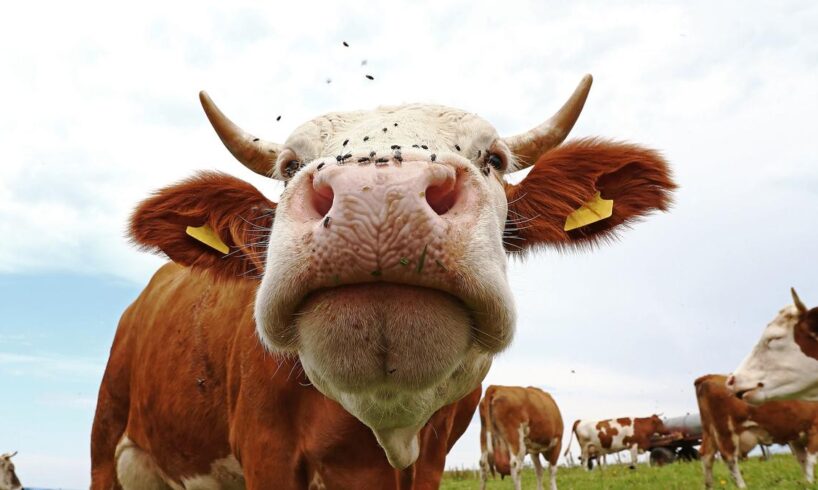
WA is in the grip of one of the worst fly plagues in living memory courtesy of an unusually long, wet winter which created the perfect breeding ground for the pesky insects.
Perth and the South-West can expect the infestation to worsen steadily in coming weeks as northerly and easterly winds blow billions of flies from their breeding grounds in the livestock-rich Mid-West.
Late spring and early summer have always been peak fly season but this year has been particularly bad because of the past few rain-soaked months.
Heavy rains generated more green feed for livestock, whose moist droppings were the perfect food source and breeding habitat for flies and other insects.
The monster population of larvae has been able to develop undisturbed because the weather is too cold for dung beetles to clean up the State’s pastures and bushland.
The beetles reduce the country’s dung load two ways. First, young beetles are voracious eaters of animal droppings as they move from larvae to beetle. Second, adult beetles dig tunnels and pull dung up to a metre underground, hoarding it for food and breeding.
Associate professor Theo Evans, from the University of WA’s School of Biological Sciences, said this time of year was a Goldilocks period for flies.
“The fly population dies off when temperatures consistently drop below 15C,” he said.
Camera IconAssociate Professor Theo Evans with the Copris hispanus dung beetle, released in WA in the 1980s. Credit: Gary Ramage/Gary Ramage
“You can pretty much draw a line across the State from Geraldton to Esperance and flies won’t survive in that southern area over winter but it’s a different story in spring.
“At the moment the air temperature is high enough for flies to thrive but the soil temperature is still quite low.
“The summer-active species of dung beetles we have in WA won’t come to the surface until the soil is warmer and until that happens the animal poo remains where it is.
“Winter-active dung beetle species and rain reduce dung in winter but at this time of year it just sits there and sustains the fly population.
“As is the case every year the summer beetles won’t be out helping until the end of December.
“The difference this year is we have had a winter that, relative to recent decades, was quite wet. It was the kind of winter we used to have in Perth 40 years ago and now we are seeing the kind of fly population that we used to have 40 years ago.
“It’s a shock for people who can’t remember what living in WA was like up until the 1980s.
“The wet, sloppy poo that moist green feed creates is why the flies are driving people crazy now.”
Bushflies thrived in Australia when livestock were imported from England because native dung beetles were conditioned to working with the dry, pellet-like dropping of animals such as kangaroos.
Between 1968 and 1985 several dozen new species of dung beetles were introduced under a program directed by the CSIRO.
Of the 55 species of beetles that were reared in CSIRO labs, 43 were released and 23 survived to spread across the country.
Associate professor Evans said there could be relief in sight.
“We are monitoring new species of beetle that were released relatively recently which are active in spring,” he said.
The first spring beetles were released five years ago and the most recent release of a spring “dung roller” occurred last year between Pinjarra and Gingin.
“We’re hopeful that by the end of the decade there will be dung beetle activity during the period we’re in now,” associate professor Evans said.
Camera IconThe Copris hispanus bettle is from Spain (hence the name ‘hispanus’) and Morocco. Gary Ramage Credit: Gary Ramage/Gary Ramage
“The winter beetles disappear around September and the summer beetles don’t emerge until close to Christmas, so this time of year is a dead zone for dung beetles but warm enough for flies. It’s a gap in coverage — October, November and into December — that we hope to close in the next few years.”
Scientists are hoping the spring beetles can withstand pressure from a species introduced decades ago which turned out to be a dung thief.
“They didn’t realise at the time but this particular species from the Mediterranean may steal the dung pulled underground by other beetles,” he said.
“Parent beetles, usually the mother, will often guard the dung as the larvae grows but that is not always the case.”
Camera IconWA is set for a 40-year worst fly season thanks to a miserable winter. Credit: Julia Gomina/Getty Images
Associate professor Evans explained why holidaymakers in the South-West can expect to be plagued while at the beach over Christmas.
“The strong easterlies and northerlies at this time of year blow the flies from the warmer parts of the State towards the South-West,” he said.
“Flies aren’t the smartest animals but they have come to realise that if they go into that big blue space at the edge of the land they will die so when they reach the beach they keep low to the ground and stay there.
“Because there is no fresh water at the beach they search for any moisture they can find and it’s usually in a human being’s eyes, ears and nose.
“When we go to the beach they see us as a living drinking fountain and the warm temperatures mean they are particularly active because their wing muscles are more efficient when its above 25C.”