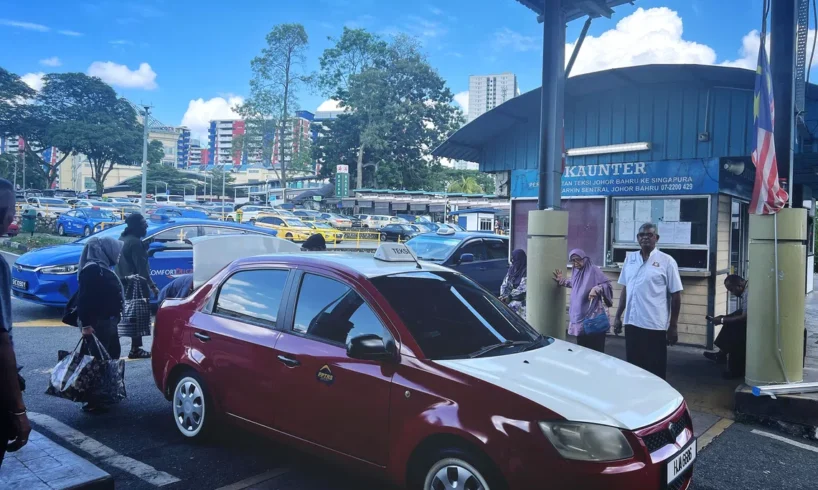
SINGAPORE/JOHOR BAHRU – Allowing cross-border taxis from both sides to drop passengers anywhere in their destination countries is a step towards making the scheme more attractive, said drivers and passengers.
The
promise of more convenience will hopefully redirect the demand towards these services,
which have been undercut by illegal operators, said drivers from Singapore and Malaysia who described waiting for long hours for a fare.
But the proposed changes could still fall short of the door-to-door services that consumers increasingly want, said observers, cabbies and passengers.
They also cited longstanding concerns about Causeway congestion and price imbalances, contributing to the issues the scheme has faced over the years.
The reactions come on the back of a joint announcement by Singapore and Malaysia on Dec 5 that both countries would increase the quota for cross-border taxis from 200 each now to 500, and allow taxis from either side to drop passengers off anywhere in their destination country.
Currently, taxis can only do so if they are registered in the destination country. Otherwise, they have to drop off at Larkin Sentral in Johor Bahru or Ban San Street Terminal in Singapore.
Some passengers like Singaporean Pah Yew Heng, 40, welcomed the move, saying that with flexibility in drop-off points, he is now more inclined to book cross-border taxi rides if he is unable to secure train tickets into Johor Bahru.
The private-hire driver will however still take the train if possible, citing the high cost of taxi rides and heavy congestion on the Causeway.
At Larkin Sentral in Johor Bahru, Malaysians told ST that the move will rule out the need to take a second trip from the designated drop-off point, which creates hassle and confusion.
Taxi driver Balakumaran Kalipan, 45, said while many passengers choose to wait for others to split the cost of a trip to Ban San, the price is not the problem.
The limited route is.
“Back when there were still Pak Wanca (drivers offering illegal cross-border services), people didn’t mind paying the higher price because they drove them straight to their doorstep.
“But we can’t do that because we are Malaysian taxis and our trips are only limited to Bugis,” he said.
Some drivers like Mr Kasinathan Annamalai, 67, said they have been waiting for the move “for years” as many passengers want the convenience of being sent to their doorsteps.
Allowing them to do this will boost incomes as it makes their services more attractive to Singaporean and Malaysian customers who no longer need to stop at the designated points and find another mode of transport elsewhere.
Legal cross-border taxi drivers from Malaysia have faced stiff competition from illegal transport providers using private vehicles.
Singapore’s Land Transport Authority has clamped down on this, with more than 140 vehicles seized for operating illegal cross-border services.
Retired Johorean, Mr John Lim, 75, who uses a walking stick and is partially visually and hearing impaired, said he hopes the changes will roll out earlier, having used illegal cross-border rides in the past to get to his Singapore home in Bedok.
“When I take the taxi, after stopping at Ban San Street I still have to take the MRT to Bedok,” he said.
A ComfortDelgro spokesperson said the increased quota is timely as it had cabbies keen on taking on cross-border bookings. The firm recently rolled out a hotline booking system for doorstep pickup here.
A taxi coordinator (left) speaking to passengers who are waiting to pool a taxi ride to Singapore at the Johor Bahru-Singapore taxi terminal in Larkin Sentral, in Johor Bahru on Dec 5.
ST PHOTO: HARITH MUSTAFFA
The spokesperson said the enhancements would also make it more convenient for passengers to secure cross-border taxis.
While there is broad support for the moves, some have raised concerns about traffic and if the increase in demand expected from these moves will be realised.
Singaporean Chamkaur Singh, a taxi driver of close to 50 years, said he is worried about insufficient parking space for more taxis at both terminals.
The 74-year-old, who drives an individually owned yellow-top taxi, added that he is concerned the congestion along the Causeway will worsen with more taxis – especially when it already takes him two to three hours to cross daily.
Mr Rosli Ali, 60, said he typically manages only three trips a day due to the jam on the Causeway.
Strides Premier taxi driver Simon Wong, 62, said there may not be enough demand right now for licensed taxi travel between Singapore and Johor Bahru to warrant an increase in driver quota, especially after the school holidays.
On the supply side, he said he has observed that some existing cross-border taxi drivers do not ply the route frequently.
The long waits on the Causeway have turned off some Singapore drivers, said Mr Singh.
Experts said the move is a step in the right direction, but further adjustments may be needed for it to match demand.
Taxi driver Balakumaran Kalipan, 45, said while many passengers choose to wait for others to split the cost of a trip to Ban San, the price is not the problem.
ST PHOTO: HARITH MUSTAFFA
National University of Singapore economist Timothy Wong said taxi and ride-hail trips are primarily attractive when they are door-to-door – because only then is the service sufficiently convenient to justify the higher cost relative to public transport.
Current regulations that restricted the locations for pick-up and drop-off have diminished the attractiveness of legal services, causing passengers to turn to illegal services, he noted.
Transport economist from the Singapore University of Social Sciences Walter Theseira said the changes to taxi drop-off rules improves the scheme’s usefulness.
But there is still unmet demand among those who want a “complete daily package service” that could bring passengers from one location to another before heading home, he added.
Another remaining issue lies in the scheme’s economics. With fixed pricing, there will likely be an imbalance of supply and demand, he noted.
Singapore-registered vehicles might not be keen to ply the route if pricing is not allowed to rise when demand or supply conditions justify it, such as during high congestion weekends or festive seasons, he said.
Operators currently run fixed prices for the service. Pickups from Ban San cost $60, while most trips from other Singapore locations to Larkin Sentral Terminal cost $80. Rides from Changi Airport or Seletar Airport cost $120.
He expects more liberalisation in the services if issues like safeguarding against competition with domestic taxi services are successfully addressed.
However, liberalisation in terms of moving away from restricted pick-up points to allow for door-to-door services could raise further questions, he said.
It could, for example, create cross-border pricing and equity issues.
“Everyone knows a Singapore-based taxi cannot offer the service at the same price as a Malaysian taxi so a Malaysian vehicle offering any pickup point flexibility in Singapore will generally outcompete the Singapore vehicle.”
Society has a lot to gain from a more liberalised cross-border taxi industry, NUS’ Dr Wong said.
Changi Airport could benefit from more Malaysians flying from there if they can easily get to the airport from their homes in Johor, he suggested.
“While we may think that Malaysian drivers may have more to gain from this arrangement since they are able to operate at lower costs, there are other ways in which Singapore gains from a larger cross-border taxi market.”