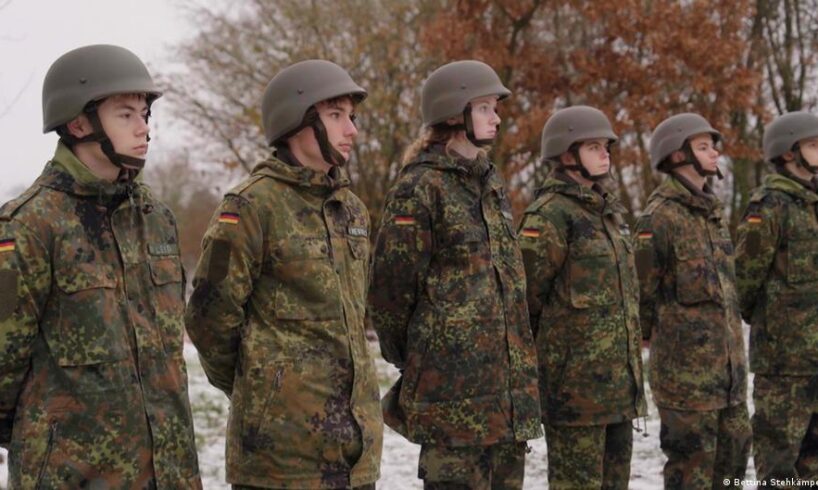
It is snowing, and 16-year-old Carlotta is standing on the vast military training ground in Grafenwöhr watching a howitzer 2000 fire live ammunition. It is cold and very loud when the shells are fired, so Carlotta has to wear earplugs.
This is not a day like any other for the young school student: While her friends are sitting in warm classrooms in Cologne, she has made her way to Bavaria by train alone. In the barracks of Tank Artillery Battalion 375 in Weiden, she has moved into a room and been given a uniform, in which she now stands in the winter cold on the grounds, together with two dozen other young men and women.
A whole team of supervisors looks after the young people: The German military is sparing no effort to recruit new soldiers. Carlotta also wants to see if the Bundeswehr is really something for her. To do so, she is taking part in the so-called “Discovery Days” — a kind of short internship with the troops, including early morning sports and camaraderie evenings.
The student can well imagine joining the army later. “For three or four years to start with, and if I like it, for eight years,” she told DW. But she doesn’t think much of conscription: “You shouldn’t force anything on people. It’s much better to join voluntarily than to be forced, because then you lose your motivation.”
Carlotta has joined a “Discovery Day” at the Bundeswehr, though she is skeptical of compulsory military serviceImage: Nina Werkhäuser / DW
Conscripts will earn more starting in January
Defense Minister Boris Pistoriussees it the same way: The aim of the new military service law, he says, is to motivate more young people to volunteer. One incentive is better pay: Starting in early 2026, new recruits will receive a respectable monthly wage of €2,600 ($3,000) before tax. In return, they must serve in the military for at least six months. Those who commit to at least twelve months will also receive a subsidy for their driving lessons.
Germany’s new military service, which the Bundestag approved on Friday, is therefore a kind of incentive drive with which Pistorius wants to avoid one thing: A rapid return to full conscription, which his center-left Social Democrats (SPD) reject. Military service will remain voluntary “if everything goes as well as we hope,” Pistorius emphasized in the Bundestag debate.
But will it be possible to fill the gaps in personnel without conscription? While the SPD hopes so, politicians from the other government parties, the conservative Christian Democratic Union (CDU) and the Christian Social Union (CSU) parties are skeptical. They would prefer to return to national service, which Germany suspended in 2011.
The Bundeswehr wants to recruit 80,000 new soldiers by 2035, and the path to that target is laid down in detail in the new law. The Defense Ministry must report its progress to the Bundestag every six months. In view of the perceived threat posed by Russia, the standing army is to grow from its current level of just under 182,000 soldiers to 260,000 — this is Germany’s commitment to NATO. In addition, there are to be 200,000 reservists.
Germany seeks to recruit 80,000 more active soldiers
To view this video please enable JavaScript, and consider upgrading to a web browser that supports HTML5 video
First favored, then rejected: The lottery
The dispute over future military service plans has divided the governing coalition for months. Among the controversially discussed models was a lottery system. A proposal to determine who has to join the Bundeswehr by lottery outraged many young people in particular: Potentially life-and-death decisions should not be made at random. In general, many young people feel like they have been left out of the discussion about military service.
The new “Military Service Modernization Act” is now a compromise: For the time being, military service remains voluntary. But at the same time, all 18-year-old men will have new obligations: Starting in early 2026, they will receive a questionnaire that they must fill out. It will ask about their willingness to serve in the Bundeswehr, their physical fitness, and their education. For women, answering the questions is voluntary, as they cannot be required to perform military service under the Constitution.
From mid-2027, the process will go one step further: All men born in 2008 or later will then have to appear at an appointed to time for a fitness test that will determine, in the event of conflict, who could be drafted. Although the process will begin in 2026, it will not be until mid-2027 that the Bundeswehr will have sufficient capacity to take on new recruits.
Thousands of school students went on strike across Germany on Friday to protest against the reintroduction of military serviceImage: Thomas Frey/dpa/picture alliance
Criticism of compulsory medicals
The compulsory medical examination is particularly controversial: Critics see it as a first step towards full conscription. They also fear that the lottery system will be back on the table if not enough volunteers come forward. In that case, the government may decide to introduce a so-called “needs-based conscription,” whereby a portion of the young men in a given age group would be drafted depending on the needs of the Bundeswehr. The decision on whether to reinstate conscription in whole or in part lies with the Bundestag.
On the day the law was passed, schoolchildren took to the streets in many German cities: “We don’t want to be locked up in barracks for half a year, trained in drill and obedience, and taught to kill,” wrote the organizers of the “school strike against conscription” in their call for nationwide rallies. “We feel neglected as a generation, and we don’t see why our generation should jump into the trenches for the government,” Leo Reinemann, a student and co-organizer of the school strike in Koblenz, told public broadcaster SWR.
Number of conscientious objectors on the rise
However, no one is yet required to perform military service – for the time being, the Bundeswehr is relying on voluntary applicants. The right to refuse military service on grounds of conscience also remains unchanged.
More and more Germans are making use of this right: by the end of October, the relevant federal office had received more than 3,000 applications for conscientious objection — both from people who had not served, as well as people who were already soldiers and reservists. That means the number of conscientious objectors has thus risen to a new high since conscription was suspended in 2011.
This article was originally written in German.
While you’re here: Every Tuesday, DW editors round up what is happening in German politics and society. You can sign up here for the weekly email newsletter, Berlin Briefing.