InDNegev — a unique three-day indie music festival celebrating Israeli artists in the Negev desert — has weathered its share of challenges in recent years. Founded in 2007 by post-army university students, it began as a small, spontaneous gathering. Over time, it grew into a major cultural fixture, turning a patch of Southern Israel into a temporary village of music, camping, and community.
The festival showcases a wide range of music genres — from rock and electronic to hip-hop, folk, and experimental sounds — and draws attendees of all ages and backgrounds. Families set up tents beside groups of teens, off-duty soldiers, and 20- and 30-somethings, all mingling on the desert grounds. InDNegev is designed to feel welcoming to different kinds of attendees: For those wishing to observe Shabbat, there’s an Ohel Tefillah (prayer tent), and for those looking to unwind or reconnect, the Meetcham Adama (earth tent) offers yoga sessions and a quiet, contemplative space away from the stages.
Like so many public events, InDNegev was canceled in 2020 because of the pandemic. It returned in 2021 to celebrate its 15th anniversary. But just two years later, tragedy struck Southern Israel when Hamas terrorists attacked nearby kibbutz communities and the Nova Festival on October 7, 2023, plunging the area into crisis.
InDNegev 2025 Campgrounds. (Shaun Stoll.)
InDNegev was scheduled for the following week in Mitzpe Gvulot, just a 20-minute drive from the site of the Nova attack. Organizers were already on the ground setting up when the rocket barrage began, forcing them to take shelter. The festival was canceled and did not return for two years.
On October 13, 2025, the people of Israel rejoiced as 20 of the last living hostages returned home. Two days later, InDNegev’s social media pages shared long-awaited news: the festival would officially be returning to the desert from November 13 – 15, 2025.
Festival organizers had made the decision to wait until all living hostages returned before bringing back the festival. When they finally announced the 2025 dates, they knew it would be a smaller festival than previous years, given the limited timeline the production team had — but they were determined it would be no less meaningful.
“I bought tickets for my family immediately after the announcement,” Yaniv Ederi, a resident of Meitar (a yishuv near Beer Sheva), and father of three, told Unpacked.
A devoted regular at InDNegev since 2012, Ederi began bringing his two eldest daughters, now 14 and 10, in recent years. This year, his wife and youngest daughter, 6, joined them for the first time to show support for the Otef, the region of Southern Israel bordering Gaza.
A passionate music fan who also frequently travels to music festivals in Europe, Ederi said nothing compares to InDNegev’s spirit.
“It feels like it’s ours because it’s Israeli,” he said. “It’s who we are. For three days, we forget our worries. Work, security, politics, everything. We just enjoy Israeli music and each other. The space is beautiful and healing. InDNegev feels untouched, like we’re bringing it to life.”
InDNegev 2025 (Shaun Stoll)
The trauma of the October 7 attacks left a deep mark. “When the sirens woke us up that morning, the first thing my middle daughter asked was, ‘Dad, is InDNegev still going to happen next week?’ I didn’t know what to tell her… It felt like victory to return. To see families, kids, so much music and happiness in the same region where October 7 happened.”
Making music after October 7
InDNegev has traditionally featured both established artists and performers on the rise, creating a space where festival-goers can experience the full spectrum of Israel’s indie music scene in one place. This year’s lineup included big-name Israeli artists, such as Ninet Tayeb, Balkan Beatbox, Hila Ruach, and the punk supergroup Bo Labar (Come to The Bar), sharing the bill with newer voices.
“After October 7, so many musicians and people of art and culture found themselves unable to create,” Bo Labar frontman Ishay Berger said. “ I saw posts from friends and people online that said, ‘I can’t bring myself to write a song. I don’t have words. I don’t have music. There’s nothing inside me.’”
Before forming Bo Labar, Berger was a founding member and guitarist at Useless ID, a pioneering Israeli punk band established in the 1990s that helped shape the local alternative scene.
Bo Labar previously performed at InDNegev under the name Tabarnak, but 2025 marked their first appearance at the festival under their original stage name.
Marking 20 years since the band’s founding, Berger explained how October 7 shaped their creative process and new music: “In all the sadness, confusion, and challenges, we felt like there wasn’t room for anything heavy. We wanted to push reality away. There were like-minded people like me who wanted to escape what happened on that day entirely and just have a stupid good time. The most logical thing for us to do was to create nihilistic music. We ended up writing the new album ‘Chakuyak’ in no time. It just came out of us. Total nonsense, tons of fun and laughter.”
Mika Tal, InDNegev2025. (Samuel Cotal)
A new generation of voices
While Bo Labar has been a fixture in the Israeli punk scene for two decades, InDNegev continues to serve as a launchpad for emerging artists who are just beginning to make their mark on the country’s musical landscape.
One of those rising voices is Mika Tal, a soulful, groove-driven indie-pop singer who has been attending InDNegev since her teen years. This year, she returned to the desert not as a fan in the crowd, but as a performer onstage.
“I went to InDNegev for three years straight in high school… I have so many memories there. When I came as an audience member, I never thought I would come back as an artist,” Tal shared. “The festival hasn’t taken place in two years, so it was a huge honor to participate in this InDNegev specifically.”
Mika Tal, InDNegev2025. (Samuel Cotal)
Mika Tal, InDNegev2025. (Samuel Cotal)
The hiatus following October 7 made her debut at the festival even more meaningful. “It was challenging to approach music after that day,” she said. “I wanted to make joyful music because that’s simply my essence. We’re living in two worlds. The sadness can’t exist without happiness, and vice versa.”
In the past couple of years, Tal has released two albums, “MeTaamei Teyman” and “MeTaamei Teyman 2 (From The Flavors of Yemen).” The titles were inspired by the food stands in Rehovot, the city where she grew up, as a way to pay homage to her roots and the tastes and sounds of her childhood.
Just a week before her InDNegev debut, Tal performed at Tel Aviv’s Levontin 7, an intimate hub for emerging artists and up-close gigs. Her dream, she said, is to perform at Barby, one of the city’s larger venues that regularly hosts Israel’s top acts.
And she’s not the only young artist carving out new space on Israel’s stages.
Avraham Lagasa, InDNegev 2025. (Avraham Maisels)
Rapper Avraham Lagasa is doing the same in Israel’s hip-hop scene. Raised in Afula, where he still lives, Lagasa had originally been slated to make his InDNegev debut in 2023, a week after October 7. Like Tal, 2025 was his first actual year performing at the festival.
Lagasa was thrilled about the opportunity to bring hip hop to new ears and new spaces. He has released his first two albums in the past couple of years, “Kono” and “Ma Ze Bichlal (What Is This Anyway?)”.
“The new generation has been very successful at combining different music styles,” Lagasa said. “As a result, hip hop is much more popular. It has entered more spaces where people wouldn’t expect to hear it. When I was younger, fewer people listened to hip hop. I feel like things have significantly developed on that front.”
From basement gigs to the desert stage
InDNegev also gives a platform to bands so new that they haven’t even released a full album yet.
Avraham Lagasa, InDNegev 2025. (Avraham Maisels)
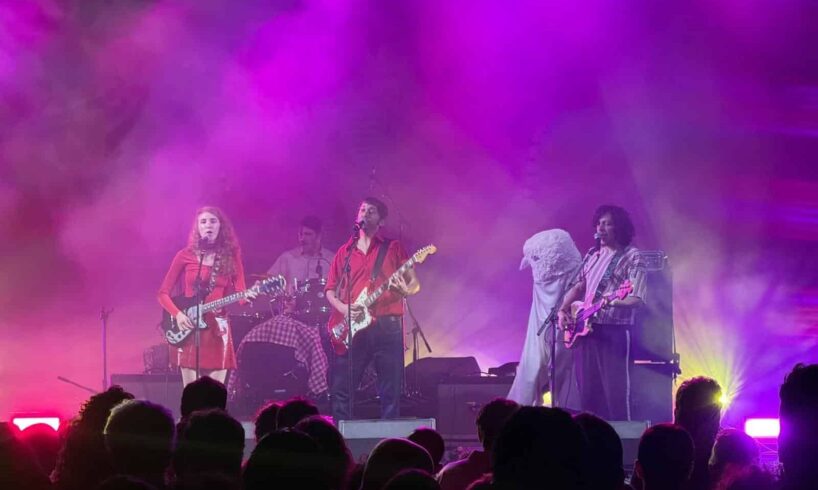
HaExiot (the Exes), an avant-garde punk trio that formed in Mitzpe Ramon, is one such act. The band consists of Shachaf Sinai (singer and drummer), Noya Kala (bass), and Yonatan Rosenwax (guitar). Their festival slot came at the last minute: a producer called just a week and a half before InDNegev to invite them as the opening act.
The band described their music as experimental and niche, often feeling like they’re “just playing in dark basements with friends.” Their scene, they said, is “very small… a very DIY vibe. There could be 10 or 20 people in the audience, and it still gives us a lot of strength and inspiration. It’s not built like the mainstream music space. There’s a lot more freedom.”
Despite the intimacy of their scene, opportunities like InDNegev and recently signing with a label have given them new visibility.
HaExiot’s debut album, “Elohim Todah, Elohim Slicha” (Thank You God, Sorry God), is slated for release on December 1, 2025, with two singles dropping November 24. Each track, the band explained, is unique: “Every song [on our album] is like a chapter that isn’t related to the next. It’s like the show ‘Black Mirror.’”
The festival’s energy reflects a larger movement across Israel, as musicians continue to create, perform, and connect despite the challenges of the past two years.
“InDNegev has become a holiday for me,” said Gal Gefnan, a 27-year-old Tel Aviv resident who has been attending the festival since he was 19. “The best time to hear an artist is when they’re at the beginning of their journey, still trying to attract an audience. The crowd is so warm and embracing. You don’t need to come with a huge group to enjoy the festival. The only thing you need to come with is a smile.”
“The whole point is adding more color to the ‘Otef,’” he added.
In the wake of October 7, the festival’s return symbolizes more than just a weekend of performances. It reflects the resilience of Israel’s creative communities.
From seasoned acts to rising voices, artists are reclaiming their stages, experimenting with new sounds, and connecting with audiences in ways that reflect both personal and national recovery. Across genres, Israel’s music scene is highlighting that even amid trauma, creativity, connection, and joy endure.