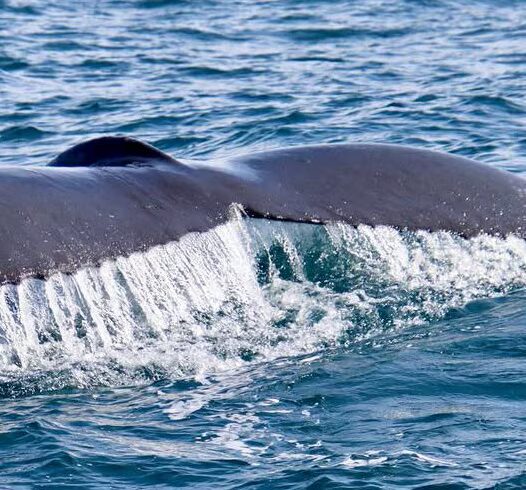
Underwater recordings of whale sounds could be a sign that not all humpback whales are completing the yearly migration up to Queensland.
An initial analysis of whale sounds recorded off the Batemans Bay coast over a period of five months in 2024, indicate that some female humpbacks may be staying on the NSW south coast for longer than expected.
Milly Street, a student researcher from Griffith University, has spent the past year studying the recordings for research that is part of the Whales and Climate research program lead by Dr Olaf Meynecke.
The program aims to understand how changing ocean conditions are influencing the recovery of humpback whale populations.
Milly Street has spent the past year analysing 11,000 audio files recorded by a hydrophone that was installed off the NSW South Coast near Batemans Bay throughout 2024. (ABC South East: Jacinta Counihan)
The recordings are collected from a device called a hydrophone, an underwater microphone that records 24/7 and can be left in the ocean for up seven months.
The historical scientific consensus has been that most humpback whales migrate north from Antarctica each year as the warmer waters are the perfect conditions for reproduction.
However in her research, Ms Street found that during the 2024 season, humpback whale sounds remained steady rather than declining at the point from July when the whales were expected to have already passed through on their way north.
“Generally, we expect to see a little bit of a decline in the acoustic presence of humpback whales along the South Coast of NSW,” Milly Street said.
“But what we found was that there was a detection of humpback sounds throughout the whole deployment of the hydrophone, which suggests that they could potentially be hanging around.”
Visual representation of the sounds made by humpback whales off the NSW South coast. (ABC South East: Jacinta Counihan)
The theories
Ms Street said the 2024 migration was potentially a non-breeding year for some female humpbacks.
“Generally, female humpback whales reproduce every two years,” Ms Street said.
“We think that some female humpback whales may not be making the full migration north when they’re not breeding, choosing to stay in sheltered lower waters.”
“This way they can store their energy for the next migration, as they generally don’t feed during their migration.”
Research suggests female humpback whales may sometimes be skipping the yearly migration north. (Supplied: Milly Street)
It’s also possible that the consistent sounds are produced by multiple humpback groups passing by at different points in their migration.
“It could be reflective of different cohorts travelling to and from their Antarctic feeding grounds at different times as well,” Ms Street said.
Answers may come thanks to the installation of a second hydrophone that’s been sitting off the Batemans Bay coast for the past six months.
The hydrophone that was recently pulled out of the ocean on the NSW South Coast near Batemans Bay after more than six months in the water. (ABC South East: Jacinta Counihan)
The recording device
The hydrophone is a small microphone, contained in piece of pipe, and attached to anchors to keep it submerged.
A scuba diver is needed to install the device as it needs to be placed offshore in deep water.
Local dive company, Beneath the Bay, worked with Ms Street and her team to install the device in 2024, and on 20 November 2025, a second hydrophone was collected.
“About six months ago, we dived off Burrewarra Point and went to a spot where we thought we could relocate the device again fairly easily,” Beneath the Bay owner, Michael Bellette said.
Michael and Tammy Bellette own the dive company, Beneath the Bay, on the NSW South Coast. They have helped install two hydrophones off the coast. (ABC South East: Jacinta Counihan)
“We anchored it in 28 metres of water, with a couple of buoys that float just above, so it didn’t bang up against the rocks.”
The recordings from this second hydrophone will now be analysed and compared with last year.
It’s hoped the results will provide answers to the 2024 findings, and more broadly, build a more complete picture of humpback whale migration along the east coast.