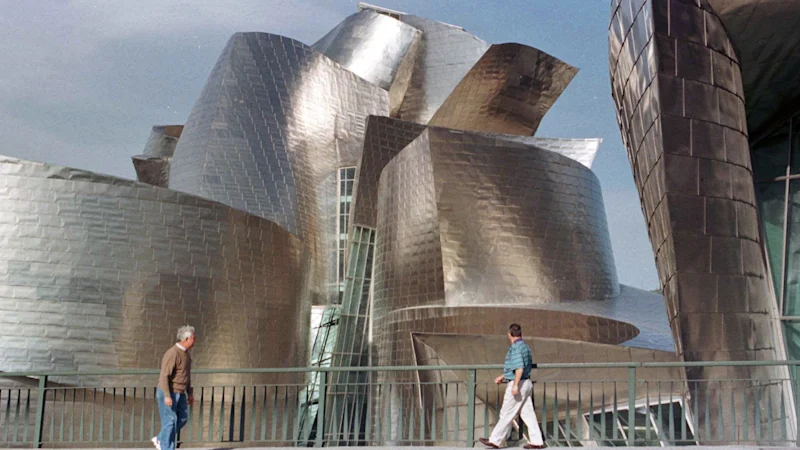
“I was rebelling against everything,” Gehry said in an interview with The New York Times in 2012, explaining his antipathy toward the dominant architectural movements of the time, as exemplified by the Farnsworth House on the Illinois prairie, a stark, flat, steel-and-glass modernist pavilion by Mies van der Rohe.
“I couldn’t live in a house like that,” he said. “I’d have to come home, clean up my clothes, hang them properly. I thought it was snotty and effete. It just didn’t feel like it fit into life.”
The Gehry-designed Dr Chau Chak Wing Building at UTS Business School in Sydney.Credit: Fairfax Media
For some, his work was more sculpture than architecture. Others saw it as emblematic of a global culture that reduced architecture to a form of branding. Gehry, whose name was recognised around the world, was sometimes derided as a “star-chitect”.
But his work’s emotional ferocity could feel empowering, as if architecture had rediscovered a part of itself that had been lost after decades of dreary functionalism and postmodernist cliches. And the widespread focus on his buildings’ dazzling exteriors could distract from Gehry’s deeper goals: to create an architecture that was not just affecting but democratic in spirit and evocative of the messiness of human life.
He was born Frank Owen Goldberg on February 28, 1929, in Toronto to Irving and Sadie (Caplan) Goldberg. His father held a series of jobs, including managing a grocery store and selling pinball and slot machines. Frank and his sister, Doreen, lived with their parents in a two-family house clad in brick and tar-paper shingles (a material he would use in some of his designs).
As a boy, he worked part-time in his maternal grandfather’s hardware store, stocking the shelves with tools, screws and bolts – an experience, he said, that spawned his love of everyday materials.
The Walt Disney Concert Hall in Los Angeles, another Gehry masterpiece, opened in 2003.Credit: Getty Images
Once a week, his maternal grandmother would come home from the market with a live carp, another formative experience, which would inspire the fish imagery that later appeared in his work. “We’d put it in the bathtub,” Gehry recalled, “and I’d play with this fish for a day until she killed it and made gefilte fish” (a traditional Ashkenazi Jewish dish).
Frank’s world abruptly fell apart in the mid-1940s, when his father, a heavy drinker, had a heart attack as the two were arguing on the front lawn, a memory that Gehry said haunted him for decades. His father never fully recovered. After a doctor warned that he would not survive another Toronto winter, the family moved to Los Angeles, renting a cramped $US50-a-month apartment in a run-down neighbourhood just west of downtown.
As an architect, Gehry was a late bloomer. After a brief stint in the army, he married Anita Snyder, who helped pay his way through the University of Southern California, where he initially studied ceramics. He shifted to architecture after a teacher introduced him to Raphael Soriano, a pillar of postwar modernism in Southern California. (It was around this time, too, that he adopted Gehry as his surname, a somewhat random choice inspired, he said, by the desire to avoid antisemitism.)
Gehry spent several years toiling as a mid-level designer and project manager at Gruen Associates, a firm known for its shopping malls. After he opened his own office in 1962, much of his early work was for mainstream developers. He designed a sprawling headquarters for the Rouse Co. in Columbia, Maryland, and two unremarkable department stores for Joseph Magnin in California.
‘You go into architecture to make the world a better place. A better place to live, to work, whatever. You don’t go into it as an ego trip.’
Frank Gehry, speaking in 2012
But he was an outsider by nature, and he began looking beyond the work of other architects for inspiration. Like many Angelenos, he was drawn to the laid-back, anything-goes atmosphere of the city, whose mix of garish mansions, flimsy bungalows, vacant lots, Googie’s coffee shops and colourful billboards was the antithesis of East Coast architectural academicism.
And he became close to a generation of Los Angeles artists – Robert Irwin, Billy Al Bengston, Ed Moses, Larry Bell – whose surfboard-inspired aesthetic and raw work spaces suggested an alternative to the chilly austerity of late modernism and the reactionary tendencies of postmodernism.
“The artists were living in industrial buildings and warehouses,” Gehry said in the 2012 interview with the Times. “They were constantly moving things around – changing the rooms, building lofts or storage spaces. It was so free and unselfconscious. I wanted to do that.”
In the late 1960s, Gehry and his wife divorced, and in 1975, he married Berta Aguilera. She survives him, along with their two sons, Sam, an architectural designer, and Alejandro, an artist; a daughter, Brina Gehry, from his previous marriage; and his sister, Doreen Gehry Nelson. Another daughter from his first marriage, Leslie Gehry Brenner, died in 2008.
Gehry’s approach to his own Santa Monica home divided critics – and his neighbours.Credit: wikipedia.org
The Gehrys bought their Santa Monica house, a two-story pink-stucco affair, in 1977. At Aguilera’s prodding, he began to tear it apart.
The house’s rough, unfinished appearance attracted the attention of architecture critics, even as it infuriated neighbours. But its tormented forms – suggesting a world that had been ripped up and gently pieced back together – had their own kind of beauty. And the use of crude, everyday materials was Gehry’s assertion that the working-class aesthetic he had grown up with could be as appealing as anything found in the more refined corners of the city.
Decades later, he and Aguilera moved out of the little house that had first brought him fame and into a more luxurious spread overlooking Santa Monica Canyon. Designed with his son Sam, the new house was a sprawling, sometimes awkward composition of angled, heavy-timber posts and beams. Nonetheless, it retained some of the rough-and-tumble qualities of Gehry’s earlier architecture, and its jostling forms reflected a lifelong quest for emotional and creative freedom.
Gehry kept on working.
An interior view of Gehry’s Luma Foundation building in Arles, France.Credit: Getty Images
In 2017, he completed the Pierre Boulez Hall in Berlin, designed in collaboration with conductor Daniel Barenboim: a compact, box-like space with a sunken floor and a floating elliptical balcony, contained inside an austere neo-classical building from the 1950s. And in 2021, the Luma Foundation building in Arles, in southern France, was finished; a twisting tower of stainless-steel bricks, it was inspired, in part, by the rocky terrain of the nearby Alpilles mountain range.
At his death, Gehry was completing several projects for luxury goods magnate Bernard Arnault, including an 7618-square-metre flagship store for Louis Vuitton in Beverly Hills, California, and, in Paris, the conversion of an abandoned 1960s building into an exhibition space and events hall down the block from Arnault’s Fondation Louis Vuitton building. He was also putting the final touches on a 1000-seat concert hall for the Colburn School of Music, near his Walt Disney Concert Hall in Los Angeles.
Loading
“You go into architecture to make the world a better place,” Gehry said in 2012. “A better place to live, to work, whatever. You don’t go into it as an ego trip.”
He added: “That comes later, with the press and all that stuff. In the beginning, it’s pretty innocent.”
This article originally appeared in The New York Times.
Get a note directly from our foreign correspondents on what’s making headlines around the world. Sign up for our weekly What in the World newsletter.