Shafaq News
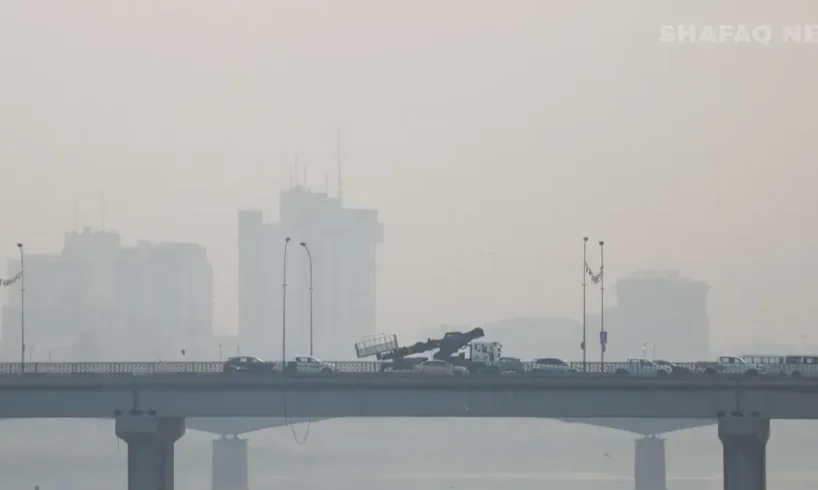
At dawn in Baghdad, the first thing many residents
notice isn’t the warmth of the sunrise but the taste of the air — a faint
bitterness settling on balconies, market stalls, and palm-lined streets where
early commuters gather.
These mornings reveal how rapidly the city’s natural
rhythms have shifted: less birdsong, more dust; fewer patches of green, and
more concrete rising in every direction. Once shaped by rivers and orchards,
Iraq’s environment is visibly transforming — a daily indication that something
profound is changing beneath ordinary life.
Baghdad is no stranger to crises, yet the environmental
decline sweeping its streets has reached alarming levels. Annual average PM2.5
concentrations now exceed 70–80 µg/m³ — nearly 14 times the World Health
Organization’s safe limit. Iraqi monitoring stations and international climate
observatories have consistently ranked Baghdad among the top 20 most polluted
cities globally, and during sandstorm seasons, sometimes among the top five.
Breathing the Bill
The effects extend beyond hazy skies as public health,
quality of life, and long-term economic prospects are all threatened by
environmental decline. In 2024, the Ministry of Health reported that
respiratory illnesses accounted for nearly 18% of clinic visits during peak
pollution months, while the World Bank estimated that environmental degradation
costs Iraq over $4–5 billion annually in lost productivity, healthcare burdens,
and climate-related disruptions.
Government measures have targeted industrial waste and
hazardous emissions, yet environmental specialists caution that limited
technical capacity and uneven monitoring hinder progress.
Among those raising alarms, the Green Iraq Observatory,
a team tracking environmental conditions across the country, reports stark
findings: shrinking green belts, unplanned construction, and rising air
contamination have collectively eroded quality of life in Iraqi cities.
The Observatory also noted that Baghdad has lost nearly
40% of its green cover since 2000, a decline accelerated by record-breaking
heat waves and years of insufficient urban planning.
Environmental researcher Omar Abdul-Latif explained to
Shafaq News that key pollutants — nitrogen dioxide and sulfur dioxide — are now
widespread in the urban atmosphere. Readings from eastern Baghdad indicate NO₂
levels nearly double the global urban average, while SO₂ frequently exceeds
Iraq’s own thresholds.
Short-term exposure causes nausea and discomfort, while
prolonged exposure contributes to cardiovascular complications, reflected in a
15% increase in ischemic heart cases over the past decade.
Warning that acid rain, a byproduct of these emissions,
is degrading soil chemistry and undermining vegetation, he noted the strains
Iraq faces under rapidly intensifying climate change, pointing that last year
alone, the country experienced more than 100 days of dust storms — a record
unmatched in its modern meteorological history.
Read more: The air we breathe: How pollution is quietly rewriting Iraq’s future
Rivers Run Low
Officials in the Ministry of Environment acknowledge the
crisis. Climate shifts have reduced river flows, worsened drought, and
increased dependence on water sources controlled by neighboring countries.
Iraq’s share of the Tigris and Euphrates has fallen nearly 30% since 2000, with
projections suggesting a 50% drop by 2035 if current water policies persist.
Loay al-Mukhtar, the ministry’s spokesperson, told
Shafaq News that a national strategy is essential to improve water efficiency,
modernize irrigation, expand treatment infrastructure, and ensure sustainable
resource use. Such measures are crucial for addressing acute shortages and
enhancing water quality, particularly as per-capita water availability has
declined from 2,100 cubic meters in 1977 to under 400 cubic meters today —
among the lowest levels in the region.
Environmental experts are also monitoring rapid urban
expansion. Ecologist Iqbal Latif Jaber observed to Shafaq News that rural
migration and unregulated city growth are shrinking green spaces. Between 2000
and 2020, Iraq’s urban population rose from 66% to over 71%, adding six million
city dwellers.
As fields give way to concrete, carbon emissions rise,
waste accumulates, and chemical residues increase. The result is a fragmented
urban ecosystem where soil becomes contaminated, natural streams disappear, and
biodiversity that once supported city life quietly diminishes.
Official records illustrate the scale of the shift: Iraq
has lost nearly 30% of its productive agricultural land over the past three
decades due to climate pressures and prolonged drought, with the last four
years marking some of the most severe water shortages in modern history. Rural
provinces such as Nineveh, Babil, and Diyala have reported crop yield reductions
of 40–70%, intensifying economic pressures and accelerating migration to
already strained cities.
In response, the Ministry of Environment has conducted
inspections targeting facilities responsible for hazardous waste. These
measures include reassessing permits, tightening oversight, upgrading
containment systems, and deploying digital tools to track waste disposal in
real time.
The objective is to limit contamination from industrial
and oil-sector byproducts. Iraq produces 31 million tons of solid waste
annually, including millions from oil operations, yet only a fraction is
treated with modern systems. Experts warn that outdated technology and weak
supervision allow some facilities to operate without proper control.
Read more: Green turning grey: Inside Iraq’s accelerating desertification
Planting Hope Now
According to the Green Iraq Observatory, the path
forward lies in transforming Iraq’s environmental trajectory rather than merely
managing decline. The organization stresses the need for a comprehensive
green-development strategy that reduces carbon reliance and restores degraded
landscapes.
Such a plan would involve large-scale ecological
restoration, including a national initiative to plant fifteen billion trees — a
project designed to combat desertification, cool urban environments, and
improve air quality. Equally critical, the Observatory noted, is strengthening
water governance, enforcing industrial compliance, and restoring green cover
across Iraq’s densely populated cities.
Written and edited by Shafaq News staff.