DOHA — Qatari Prime Minister Mohammed bin Abdulrahman Al Thani said Saturday that Doha does not consider the current situation in Gaza to be a ceasefire, arguing that this would require an Israeli withdrawal from the entirety of the enclave.
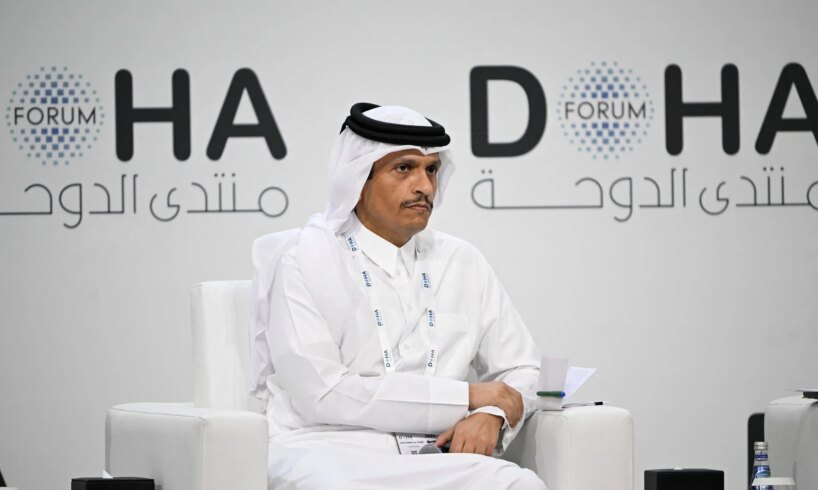
Al Thani’s comments were made during a panel discussion at the Doha Forum, and were later echoed by Turkish Foreign Minister Hakan Fidan, who laid out Ankara’s vision for a successful implementation of the second phase of US President Donald Trump’s Gaza peace plan, which the US is looking to begin in the coming weeks.
“We are at the critical moment,” Al Thani said about the Gaza peace process.
“What we have just done is a pause. We cannot consider it yet a ceasefire. A ceasefire cannot be completed unless there is a full withdrawal of the Israeli forces, there is stability back in Gaza [and] people can go in and out, which is not the case today,” he maintained.
At the start of the truce on October 10, Israel withdrew its forces to a newly drawn Yellow Line that roughly divides the Gaza Strip into eastern and western halves. While Israel was supposed to allow the reopening of the Rafah Border Crossing, it held off on doing so for well over a month, arguing that Hamas must release the remaining deceased hostages in Gaza. The body of a slain police officer is still held in the Strip.
Get The Times of Israel’s Daily Edition
by email and never miss our top stories
By signing up, you agree to the terms
Earlier this week, Israel said it would allow the Rafah crossing to reopen in one direction, for the transit of Palestinians out of Gaza, but Egypt has rejected this framework, insisting that Palestinians be allowed to enter the Strip as well.
Palestinians walk through the destruction left by the Israeli air and ground offensive in Gaza City, December 5, 2025. (AP Photo/Abdel Kareem Hana)
Al Thani said the mediating countries Qatar, Turkey, Egypt and the US are “getting together in order to force the way forward for the next phase.”
A US official told The Times of Israel on Thursday that Washington is aiming to announce a transition to the second phase — which will see the operationalization of a technocratic Palestinian government and International Stabilization Force overseen by a Board of Peace headed by US President Donald Trump — in the next two weeks or so.
But Al Thani clarified that Qatar also views phase two as “temporary because at the end of the day, if we are just resolving what happened in Gaza… it’s not enough. There is a root for this conflict.”
“This conflict is not only about Gaza, but also the West Bank. It’s about the rights of the Palestinians for their state,” the Qatari premier continued. “We are hoping that we can work together with the US administration to achieve this vision.”
Al Thani credited the Trump administration for its determination in the Gaza ceasefire talks, arguing that Washington’s willingness to speak directly with Hamas was what helped secure “breakthroughs” needed for the agreement in October.
Qatar’s Prime Minister Sheikh Mohammed bin Abdulrahman Al-Thani (2nd L) addresses the panel as moderator and international journalist Christiane Amanpour (L), EU top diplomat Kaja Kallas (3rdL), Turkish Foreign Minister Hakan Fidan (2nd R) and Spain’s Foreign Minister Jose Manuel Albares (R)at Doha Forum on December 6, 2025. (MAHMUD HAMS / AFP)
Asked about opposition from Prime Minister Benjamin Netanyahu’s coalition partners to elements of the Trump peace plan that include a potential pathway to a future Palestinian state, the Qatari prime minister said the US role will be critical in ensuring that Israel adheres to the deal’s terms.
Pressed on Qatar’s hosting of Hamas’s leaders, Al Thani claimed this open channel with the terror group was critical for reaching every one of the ceasefire and hostage release deals throughout the Gaza war.
He argued that many of Qatar’s most vocal critics come from countries that rely on Doha’s mediation efforts, in an apparent reference to Israel, where many government officials have knocked the Gulf country over its longstanding support for Hamas.
“Qatar provides a platform for those parties to talk. It doesn’t mean that we are taking one side or the other. Our role is to make sure that the dialogue is ongoing and the dialogue is coming out with a positive outcome… that ends conflicts,” Al Thani said.
Turkey urges ‘realistic’ expectations for ISF
Also speaking at the Doha Forum, Turkey’s top diplomat Hakan Fidan stated that “we should be realistic” about what to expect from the International Stabilization Force the Trump administration is hoping to stand up at the beginning of 2026.
“When we define the mission of the ISF, we should be realistic and nuanced in expecting certain things from ISF because there are realities in the field,” Fidan said.
Turkish Foreign Minister Hakan Fidan looks on as he attends a session on the opening day of the Doha Forum, an annual diplomatic conference, in Doha, December 6, 2025. (Mahmud Hams/AFP)
The Turkish foreign minister did not get into specifics, but appeared to be referring to assertions by Israel that the ISF play an active role in the disarmament of Hamas — a demand that is said to concern many countries considering contributing troops to the force due to fears of clashes with Hamas operatives or of finding themselves in the middle of fighting between Palestinian terror groups and Israeli forces.
While Turkey — one of the ceasefire mediators — has privately offered to contribute troops to the ISF, Israel has been adamant that it will not allow such a development, as Ankara has been one of the world’s leading critics of Jerusalem since the start of the war and is a leading backer of Hamas. Asked at the Doha Forum whether Turkey is prepared to contribute to the ISF, Fidan avoided answering directly but says that his country “is ready and willing to do whatever it takes for us to contribute to ongoing peace.”
Fidan then indicated that negotiations on standing up of the ISF are still in their early stages, with many key questions left unanswered.
“There is a big discussion taking place [on] how to form [the ISF], what [will be] the specific mission statements and what will be the rules of engagement,” he said, adding that the list of contributing countries is still not final, along with the command structure.
Islamic Jihad and Hamas gunmen search for the remains of deceased hostages in Beit Lahiya, northern Gaza Strip Wednesday, Dec. 3, 2025. (AP Photo/Jehad Alshrafi)
“Our first objective in deploying the ISF is to separate Palestinians from the Israelis on [the] borderline. This will be our main objective. Then we can address the other remaining issues,” Fidan continued, apparently referring to the Gaza border, as opposed to the Yellow Line, which was the demarcation set up as part of the October 10 ceasefire that leaves Israel in control of the eastern half of Gaza.
He noted that the ISF will work alongside a vetted and trained Palestinian police force, along with a Palestinian governing body, which will be overseen by the Board of Peace, headed by Trump. “All these organs supposedly will work together in a synchronized manner.”
After the panel discussion, Fidan told Reuters that a credible Palestinian civil administration and a vetted, trained police force should be in place to allow Hamas to disarm, claiming the terrorist organization is prepared to hand over governance of the enclave. While Hamas has expressed openness to handing over power to a technocratic government, it has refused to hand over its weapons as required by Trump’s plan.
In an interview on the sidelines of the event, Fidan said that without those initial steps, expecting Hamas to disarm in the first phase of the ceasefire deal is neither “realistic nor doable.”
Turkish Foreign Minister Hakan Fidan attends a session on the opening day of the Doha Forum, an annual diplomatic conference, in Doha, December 6, 2025. (Mahmud Hams/AFP)
He said the proposed police force would exclude Hamas members and would be backed by an international stabilization force, and that Washington is pressing Israel over Turkey’s bid to join the force.
Fidan warned that failure by the international community to advance the ceasefire plan to its next stage would amount to a “huge failure” for the world and for Washington, noting that Trump has personally led the push.
Egyptian FM: ISF should begin ‘as soon as possible’
Egypt’s Foreign Minister Badr Abdelatty also spoke in Doha, urging the rapid deployment of the ISF and the implementation of the ceasefire’s second phase.
“As for the International Stabilization Force, we need to deploy this force as soon as possible on the ground because one party, which is Israel, is every day violating the ceasefire… so we need monitors,” the minister said.
He also said the Rafah crossing “is not going to be a gateway for displacement. It’s only for flooding Gaza with humanitarian and medical care.”
Egyptian trucks and heavy machinery line up on the Egyptian side of the Rafah border crossing with the Gaza Strip on October 26, 2025. (AFP)
Israel announced on Wednesday that it will reopen the Rafah crossing in the coming days for the exit of Palestinians from the Gaza Strip to Egypt, though Cairo denied it was coordinating with Jerusalem on renewing operations at the facility.
Reacting to the move, the foreign ministers of Egypt, Indonesia, Jordan, Pakistan, Qatar, Saudi Arabia, Turkey, and the United Arab Emirates “expressed their deep concern regarding the statements issued by the Israeli side concerning the opening of the Rafah Border Crossing in one direction with the aim of transferring residents of the Gaza Strip to” Egypt, they said in a joint statement.
The ministers voiced “their absolute rejection of any attempts to expel the Palestinian people from their land” and said they were against “compelling any resident of the Gaza Strip to leave,” urging for the crossing to be opened in both directions.