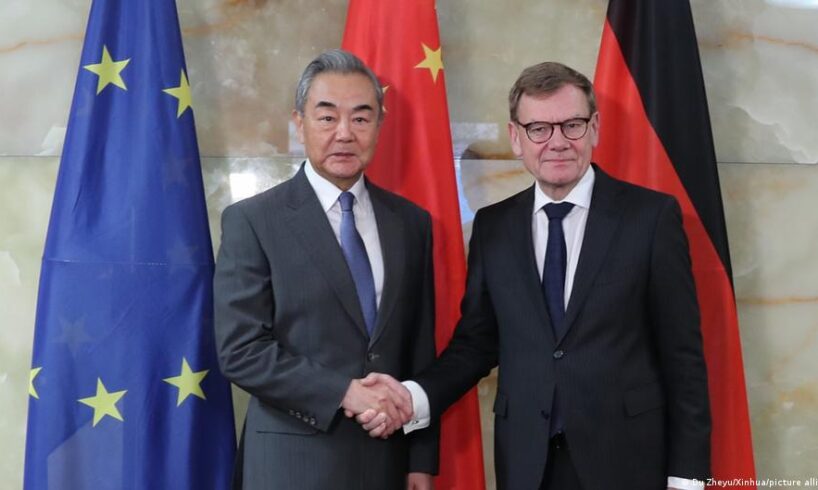
So now it’s happening after all: From this Sunday until next Wednesday, Germany’s Foreign Minister Johann Wadephul will travel to China. There is a lot to discuss with the Chinese government.
Wadephul, a member of Chancellor Friedrich Merz’s center-right Christian Democratic Union (CDU), originally planned his first trip to China for October 26. But on October 24, he canceled at short notice. According to political insiders in Berlin, Wadephul had not been able to schedule talks with enough high-profile partners, so he decided the trip was not worth making.
A German foreign minister with whom almost no one in Beijing wants to talk? Some observers spoke of a diplomatic scandal, especially since part of Wadephul’s purpose on the trip was to prepare Chancellor Friedrich Merz’s inaugural visit to China.
Who is Germany’s incoming foreign minister, Johann Wadephul?
To view this video please enable JavaScript, and consider upgrading to a web browser that supports HTML5 video
Wadephul’s concern about China’s ‘aggressive behavior’
In Germany, observers decided that Wadephul had fostered a rather frosty relationship between Germany and China and saw a connection to critical comments made by Wadephul in the run-up to the visit. Before his trips to Japan and Indonesia, the foreign minister had repeatedly and publicly denounced China’s “increasingly aggressive behavior” in the Taiwan Strait and in the East and South China Seas.
A spokesperson for the Foreign Ministry in Beijing, Mao Ning, promptly warned the CDU politician against continuing to “incite confrontation and fuel tensions.” It was shortly after that the Chinese gave Wadephul the cold shoulder, claiming it was impossible to arrange any other meetings than that with Chinese Foreign Minister Wang Yi, who had previously visited Berlin.
But Vice Chancellor and Finance Minister Lars Klingbeil, of the center-left Social Democrats (SPD), has since visited China. He apparently succeeded in calming the waters. “We are seeking dialogue with China in order to find solutions to pressing problems despite growing international tensions,” Klingbeil said before his trip in mid-November.
At a meeting with government representatives in China, Klingbeil managed to insist on reliable access to critical raw materials for German companies without upsetting his hosts.
Why China’s rare earth supremacy damages the global economy
To view this video please enable JavaScript, and consider upgrading to a web browser that supports HTML5 video
Germany, China and trade wars over rare earths
Among many other issues, Germany is particularly concerned about rare earths. The country is largely dependent on China for supplies of rare earths, such as lithium. These raw materials are necessary for the manufacture of countless products, particularly in the automotive industry, but also for military equipment such as submarines and fighter jets.
China has dominated the global market for rare earths for many years and is now also using its position geopolitically. When China threatened to halt exports a few weeks ago in a dispute with the US over trade issues, German car manufacturers feared a standstill in production.
According to Janka Oertel, political scientist and sinologist in Berlin, the fact that Germany is now feeling the effects of this dependence is a consequence of years of inaction. Rare earths from China were inexpensive and available in large quantities, so domestic production was abandoned and companies banked on imports instead.
“We weren’t particularly keen on building mines here because it causes considerable environmental damage. And we were actually quite happy that it was happening elsewhere,” Oertel told German public broadcaster Phoenix.
DW interview with German Chancellor Friedrich Merz
To view this video please enable JavaScript, and consider upgrading to a web browser that supports HTML5 video
Another sensitive issue is Beijing’s role in Russia’s war in Ukraine. On the sidelines of the G20 summit in South Africa in November, Merz gave an interview to DW, and said: “China can increase pressure on Russia to end this war. That is the subject of my talks with the Chinese government and, if necessary, will also be the topic of my meeting with the Chinese president next year. But I hope that we will reach a ceasefire by then and that this will not overshadow my talks in Beijing.”
In South Africa, Merz was able to speak with Chinese Premier Li Qiang and then announced that he would make his long-awaited inaugural visit to Beijing in January or February 2026.
This article was originally written in German.
While you’re here: Every Tuesday, DW editors round up what is happening in German politics and society. You can sign up here for the weekly email newsletter, Berlin Briefing.