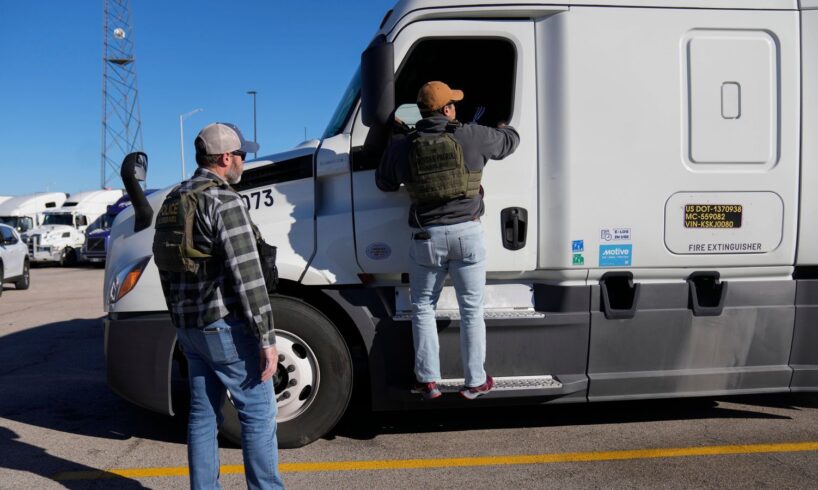
U.S. Border Patrol agents speak to a truck driver during an immigration enforcement operation at a truck stop Monday, Nov. 3, 2025, in Hampshire, Illinois. [AP Photo/Erin Hooley]
In a move targeted at immigrant truckers, the Trump administration has revoked the accreditation of nearly 3,000 CDL (commercial driver’s license) training centers and placed another 4,500 on notice that they must prove compliance with federal Entry Level Driver Training (ELDT) requirements within 30 days.
The federal Training Provider Registry lists roughly 16,000 providers nationwide. With nearly 3,000 removed and 4,500 more under review, the purge affects approximately 45 percent of all entries in the registry. More than 40 percent of listed CDL training providers could lose their ability to certify new drivers. Furthermore, graduates of any removed center will not be recognized as having completed federally mandated training, and many current CDL holders may find their credentials revoked.
ELDT requirements include covering the required curriculum, maintaining complete and accurate training records, verifying instructor qualifications, and documenting that the school has the necessary equipment and facilities.
According to federal auditors, the training providers removed from the registry failed to meet the requirements of the ELDT rule. Centers were cited for falsifying or manipulating training data, neglecting to cover required curriculum topics, employing instructors who did not meet federal qualifications, or lacking the necessary equipment and facilities to provide legitimate commercial driver training.
Many failed to maintain complete and accurate records or refused to provide documentation during federal reviews. Some of the removed providers had been inactive for years, a result of a registry system that allowed schools to self-certify without inspection or verification.
But the main target of the move is immigrants. In September, the Trump administration imposed sweeping restrictions on non-domiciled commercial driver licenses after a series of highly sensationalized fatal crashes in Florida, Texas, Alabama and California involving big rigs. Officials focused on the immigration status of the drivers involved and presented these isolated incidents as evidence of a wider safety crisis caused by immigrants.
The interim final rule (IFR), a fast-tracked regulation issued without the usual public comment period, sharply limited which non-citizens could obtain a CDL, shortened license validity to one year or less and required states to verify immigration status through federal databases. The Federal Motor Carrier Safety Administration (FMCSA) claimed the restrictions were needed because the agency could not reliably verify foreign driving histories and that the rule was necessary for public safety.
In early November, a lawsuit was filed on behalf of Jorge Rivera Lujan, a longtime CDL holder and DACA recipient (Deferred Action for Childhood Arrivals, an Obama-era measure that allowed some undocumented immigrants who entered the country as children), arguing that the rule was imposed without due process and causes irreparable harm to lawful workers. Rivera Lujan, who has lived in the United States since childhood and operated his own small trucking business for years, was unable to renew his CDL on September 30 despite a decade of legal compliance and safe operation.
On December 4 the United States Court of Appeals for the District of Columbia granted a request to place the case in abeyance and maintain the temporary stay it issued in November, halting enforcement of the rule while the litigation proceeds.
The stay has temporarily protected the nearly 200,000 non-domiciled CDL holders who would have lost their jobs under the new restrictions.
This move followed Trump’s xenophobic executive order last May requiring English proficiency for all commercial drivers, a rule not grounded in any safety data and imposed despite the widespread multilingual support built into modern navigation and communication systems.
The fatal crashes over the summer were seized upon by the administration to reinforce this narrative. Transportation Secretary Sean P. Duffy made the government’s position unmistakably clear. He claimed that “licenses to operate a massive, 80,000-pound truck are being issued to dangerous foreign drivers, often times illegally.”
Duffy used the crashes to portray immigrant workers as a systemic danger, even though there is no publicly available evidence showing that immigrant or foreign born truckers are disproportionately involved in fatal collisions. His statements fused immigration enforcement with CDL licensing and provided the justification for both the restrictions on non-domiciled drivers and the nationwide audit of CDL training providers.
According to COGO, a commercial trucking insurance firm that analyzes federal crash data, immigrant drivers are involved in a tiny fraction of fatal truck crashes. Only five fatal crashes this year involved non domiciled commercial drivers out of approximately 1,600 fatal truck crashes recorded through July, or three-tenths of one percent.
Immigrant and foreign born drivers make up between 16 and 20 percent of the trucking workforce, a share far out of proportion to their minuscule representation in fatal collisions.
The crisis in CDL training is the result of decades of deregulation. The ELDR rule was originally developed to end the fragmented system in which each state determined its own standards, producing wide variations in training quality. Industry lobbying stripped the rule of its core provisions before implementation.
Mandatory training hours were removed. Behind the wheel requirements became optional. Instructor qualifications were weakened. Training centers could join the federal registry by submitting an online form without inspection, credential verification, or proof that they possessed equipment or instructors.
For decades, Democratic and Republican governments alike allowed the trucking industry to shape federal regulations to its benefit, repeatedly delaying implementation, weakening enforcement mechanisms and resisting any measures that would impose real oversight on CDL training programs. The result is a nationwide patchwork of state-based standards easily exploited by operators.
The escalating attacks on immigrant workers is part of a broader war on the working class. Employers in the United States have announced approximately 1.1 million job cuts so far this year, a level of contraction not seen since the 2008 financial crash. The cuts span every major sector of the economy, from telecommunications and information technology to manufacturing and retail.
Logistics and warehousing have been hit especially hard. Nearly 48,000 jobs were eliminated in that sector in October alone, part of a jobs bloodbath that has swept through UPS, FedEx, Amazon, and other major employers this year.
Immigrant workers are being targeted as scapegoats to expand the government’s powers over the workforce as a whole. Measures first directed at immigrants will later be applied more broadly to stem the rising tide of social unrest in the face of the accelerating crisis of capitalism. The defense of jobs and democratic rights requires the development of independent rank-and-file committees that unite immigrant and “native-born” workers in a common struggle against these escalating attacks.
Subscribe to the IWA-RFC Newsletter
Get email updates on workers’ struggles and a global perspective from the International Workers Alliance of Rank-and-File Committees.