Growing up in Bariga, Lagos, Musibau Shittu never imagined that sport would become his escape from hardship or the platform that would one day take him to many countries in Africa and Europe.
He was barely 10 months old when he became physically challenged, and was young when he began noticing that many people in his community survived through begging.
In this exclusive interview with PREMIUM TIMES, the national wheelchair basketball player shares the story of his unlikely path into para-sports, the struggles of growing up in Bariga, the state of wheelchair basketball in Nigeria, and his dreams of reaching the Paralympics.
Excerpts…
PT: Tell us a bit about your career. How did you get involved in wheelchair basketball?
Shittu: I started sports around 2000 or 2001. I was first a table tennis player, and I played quite well, but I never got the chance to represent Nigeria. I also played lawn tennis for many years. I also played tournaments in South Africa, Switzerland, and France and was once ranked around 110-115 in the world in some individual events.
But even during that time, I was already playing wheelchair basketball. It’s a team sport, and I love being part of a team. So, I dedicated myself to it. Thank God the coaches saw the talent in me and picked me for the national team.
PT: In Nigeria, people with physical disabilities are often pitied and discouraged. Why did you choose sports? Was it to challenge that mindset?
Shittu: Growing up, my father wanted me to focus on education because of my condition. He felt that was the only way I could survive. But he died when I was still very young, leaving my mother with six children, and I was the fifth.
I wasn’t born disabled—it happened when I was about 10 months old. My parents did their best, but life in Bariga is tough, especially for someone in my condition. I saw many disabled people begging, and I didn’t want that life. So at first, I focused only on my education.
But my brother introduced me to sports, starting with table tennis. I wasn’t interested at first. I didn’t see how disabled people could survive through sports. But when I finally joined table tennis at the National Stadium, everything changed. I saw Paralympians. I met people like Coach Anosiru Suli, who became like a father to me. He shaped my path in sports more than anyone else.
Musibau Shittu on the National Institute of Sports basketball Court
PT: How did your confidence grow in wheelchair basketball specifically?
Shittu: Honestly, I had no confidence at first. I saw able-bodied people miss shots, so I thought it was impossible for someone like me. But my coaches encouraged me deeply. Coach O’Brien Adoki, who is now late, was one of the pioneers of wheelchair basketball in Nigeria. He inspired us by showing stories of people like Tobi Ogunyemi, who played professionally in South Africa.
My first international exposure was a trip to Ghana. Later, I was selected to represent Nigeria at the All-Africa Games in 2007 (in Algiers). That tournament convinced me that basketball was my future.
PT: Comparing the early years to now, has wheelchair basketball in Nigeria improved or declined?
Shittu: To be sincere, we were doing much better in the early years. We travelled to tournaments regularly and gained experience. People like Hon. Bukola Olopade (current D.G Nigeria Sports Commission) really invested in us around 2011–2012. We went to Morocco and many other places.
Today, the game is crawling. I don’t want to disrespect anyone, but the truth must be said. The sport is far behind developments in Europe. I have played in Africa and Europe, so I know the difference.
We don’t have enough tournaments, equipment, or proper training structures. Without these things, we can’t grow. It’s like sending a child to school without books.
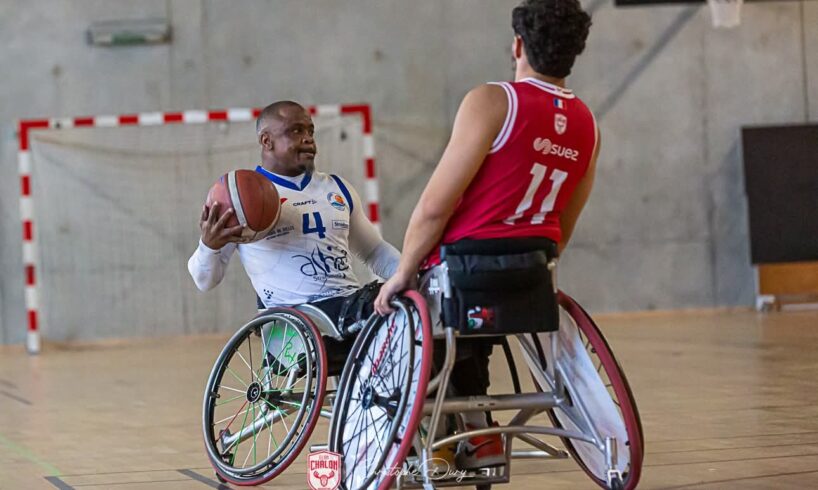
Musibau Shittu attempts a shot
PT: How did your breakthrough into European basketball happen?
Shittu: Before I finally moved to Europe, I had travelled a few times for tournaments—in France, Switzerland, Germany. My current teammate, Lukman Ibrahim, always invited me and told his club about me.
READ ALSO: FCTA set to domesticate, implement disability Act
I later got visas to the US and Germany in 2015. I chose Germany because the US doesn’t run professional wheelchair basketball the same way. When I arrived, Lukman spoke to his club, and they took me because they already knew my ability from my earlier visit. That was the breakthrough, and I thank God for it.
PT: How many Nigerian players are currently playing professionally in Europe?
Shittu: Roughly, we have two in Italy, about five or six in France, and maybe two in Spain. Altogether, around 10 to 15 Nigerian wheelchair basketball players are scattered across Europe.
PT: What personal dreams are you still chasing in your career?
Shittu: My biggest dream is to play at the Paralympics. That is the highest honour for any para-athlete. I also want to play at the Commonwealth Games. Representing Nigeria will always be a priority for me, no matter the sacrifice. Even if I change nationality one day, the blood in me will always be Nigerian.
PT: You grew up in Bariga. How much of an influence have you become on others with disabilities?
Shittu: I don’t praise myself, but in my small way, I help people. I don’t hide my phone number. People call me for advice or help, and I respond. Life is simple; we will all leave what we have behind one day. What matters is the legacy.
From Bariga to poster boy in France
I also set up my own academy to support upcoming disabled athletes. Sports have changed my life and my family’s. I want others to experience that too.
PT: Tell us more about your academy.
Shittu: It is called FOLMUS Disabled Sports Academy—F-O-L-M-U-S. We are based at the National Institute for Sports (NIS). We don’t have an office yet, but we train athletes. One of our players won two gold medals in badminton at the last West African Games held in Abeokuta. We support athletes across a range of para-sports, not just basketball.
My goal is to help build the next generation.