Six hundred samples. Roughly 180 sites across the Canadian Arctic. And more than 3,000 microbes providing more than four trillion pieces of data on the genetic composition of the Arctic Ocean.
These are the quick numbers behind the work of Srijak Bhatnagar, an assistant professor at the University of Calgary and Athabasca University, who along with his team spent seven years studying and cataloguing environmental DNA from Canada’s most northern waters.
Environmental DNA is genetic material shed by all organisms, including fish, birds, insects and microbes, into their environment. It includes feces, skin, tissues and mucus, which allows researchers to identify the creature that shed it, providing a picture of the living composition of the ocean and its inhabitants.
Through samples collected over a six-year period by various researchers aboard the CCGS Amundsen, an icebreaker and Arctic research vessel, Bhatnagar’s team believes they can help identify more than 80 per cent of all environmental DNA found in the Arctic Ocean.
The significance of this work goes beyond the numbers. According to Bhatnagar, collecting and cataloguing as much environmental DNA as possible is essential to understanding and combatting climate change. The data provides insight into populations and migration patterns for key species in the region, and tracking the impacts of diseases and other marine contaminants on the ecosystem and food security for local communities.
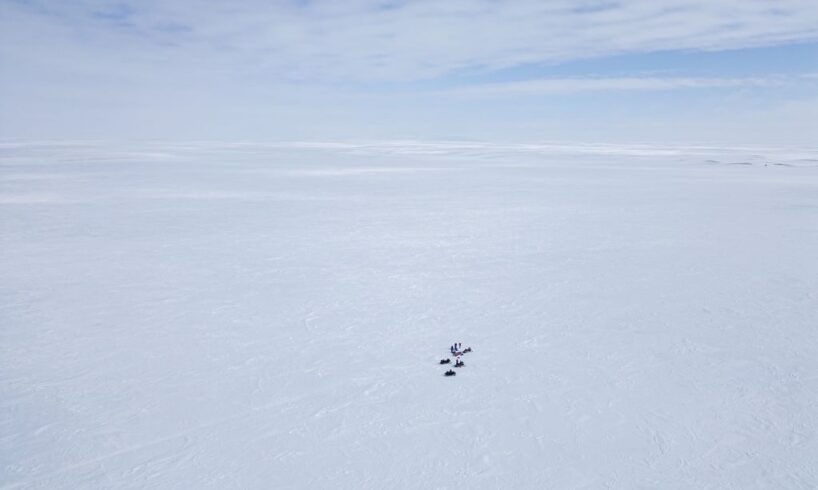
Srijak Bhatnagar (centre) and his team of researchers are studying the DNA of the Arctic Ocean, through genetic material shed by its animal, insect and microbial inhabitants. Bhatnagar believes the group can now help identify more than 80 per cent of all environmental DNA found in the region’s ocean, making tracking population and migration patterns for key species easier. Photo: Limelight Photography
Many animals and plants in the North are threatened by climate change, like the Arctic cotton shown here, which is used for wick in qulliq (traditional Inuit oil lamps). Bhatnagar and his team plan to share the information they’ve acquired with other researchers and Inuit communities to enhance their understanding of regional flora and fauna. Photo: Shivangi Mishra
The team plans to make the information accessible to other researchers as well as Inuit and other Indigenous communities in the Canadian Arctic. They are currently building an online environmental DNA database with their ocean samples, which will be added to larger, publicly available databanks created and hosted by the International Nucleotide Sequence Database Collaboration, which includes DNA from both terrestrial and marine species in the Arctic. But they also travelled through Nunavut and Nunavik, hosting a series of workshops aimed at making the connection between genomic data and the environmental changes Inuit communities are seeing on the ground.
Bhatnagar’s team is also collaborating with researchers at Carleton University to build a larger, publicly accessible AI-supported system that will be fed by all genomics research taking place in the region, including the ocean environmental DNA his team has studied. The goal, he says, is making “the ChatGPT for genomic information.”
Such a platform, Bhatnagar says, could give communities the tools to answer critical questions: what can the DNA in Arctic waters tell us about mercury contamination in the region? What can local bacteria tell us about the impact of climate change on the population of key wildlife species?
“I cannot emphasize enough how many questions this could answer that I can’t even think of and only the future would reveal,” Bhatnagar says.
A safe, accessible and inexpensive method
Between 2013 and 2019, Bhatnagar’s team processed environmental DNA samples collected from the ocean by various researchers aboard the Amundsen, from across the Canadian Arctic archipelago and as far north as Nares Strait, which lies between Nunavut’s Ellesmere and Greenland. Genome Canada, a federally funded non-profit organization, provided more than $10 million in project funding to Casey Hubert, a professor at the University of Calgary and mentor of Bhatnagar’s.
Hubert’s research aims to understand what kinds of microbes live in the Arctic Ocean, how abundant they are and how they may offer a nature-based solution in a region that is seeing less sea ice, more shipping and potentially greater chances of oil spills due to increased traffic.
“Arctic Canada does not have capacity to mount a quick oil cleanup response,” he explains. “So what it comes down to is bacteria that are in the ocean that can actually degrade oil, crude oil or diesel.”
Research on the microbial environment in Canada’s Arctic Ocean means increased nature-based solutions for a region that’s feeling the effects of climate change and mounting ship traffic, which can lead to increased risk of oil spills. Certain microbes have the ability to degrade different types of oil. Photo: Shivangi Mishra
The collected samples have revealed significant quantities of microbes that can degrade various types of oil. They also provide a baseline for these microbes, so any change in the composition of microbes and marine life in the area can be measured after an incident, such as a spill.
“Pollution incidents could also disturb the environment, disrupt the ecosystem,” Bhatnagar explains. “So how do we know that when the oil cleanup has happened, the environment is back to its old self, or has now moved on to a new self?”
This method of research and data collection is also less harmful to the ecosystem than other techniques, he adds.
“Using an [environmental DNA] baseline is a lot faster and cheaper and less deadly than trawling [where you] pull up everything, count it and by the time [the marine organisms] come up, they’re already dead,” Bhatnagar says.
“We use a gram of seafloor or a litre of water and that’s about it. It’s a lot less invasive and faster and cheaper, and it’s replicable,” he says, meaning researchers can compare samples over time. “They can see the changes happening over our lifetime because of climate change.”
Changing populations, migration patterns and food sovereignty in the Arctic
Alongside making environmental DNA from the ocean samples accessible, Bhatnagar says funding from Genome Canada is also being used to increase the uptake of genomics to inform discussions around food sovereignty for Inuit. This includes discussions about population management and migration patterns, from co-managing herds to monitoring initiatives for local biodiversity.
In order to do this, Bhatnagar and his team visited communities across Nunavik and Nunavut between January 2024 and March 2025, speaking to Elders, hunters and trappers committees and Inuit government representatives about how environmental DNA-based tools could support their goals.
Reducing the impacts of research activities on local wildlife and marine life is significant, according to Allen Gordon, an Inuk historian, municipal councillor and wildlife technician in Nunavik who participated in a community workshop held in Kuujjuaq, Que., earlier this year.
Researchers visited the community of Kuujjuaq, Que., to discuss how their mapping of Arctic DNA can support Inuit food sovereignty and other goals. Photos: Shivangi Mishra
“With new techniques and with new genetics research, you may not need to just always kill — because to sample that beluga, [for example], you’ll have to kill it,” he says.
“Now you may be able to get a lot of samples just from the water, and the water will tell you who’s been around, who’s left their mark.”
Gordon adds that larger DNA information can help answer questions Inuit have about wildlife as a source of food that are unique to each community. In Nunavik, Inuit want to know more about belugas, which they have largely been prevented from harvesting in Ungava Bay for decades due to declining local populations.
“The government came out in the ’80s saying, ‘No more hunting. Your [beluga] population is way too low. No more hunting at all,” Gordon recalls. “But then questions came [from Inuit]: are these whales that we still see and sometimes harvest — are they unique to Ungava Bay or are they the ones that move around to Churchill to join that big population?”
Gordon adds that it’s an example of how science can help both the Canadian government and Inuit find consensus on their shared goal of maintaining a healthy beluga population: “For us Inuit being a harvesting society — we want to keep eating and killing belugas.”
Inuk historian Allen Gordon shows the research team an enlarged microscopic image of salmon scales. Photo: Shivangi Mishra
Shivangi Mishra, a postdoctoral researcher who co-created the community workshops with Bhatnagar, says working with Inuit is essential for ensuring any digital technologies including the database reflect local knowledge that precedes, completes and complements scientific research on Arctic genomics.
“Science is a very powerful tool, but grounding the science in Indigenous values and traditional values is more important,” she says.
“Technologies are just a tool. They always complement, but it’s not like they are the only solutions.”
Through the workshops, Gordon says he has been happy to connect with other Inuit working with Bhatnagar’s team who are learning about genomics, making the science accessible to their communities and attempting to apply it to local decision-making. In one meeting, he heard from Emily Angulalik, the executive director for the Pitquhirnikkut Ilihautiniq Kitikmeot Heritage Society in Cambridge Bay, Nvt., who shared that Inuit in the community are seeing more diseases and parasites in muskox. This was surprising for Gordon because over in Nunavik, the local muskox population is healthy and currently growing by nine per cent each year, according to 2024 statistics from the Government of Quebec.
Some of the important specimens Srijak Bhatnagar’s team are working with are from various Arctic fish species. A researcher shows the ear stones, formed from calcium deposits in the ears of bony fish, used to determine a fish’s age. Photo: Shivangi Mishra
With Angulalik’s participation, Gordon says the conversation around food sovereignty and research in the region was more expansive. The two of them shared with the team the importance of involving communities, valuing their knowledge and ensuring scientific research returns to Inuit.
“We had a lot of similarities of Inuit knowledge that in the past had not really been taken into account,” Gordon says.
‘We must use our language to learn our ways’
The AI chatbot will function as a mix between a search engine like Google and an AI-overview system like ChatGPT, Bhatnagar says, that will use the most current and comprehensive genomic research available.
Bhatnagar says decisionmakers will be able to ask the chatbot questions about local species, the researchers studying them and community involvement in the work.
“The platform will tell me that, for example, polar bears [in that area] are actually thriving. So if we were to hunt polar bears, we go to that side and not to this side, and that information helps [people] with decision-making, from an individual level to territorial and federal government levels.”
While the system will not host the environmental DNA itself, it will draw from all publicly available research and the environmental DNA that Bhatnagar’s team is adding to the larger databanks at the International Nucleotide Sequence Database Collaboration.
Preserved remains of Arctic animals. Researchers hope to build an AI-powered searchable database with information about patterns of the region’s fauna. Photo: Shivangi Mishra
Christy Caudill, a systems scientist at Carleton University, is working alongside Bhatnagar to build this platform in partnership with Angulalik and the Pitquhirnikkut Ilihautiniq Kitikmeot Heritage Society. She says the AI tool will function as “a knowledge mobilization system.”
Caudill notes communities like Cambridge Bay have been using both actual genomic science and Inuinnait knowledge around genomics as part of their local monitoring programs for a long time. But there are gaps between Inuit ways of knowing and genomics, particularly when it comes to terminology.
“We must use our language to learn our ways,” Annie Atighioyak, president of the Kitikmeot Heritage Society, says of this work. “Through spoken Inuinnaqtun, observation, hands-on activities and not just the written form. Let the learners see, hear, feel, practise or taste the language and culture.”
With Angulalik and Elders at Pitquhirnikkut Ilihautiniq Kitikmeot Heritage Society in Cambridge Bay, the team translated hundreds of terms used in genomic science to Inuinnaqtun. Together, they co-created a definition that incorporates scientific information but is rooted in the culture and Inuinnaqtun dialect. Elder Mary Kaotalok and Angulalik translated ‘genomics’ as: “Aallanngurninga uumajuvaluit ihumaaluktut qanurinninganik, aulavallianinganik, nunaujiurnirmilu naunairutikhangit.”
Alongside these translations, Angulalik and Caudill have also been developing knowledge models that identify the linkages between Inuit and scientific ways of knowing, and ensuring the platform is rooted in both.
For example, Angulalik and Elder Mabel Etegik described the relationship between their knowledge of muskox and their knowledge of climate change, culture, weather and working together. Their knowledge of this keystone cultural species and its connections and context will be indexed by the AI tool and can be searched and summarized for users.
Caudill adds the process has also led to important discussions about “how [genomics] can be expressed in an everyday context to people” as well.
Emily Angulalik, executive director for the Pitquhirnikkut Ilihautiniq Kitikmeot Heritage Society in Cambridge Bay, Nvt., has helped produce genomic science translations made from English into Inuinnaqtun. In addition to supporting translations, the research team has been working to develop knowledge models that identify links between Inuit knowledge and non-Indigenous scientific knowledge. Photo: Shivangi Mishra
“The term ‘genomics’ is inherently difficult to fully understand, unless that is your field of study. It can take years of specialty study to truly understand the concept of wildlife genomics as it relates to larger contexts and informs areas such as conservation,” she says.
“But, for the first time, it can now be said in only four lines in Inuinnaqtun and understood by those speakers in its holistic context. I think that is a brilliant example of the strength of language itself and the power that it has to relay information.””
Angulalik agrees, adding this work will make genomics research more accessible to Inuinnait moving forward.
“It’s a slow process but the terms will be used in our future — for our youth and for the generations to come,” she says.
“It’s also so important for our Elders and for Inuinnaqtun speakers [today] to understand the importance of the terms.”
Researchers hope to present an initial version of their AI-powered platform at the ArcticNet conference in Calgary this December, and to have it accessible to the public by late summer. Photo: Shivangi Mishra
Meanwhile, Caudill and Angulalik are hoping to present an initial version of the AI platform at the ArcticNet conference in Calgary this December and have it ready for public use by August. It will include more than 100 translations from genomics science co-developed with Inuit partners, some of them in Inuinnaqtun.
Caudill and Angulalik are now engaging in discussions about data sovereignty and digital ownership with Inuit as well.
“Consistently, our Inuit partners have said, ‘We welcome science. We welcome Western science. We welcome technologies. We welcome innovations. And also, we’re taking that seat with you at the table,’” Caudill says.