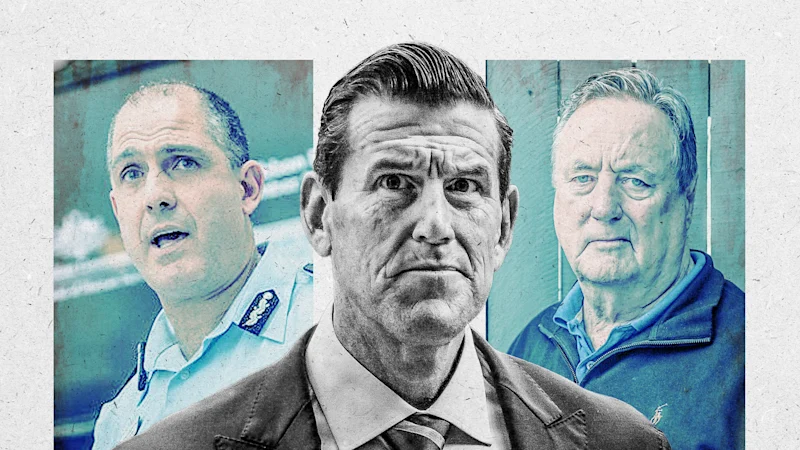
A civil court found that Roberts-Smith was, on the balance of probabilities, responsible for the murder of four civilians in Afghanistan, but more than seven years after his referral to the AFP he still has not been charged with a criminal offence.
The leak investigation cost Jabbour his career and a possible tilt at the top job of AFP commissioner. It also led to a further investigation that saw him facing charges over two unrelated incidents, which were both thrown out by a magistrate in 2021. A subsequent report by anti-corruption body the Australian Commission of Law Enforcement Integrity also found those charges could not be sustained.
The documents include Cheeseman’s final report and statements from the three key police officers involved: then commissioner Andrew Colvin, then deputy Neil Gaughan, and then professional standards chief Nigel Ryan. Between them, these three had referred their suspicions about Jabbour’s actions to the police anti-corruption commission.
The documents were released to this masthead after an FOI application initially lodged in 2021. In a shifting series of objections over the years, the AFP claimed they were too sensitive to be released, would unreasonably affect people’s personal privacy, would interrupt police operations and would deter officers from reporting corruption against their peers.
Administrative Review Tribunal president Emilios Kyrou finally ruled that a large portion of the documents were in the public interest, and ordered the AFP to release them.
Keelty, who also lost his job and relinquished his Order of Australia in 2020 after his conversations with Roberts-Smith were revealed, welcomed the documents’ release, saying the police had been involved in a cover-up by trying to keep them secret, using arguments that were lies.
Cheeseman’s findings vindicated him and Jabbour, he said.
“How much has this cost, defending the embarrassment of a flawed investigation and an egregious abuse of power?” Keelty asked. “The investigation itself went on for years … and then they’ve tried to keep it from the public. It’s beyond comprehension.”
In a statement, the AFP said it welcomed the tribunal’s decision to “uphold the majority of the AFP’s exemption claims over the documents”, saying the tribunal’s reasons supported the approach the force had taken.
“The AFP acted appropriately in seeking to maintain the confidentiality of these processes,” it said.
It did not answer questions about whether the Jabbour investigation was misconceived.
Jabbour became the prime suspect in the leak because of a 22-minute phone call he had with Keelty, who was on his way to his first meeting with Roberts-Smith in June 2018. Keelty and Jabbour both deny any information about the war crimes referral was passed on in that call.
A second report, by the Australian Commission for Law Enforcement Integrity and obtained by this masthead outside the FOI system, found there was “no evidence that Mr Jabbour was briefed on the referral” at that time.
However, after Keelty met Roberts-Smith, the war criminal rang a confidant saying he believed he was likely to be investigated by the AFP.
Keelty had earlier spoken to commissioner Andrew Colvin, and later spoke to another deputy AFP commissioner, Neil Gaughan. Gaughan had Ryan, the head of the professional standards unit, take notes of the call.
Loading
Colvin’s statement, released in the FOI documents, said he knew of the war crime referral from June 1, two weeks before Keelty’s meeting with Roberts-Smith. He also confirmed he spoke to Keelty regularly on various topics.
“I do not have any recollection of discussing the [war crimes] inquiry or Mr Roberts-Smith with [Keelty] and I cannot imagine why I would have. It would not be unusual for us to discuss matters that are on the public record. However, they would be contained to only what is publicly known.”
At the time, this masthead had begun reporting about war crimes allegations in Afghanistan being probed in a military inquiry, but had not yet named Roberts-Smith.
Gaughan’s statement, also released in the FOI documents, said Jabbour had informed him that Keelty had met with Roberts-Smith. When Keelty called Gaughan, he arranged to have Ryan take notes.
The Cheeseman report makes clear that Gaughan, Ryan and Colvin made the referral to the police anti-corruption agency.
Ryan’s notes, also partially released, show Keelty expressing support for Roberts-Smith but insisting Jabbour had told him nothing.
“Mr Keelty further stated that he had the intention to speak to Mr Roberts-Smith and tell him if the AFP approached him he would need to be presenting himself as a co-operative individual. DC Gaughan told Mr Keelty that he had no knowledge of the matters apart from three letters relating to the investigation that were already [publicly] known.”
It’s unclear which letters the statement refers to, and the unredacted words in the investigation report do not address that question.
Jabbour said he hoped the failed investigation would lead to better police procedures to “prevent similar situations in the future and to ensure others are not placed in similar circumstances”.
Start the day with a summary of the day’s most important and interesting stories, analysis and insights. Sign up for our Morning Edition newsletter.