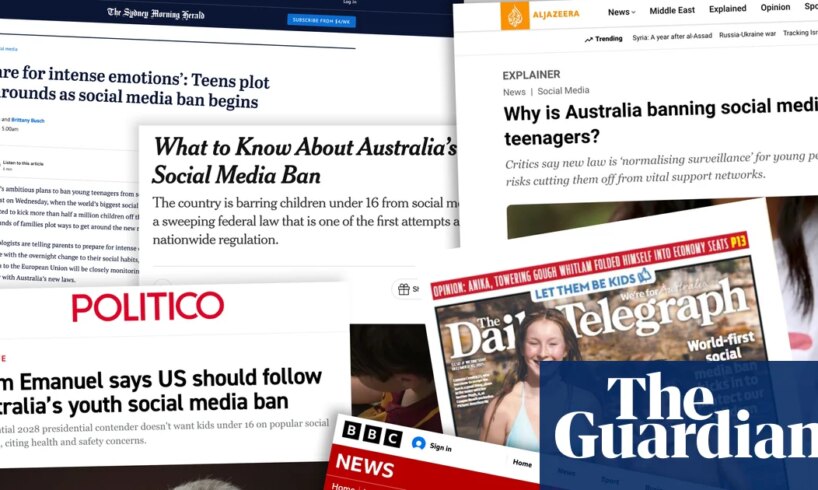
The BBC blogged about it, News Corp boasted about it and the New York Times questioned its effectiveness.
Australia’s world-first laws stopping children accessing social media until they turn 16 turned heads globally, with mixed and nuanced results.
In the UK, the BBC ran a live blog canvassing the views of teenagers, exploring how success will be judged and hearing from critics who suggested the ban could “isolate vulnerable teenagers and push children into unregulated corners of the internet”.
In the Times, the former Conservative education minister Lord John Nash wrote that Australia was taking a “brave stand” alongside Malaysia and other countries looking at similar bans. He is pushing for the UK to adopt the Australian model.
Are Australian kids breaking the law if they sneak on to social media? – video
News agency Reuters summarised moves afoot in Britain, China, Malaysia, the US, the European Union and various European countries to implement various age-based measures.
In the US, Politico ran an exclusive with potential 2028 Democrat presidential candidate Rahm Emanuel, who is a fan of the ban. He told the outlet that “anything that allows us to keep focus on improving academic standards and protecting our children on a public health basis is going to be a priority”.
It was a “grand social experiment”, the New York Times said before the ban came into place.
Once the ban took effect, it ran a piece noting that Australia’s experience could be a template for other countries, or a “cautionary tale”. And while proponents have talked about the suicide and mental health risks of social media, the Times reported an ABC survey found three in four children polled intended to keep using it.
In a separate piece, it quoted Amnesty International questioning the effectiveness of blanket bans. “A ban simply means they will continue to be exposed to the same harms but in secret, leaving them at even greater risk,” the organisation said in a statement.
The Danish digital affairs minister, Caroline Stage Olsen, told CNN that Denmark’s aim of banning social media for children under 15 was about keeping children safer, and said there was “not that much” pushback there.
Al Jazeera spoke to a range of experts and heard: how difficult it will be to enforce; that banning things doesn’t work on its own; that the age verification methods “are often inaccurate” or can be circumvented; that harms occur on platforms not covered by the ban; and that for many young people, social media access can be “not only beneficial but life-saving”.
“Research undertaken in Australia and other countries has shown that the impact of social media on young people is complex and varies widely,” its coverage noted.
What the local papers said
The Sydney Morning Herald reported on some of the bumps the ban will meet along the way. Teens are plotting workarounds, it said, and there’s a high court challenge under way. Its latest polling shows while most voters support the policy, most are also sceptical it will work.
Over at the Australian Financial Review, a front-page teaser read “It’s the algorithm, stupid: Under 16s ban misses mark”.
The Australian was relatively understated, with a news piece on both the ban and the responsible minister’s travel travails, and an inset piece about how “disgruntled teenagers” plan to get around the ban with makeup, their parents’ IDs and hidden networks.
Australia’s News Corp tabloids, on the other hand, were beating their own drums. The Daily Telegraph’s front page trumpeted that the “world-leading laws” were the result of News Corp’s Let Them Be Kids campaign as well as the “bravery of the parents whose children have died as a result of social media”.
The paper’s editorial sounded like a Walkley award entry, tracing how its campaign persisted in the face of blowback from enormously wealthy tech companies to usher in a “rational new era in social media regulation”.
It was a similar vibe at the Herald Sun, promising kids a safer and brighter future thanks to the paper’s campaign.
Tell that to the lobbyists at 36 Months, South Australian premier, Peter Malinauskas (and his wife, Annabel West), US psychologist Jonathan Haidt, former opposition leader Peter Dutton and eSafety commissioner, Julie Inman Grant, who played major roles along the way.