The Department of National Defence is scrambling to figure out how it will clothe, equip and train hundreds of thousands of new reservists envisioned under an ambitious mobilization proposal that Canada’s top military commander describes as a work in progress.
Similarly, in what may be an ominous sign of the times, the department has established a key position dedicated solely to growing the military in the event of a major crisis.
Internal documents obtained by CBC News show the military buildup will, at the moment, proceed slowly because the defence industry is either overwhelmed — or not equipped for the ramp-up.
While Canada had various mobilization schemes during the first and second world wars, the new director general position is — according to a defence expert — the first of its kind and faced with the daunting mission of delivering 100,000 reserve soldiers and an additional 300,000 citizen soldiers in a supplementary reserve, should the need arise. That would be on top of an estimated 85,500 regular — or full-time — force of soldiers, sailors and aircrew.
“Existing supply chains, inventories and personnel systems are already at capacity,” says an internal slide deck presentation, dated July 2025, from the Defence Department’s material branch.
The briefing noted the system was already struggling to re-equip the regular force and that the new initiative’s success will be “predicated on a gradual intake (slow trickle) due to current inventory and warehousing and contract limitations.”
The country’s top military commander said they are working on options to present to the federal government, hopefully by spring.
“They are currently doing an analysis of what is in the realm of possible,” said Chief of the Defence Staff Gen. Jennie Carignan.
“Basically they are planning to plan. So, what is clear is we don’t have a plan as of yet. We need to figure out how we are going to do this. And the first step is to figure out what are the roles and missions of this strategic reserve.”
The part-time force would be mostly employed at home, she said.
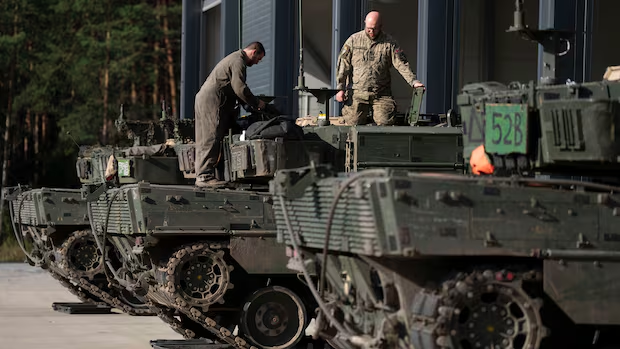
Gen. Jennie Carignan says the military is now ‘planning to plan’ for a major reserve force. (Kelly Clark/The Canadian Press)
A directive, signed last spring by Carignan and deputy defence minister Stefanie Beck, is much broader and envisions the supplementary reserve would be used for “low-intensity natural disaster response to high-intensity large-scale combat operations.”
Carignan doesn’t see an invasion threat to the country, but believes there are a variety of other potential threats, such missile strikes, that would require an organized response.
The Ottawa Citizen was the first to report on a mobilization directive signed last spring by Carignan and Beck, which envisioned federal civil servants, among others, volunteering for the supplementary force.
The documents obtained by CBC News paint a detailed portrait of a system struggling to wrap its head around all of the challenges of growing a force.
Hand-me-down uniforms floated
The new mobilization office within the Defence Department is expected to have eight officers and six civilian defence employees and will be tasked with managing the dramatic increase in the size of the military’s part-time forces.
The scale of what’s being proposed, however, is massive and military planners are just beginning to wrap their heads around the obstacles.
“Ongoing geopolitical conflicts are straining global supply chains for military-grade equipment, further limiting access to critical material and increasing lead times for domestic procurement,” said the briefing, which noted it costs $1,850 to clothe a soldier and an additional $6,000 to equip them with basic weapons and ammunition.
Some of the new supplemental reserve could get hand-me-down uniforms from a stock of currently retired outfits, the briefing suggested.
“The current lead time to get clothing through Logistik Unicorp is six to 24 months,” the briefing said.
The presentation also said industry will need help retooling.
“This is possibly the tallest order that the Canadian Armed Forces, in my view, has received possibly since the end of the Cold War,” said Christian Leuprecht, a professor at the Royal Military College of Canada in Kingston, Ont., “because we need to reconstitute the regular force, we need to significantly and massively expand the primary reserve and then build the supplementary reserve.”
Leuprecht equated it to trying to build an airplane while flying it.
“We need, and we need to equip; we need to house these people; we need to find these people; we need to attract them; we need to train them,” he said.
WATCH | Large share of military spending boost this year covered pay:
Carney announces $2B to boost military pay, benefits
Prime Minister Mark Carney announced a pay increase for members of the Canadian military on Friday, unveiling salary top-ups and incentives that will assist the lowest-ranking soldiers, sailors and aircrew. The $2-billion boost will take effect in April.
Beyond just the basics of raising and equipping a force, Leuprecht said, there are the questions of how to deploy them, if necessary.
“How are we going to move them?” he asked.
“This country on a good day can mobilize three frigates and eight CF-18s. So that’s why, I mean, there’s a whole plan behind this. If we actually wanted to deploy this capability, how would we even move it to where we wanted it to be?”
Vincent Rigby, a former national security and intelligence adviser to the prime minister, said it’s still early in the planning. He believes, however, the government needs to make its case to the Canadian public that a force of this size is necessary.
“Getting those numbers is going to require a huge communications initiative and convincing Canadians that this is absolutely required, working closely with the private sector, working closely with industry,” said Rigby.
“It’s a huge sea change for society. This is not a country that has a particularly strong defence or national security culture in peacetime. We’ve always answered the bell when there’s an emergency, but to launch this kind of an initiative right now where there’s no emergency immediately around the corner, tangible that Canadians can see” is going to be difficult, he said.
Peter Kasurak, a historian and fellow of the Centre for International and Defence Policy at Queen’s University, said he’s skeptical that even the concept has been thought through entirely.
“I find the strategic rationale hard to grasp,” Kasurak said in an interview. “What is the national requirement to have 300,000 people in the service in any form at all, much less sort of very poorly trained in the service?
“The document refers to the deteriorating international situation and to climate disasters. But how then is this group of people — with one week of training and no uniforms or anything else — going to address that requirement? It’s difficult to see. It’s difficult to imagine.”
One of the other aspects that concerns Kasurak is the section in the initializing directive by Carignan and Beck that says once people sign up for the supplemental reserve they could be subject to “legislative activation.”
This “is more or less conscription of these people once they get on the list for overseas duties,” he said.
“It may be borderline politically acceptable, but the last time this was tried was World War I when [Prime Minister Robert] Borden tried it and people just wouldn’t sign up on that basis.”
Carignan said she doesn’t think the military will have trouble finding 300,000 volunteers because as the world situation has deteriorated, Canadians are stepping forward and asking how they can contribute to security in Canada.
“The surveys are also telling us that Canadians are looking for ways to contribute,” she said.