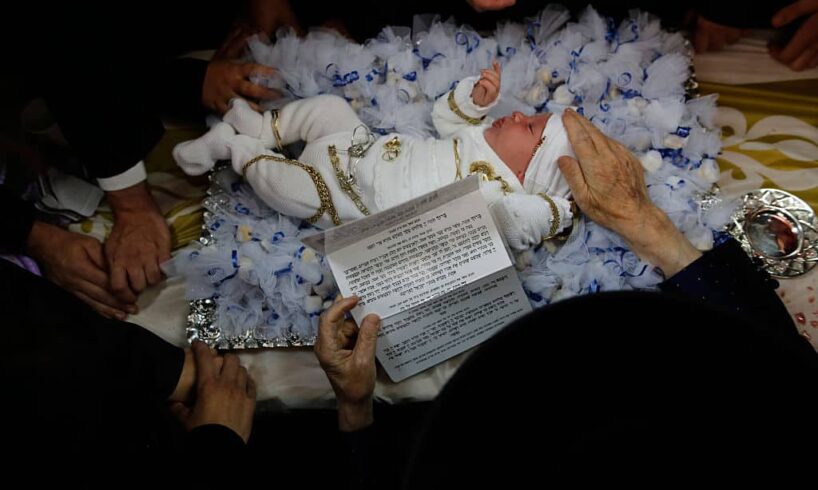
While many Jews, and even non-Jews, are familiar with the Jewish ritual of brit milah for newborn baby boys, there’s actually another tradition for newborn boys: pidyon haben. Literally meaning “redemption of the firstborn,” the ceremony as we know it today involves symbolically redeeming a baby boy from Temple service by paying a kohen (a member of the priestly class, traditionally a descendant of Aaron). But why is this ceremony so seldom performed, and what’s the exact meaning behind it? It usually takes place on the 31st day of the baby’s life.
But why is this ceremony so seldom performed, and what’s the exact meaning behind it? How do Jewish communities around the world celebrate a pidyon haben? I had many of these questions myself before experiencing this ritual with my oldest child.
What is a Pidyon Haben?
In the Torah, the idea that the firstborn “belongs” to God appears in several places. In Exodus, God declares that every firstborn male among the Israelites is sanctified in remembrance of the Egyptian firstborns who died, while the Israelite firstborns were spared. Later, in the book of Numbers, the Levites are formally taken “in place of” the firstborn sons, and the extra firstborns are redeemed by paying five silver shekels to the priests. The modern pidyon haben ceremony is a direct echo of that moment: a small, home-scale reenactment of a very ancient exchange.
So what happens at the pidyon haben ceremony? The first practical step for the family is to find a kohen to carry out the redemption process. In the United States, it has become customary to use five silver dollars as the redemption sum, echoing the Torah’s requirement of “five silver shekels.” In theory, the amount is supposed to be based on the current market value of silver. In Israel, the Bank of Israel even issues special commemorative coins to be used for pidyon haben ceremonies.
Special Pidyon Haben coins from the Israeli mint (Wikimedia Commons)
In practice, some kohanim keep the coins, some gift them back as a keepsake, and some donate the value to tzedakah. Either way, the symbolic act of transferring the money is what fulfills the mitzvah.
During the ceremony, the father publicly affirms that this is indeed his firstborn son, who meets all the halakhic criteria for redemption. The kohen then asks the father whether he prefers to have his son dedicated to Temple service or to redeem him — a dramatic but rhetorical question. The father confirms that he wishes to redeem his son; two blessings are recited, and the money is handed over to the kohen. To conclude the ceremony, the kohen recites a blessing over a cup of wine.
The whole ritual is quite brief. At our son’s pidyon haben, I remember the blessings and questions taking only a few minutes from start to finish, followed by a more relaxed festive meal and celebration with family and friends.
One pidyon haben tradition my family chose to incorporate was a ceremonial tray with symbolic objects, including garlic and sugar. In some families, the baby is even carried into the room on this tray.
No one knows for sure why garlic and sugar became common items, but there are a few popular explanations. Garlic is sometimes seen as protection against the evil eye and has historically been viewed in Jewish culture as an aphrodisiac, making it a kind of fertility symbol. Sugar cubes may represent the sweetness of the occasion and the festive meal (seudah) that accompanies the pidyon haben.
Why are Pidyon Haben so rare?
Pidyon Haben (Wikimedia Commons)
The meaning behind the pidyon haben ceremony goes back to ancient times. In the Torah’s account of the Exodus, the firstborn males of the Israelites were spared the 10th plague, the death of the firstborn. In gratitude, firstborn sons were originally considered dedicated to God’s service and, in theory, were meant to serve as a kind of priestly class in the Temple.
However, after the sin of the Golden Calf occurred in the desert, only members of the tribe of Levi — particularly kohanim within the tribe — were entrusted with this responsibility. This is the first reason why a pidyon haben ceremony is relatively rare: If either parent is a member of the tribe of Levi or have kohen lineage, the ceremony isn’t performed, because that child is already associated with the group responsible for traditional Temple duties.
Beyond the exclusion of all firstborn sons born to Levites and kohanim, there are many other halakhic (Jewish legal) conditions for the ritual that limit how often a pidyon haben happens. For instance, the baby must be the firstborn child of the mother, not just the firstborn soon. If, for example, the baby is the first son but the second child, then no ceremony is performed. Similarly, if a stillbirth occurred prior to the firstborn son’s birth, or if the baby was delivered by C-section, there’s no pidyon haben ritual according to more observant Jewish law.
If twin boys are born, only the twin who comes out first needs to be redeemed. Interestingly, there is even a Talmudic discussion about what to do in the case of conjoined twin boys; the conclusion is that they should be redeemed together for 10 shekels instead of the usual five.
All in all, when all of these disqualifications for this ritual are factored in, it becomes quite clear why so many families never experience a pidyon haben.
Pidyon Haben differ across Jewish communities
Sephardic tradition has some differences compared to Ashkenazi ones in how the ritual is carried out. Typically, a Sephardic pidyon haben takes place at night, whereas Ashkenazim are more likely to hold it during the day. In some Sephardi communities, the kohen makes a blessing holding myrtle leaves. Sometimes, the leaves are also placed on the ceremonial tray. In addition to putting garlic on the ceremonial tray, Sephardim will also occasionally distribute garlic to guests as a token of good luck.
Illustration of a pidyon haben from Juedisches Ceremoniel, a German book published in Nürnberg in 1724 by Peter Conrad Monath (Center for Jewish History)
There are also some differences in regards to the redemptive sum. Some Sephardic communities calculate the value more precisely, aiming for the equivalent of 93 grams of silver rather than simply using five standard coins. Finally, Sephardim also use a different text than Ashkenazim for the question-and-answer portion between the father and the kohen.
Among some less observant Jewish communities, the pidyon ha-bat ritual was developed in the 1970s to offer an alternate, egalitarian ceremony for welcoming a firstborn daughter. Conservative Jews often practice pidyon haben, but both parents take part in the redemption question, and the kohen can be a man or a woman. Generally speaking, though, many less observant Jews — including those involved in the Reform and Reconstructionist movement — do not commonly carry out the pidyon haben ceremony anymore as their denominations believe that Temple-related rituals are no longer relevant to contemporary Jewry and don’t recognize special status for Levites and kohanim. In fact, that’s the last-but-not-least reason why many Jews have yet to witness a pidyon haben: outside of Orthodox communities, it’s simply not commonly carried out.