By John Lee.
Iraq’s financial authorities have stressed that developing domestic financial markets is a strategic priority to support economic resilience, investment and long-term growth.
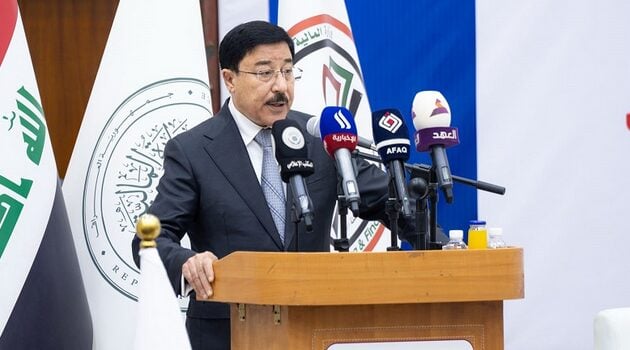
At a conference in Baghdad on the future of Iraq’s financial markets, Ali Mohsen Al-Allaq, Governor of the Central Bank of Iraq (CBI) said rapid global financial and technological shifts mean traditional economic models are no longer sufficient. It highlighted the need for adaptable institutions, innovation, and wider use of digital financial tools to enhance transparency, banking services and investment attraction.
The central bank pointed to recent progress in maintaining monetary stability and supporting the national economy through activation of the local debt market. In cooperation with the Ministry of Finance, the Iraqi Securities Commission (ISC) and the Iraq Stock Exchange, government bond issuances over the past two years have contributed around IQD 5 trillion annually (approximately USD 3.8 billion), covering more than 50% of budget financing needs.
The bank said continued expansion of financing instruments, stronger transparency and alignment with global digital trends will be essential to ensure sustainable economic growth and increased investment in Iraq.
Full statement from the CBI:
Governor of the Central Bank takes part in the “Future of Financial Markets in Iraq” conference
In the presence of His Excellency the Governor of the Central Bank of Iraq, Mr Ali Mohsen Al-Alaq, the Financial and Accounting Training Centre at the Ministry of Finance held its fifth annual international scientific conference in Baghdad under the title “The Future of Financial Markets in Iraq in an Era of Contemporary Transformations”, with the participation of a select group of experts, academics and government entities concerned with developing the financial and economic infrastructure.
In his opening address, the Governor stressed that the world is currently experiencing an unprecedented phase of profound transformation in its financial and economic structures, where technology, finance and economic policy intersect to create a rapidly changing and highly complex reality that no longer allows continued reliance on traditional models.
He stated that it is no longer possible to postpone serious reflection on the future of Iraq’s financial markets or to be content with conventional tools; rather, institutions are now required that can respond, adapt and innovate.
He added that the past two decades have witnessed a comprehensive digital revolution that has changed the nature of economic activity and created broad opportunities to digitise trading, enhance transparency, develop banking services and attract technology-driven investment.
He pointed out that there are various examples which confirm that there is no static economic model, and that rapid transformation has become the rule rather than the exception, with the strength of an economy today measured not only by the scale of its natural resources, but by the capacity of its financial markets to adapt, absorb shocks, mobilise savings and channel them into productive investment.
He underlined that developing financial markets in Iraq is a strategic necessity, not merely an optional reform step, if the national economy is to keep pace with the fast-moving global cycle.
The Governor reviewed the most prominent efforts undertaken in recent years to develop Iraq’s financial infrastructure, foremost among them efforts to reinforce monetary stability, which have been reflected in low inflation, as well as the vital role played by the Bank in stimulating the domestic debt market and financing the national economy, including bond issuances that have provided an important source of funding for the federal budget at critical points in the economic cycle.
He explained that these issuances, in cooperation with the Ministry of Finance, the Securities Commission and the Iraq Stock Exchange, have over the past two years become a key lever for budget financing, contributing an annual average of 5 trillion dinars and covering more than 50 per cent of financing needs.
He concluded by emphasising the importance of adopting modern strategies to develop Iraq’s financial markets, strengthen transparency, expand financing instruments and keep pace with global digital transformation, noting that the Central Bank of Iraq supports these steps in order to underpin sustainable economic growth and drive investment across the country.
(Source: Central Bank of Iraq)