Though his father is a famous carver, it’s not lost on writer Julian Brave NoiseCat that their Secwépemc and St’at’imc ancestors were best-known for their intricate weaving. In his new book We Survived the Night, he pays tribute to their traditions by braiding memoir and on-the-ground reporting into the arc of a Coyote Story — legends of the trickster forefather of the Interior Salish peoples. In his 2024 documentary Sugarcane, co-directed with Emily Kassie, NoiseCat investigated the history of the St. Joseph’s Mission, a residential school near Williams Lake, B.C. where his father was rescued from an incinerator as a newborn baby, and mapped the intergenerational impacts of residential school on his family and community of Canim Lake.
We Survived the Night widens the lens, looking at the ways colonialism has disrupted Indigenous lives, pushing many nations to the brink of annihilation and erasure — as well as the resilience and power of people who continue, like Coyote, to persist in survival, mischief and resistance. His reporting takes him to communities across the continent, from the unrecognized Lumbee Tribe of North Carolina to the Nuxalk Nation in coastal B.C. to the Tlingit waters in Sitka, Alaska, where he reported the excerpt below.
– Michelle Cyca, bureau chief of conservation and fellowships
This is an excerpt from the chapter “Red Herring” in We Survived The Night, published Oct. 14, 2025 by Random House Canada.
Down at the docks, I clambered aboard a Depression-era vessel named Ellie IV captained by Steve Johnson. Ellie IV is outfitted with a skiff, but the skiff’s motor was broken. So, when Steve’s crew went out to pull trees loaded down with herring eggs, they had to row like the old times. Steve is on the water about 270 days per year. He set 73 trees in 2022, yielding thousands of pounds of eggs to feed many Tlingit. Steve pointed the bow north, and we motored out of town past Daxeit Mountain. But the herring were nowhere to be found. So, when we reached Nakwasina Bay, Steve gave up on fish eggs and started looking for seals instead.
At Nakwasina, a mountain named Anaahootz towers over the site of Steve’s ancestral summer village. In the alpine, Steve says you can still see breakwaters built by Tlingit ancestors during the Great Floods. On the shoreline, you can see where rocks were leveled for canoe landings and houses. After the creation of the Tongass National Forest in 1907, the Tlingit, Haida and Tsimshian were displaced from villages and harvesting spots across southeast Alaska, like this one. Because they were considered “trespassers,” their dwellings and structures were sometimes even burned.
But the Tlingit way is coming back. Steve tries to live how his grandfathers and grandfathers’ grandfathers lived. “I think our way of life is better than the Western way,” he told me. “A lot of it is difference in worldview. Western culture is focused on giving status for what you are or what you own. Native culture is focused on what you give back and give away.” He continued, “Humans aren’t supposed to be super capitalistic and hoarding. Most civilizations are based on helping each other.”
Puttering around his ancestral bay, Steve couldn’t find herring, seal, or any of the other plenties of the past. Just a few generations ago there were many successful harvesters. But it’s all dwindling: fish, fisherfolk and fish-based civilization. With neither fish nor seal in sight, Steve turned Ellie IV around and offered a poem instead.
The red herring,
does he cross the mighty Bering?
Nobody knows what he sees,
but his eggs taste good
to you and me.
Oh, the mighty herring
he cannot fight.
He only lives
because of flight!
Everything in the sea
waits to eat thee,
but he is still, oh so free.
Come with me
and cut a tree
and herring eggs
there will be.
The Tlingit see fewer herring in the sea; 2022 was a better year than the ones immediately prior, but according to harvesters, things look precarious. More whales and sea lions have started journeying up to Alaska from California. They eat a lot of herring. So do hatchery salmon. There was a diesel spill north of Sitka during the herring spawn. It’s unclear how that impacted the fish. And it’s also unclear what effect climate change is having.
What is certain is that commercial fishermen pluck thousands of tons of herring out of the sea, killing them for their roe before they spawn. Historically, everywhere else the commercial sac roe fishery has gone in Southeast Alaska, the herring have been brought to the brink. Sitka is one of the only places where enough fish remain to support a commercial fishery.
Native harvesters say the surviving herring don’t act like their ancestors. Perhaps this is because fewer fish make it past age five. Or perhaps it’s because the fish have to dodge a high-octane fleet before they spawn. Or maybe there’s something else happening out in the warming, plastic-filled Pacific that harvesters and scientists don’t yet see. Whatever the reason, the herring have become less predictable, making local and traditional knowledge less valuable while the harvest becomes more challenging and expensive. With gas prices soaring, subsistence isn’t so cheap. Which all made the Sitka Tribe of Alaska, the activist Herring Protectors and the Tlingit wonder why, in 2022, the Department of Fish and Game authorized the largest-to-date herring catch of more than 45,000 tons.
And I was wondering the same thing. Because I came to Alaska to see how the Tlingit were cultivating and protecting herring. But what I witnessed was less straightforward. At the Board of Fish meeting, the number of voices for herring conservation vastly outnumbered those for herring commerce. But Louise Brady’s Herring Protectors and the Sitka Tribe of Alaska were fighting a losing battle.
For one, the Board of Fish does not base its decisions on the number of people who testify at meetings. It bases them on aerial surveys as well as the number of fish projected in population models. The Alaska Department of Fish and Game predicted a large spring herring run. Activists pointed out that herring were not consistently surveyed by fish and game until the last half century and that by then the fish had already been decimated. This meant that, in their view the view of a people whose oral histories and management of fish populations stretch back centuries and even millennia, rather than decades — the department’s baselines were far too low. And here was a fundamental problem. Activists and regulators were telling completely different stories based on different facts and philosophies. State regulators said they were managing the fish well, that the industry was being responsible and that as a consequence there were more fish in Sitka Sound and that those fish could be safely caught in higher numbers than ever before. Activists and tribal leaders, in contrast, said that the state was managing herring irresponsibly, that the industry had brought fish populations to the brink across Southeast Alaska and that the commercial fishery needed to be curtailed if not shut down in Sitka Sound. Each side relied on its own body of knowledge and each side was working from its own belief system about the proper relationship between people and fish. And so the Board of Fish was presented with two diametrically opposed perspectives.
To bridge this yawning divide, the Sitka Tribe of Alaska suggested amendments to the department’s management practices to protect older male herring, who Tribal Knowledge Keepers say lead the schools to their spawning grounds. They also suggested that rules governing the commercial herring take in Sitka be made more conservative to match the rest of Southeast Alaska. Neither recommendation was seriously entertained by the Board of Fish. But that was not the Herring Protectors’ and the Sitka Tribe of Alaska’s only problem. Nor was it their most significant.
The greater issue the allied activists and tribal leaders faced was that they were less practiced at influencing the Board of Fish and more divided than the commercial herring industry. While activists and tribal leaders agreed herring needed to be conserved, they disagreed on almost everything else. At times, Louise Brady and the Herring Protectors seemed to argue that the commercial herring fishery should not just be curtailed, but completely shut down. Moreover, they believed the state fundamentally did not have the right to manage herring in the first place. According to the Herring Protectors, herring should still be under the management of the Kiks.ádi, who stewarded the fish for millennia. The Sitka Tribe of Alaska agreed with the Herring Protectors on the importance of Tlingit knowledge and the need to conserve fish, but they did not want to shut down the commercial fishery, merely reel it in. And while the tribe had filed a lawsuit claiming the state failed to effectively manage the herring fishery for subsistence use, they did not go so far as to question the authority of the Board of Fish.
Meanwhile, the commercial herring industry was more unified politically and economically than ever before. Most commercial fishermen had recently formed an informal co-op to fish together and split profits, a move that largely marked the end of the every-man-for-himself days of the herring season. These commercial fishermen and the fish processors who buy their fish had grown so cocksure that they even filed proposals with the Board of Fish to regulate the subsistence herring fishery more aggressively via a permit system for harvesters, and to deregulate the commercial fishery by opening herring spawning areas previously closed to their boats. With stunning bravado, they filed a proposal to do away with a regulation requiring the Board of Fish to balance commercial and subsistence interests in its management of the herring fishery. While activists and tribal leaders sought to curtail the commercial herring fishery, the industry sought to curtail the infinitesimally smaller subsistence herring harvest. The industry group filing these proposals even called itself the Southeast Herring Conservation Alliance. It was shockingly bold. And it worked.
As the Board of Fish neared a decision, three of its members approached the Sitka Tribe’s leadership, offering an off-the-record hotel room meeting at which Louise Brady and the Herring Protectors were not welcome. The tribe was under the impression they would be meeting with a friendly group of seiners. But that was at best a misunderstanding and at worst a bait and switch. Because when tribal leaders showed up at the Hotel Captain Cook, they came face-to-face with the Southeast Herring Conservation Alliance. And they could not walk away. Because the Board of Fish members present made it clear that if the two parties did not come to a compromise then and there, their obstinance would influence the board’s votes.
After that meeting, the Sitka Tribe of Alaska abandoned their proposals and the Southeast Herring Conservation Alliance abandoned theirs. The status quo would remain. And the Herring Protectors could do nothing but protest.
While tribal leaders, industry executives and state regulators were focused on the Board of Fish, harvesters confided in me that they were equally concerned about a stealthier threat: the herring egg thief.
One subsistence harvester said about half of his 73 trees were stolen. Paulette didn’t set quite that many but lost a similar portion. A third harvester netted only about 25 or 30 bags of eggs and was unable to fill his freezer. A fourth said he had to set more branches than ever before to provide. “Theft is becoming more of a problem,” that last harvester told me. “People don’t want to do the work.”
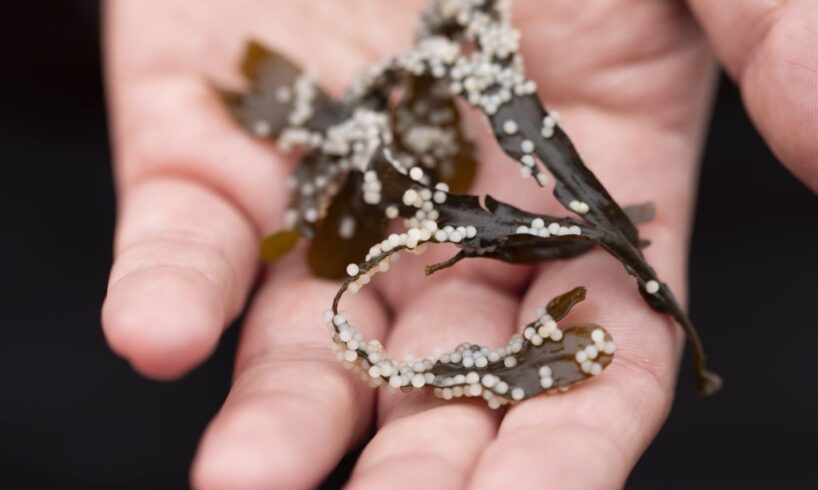
Herring lay their eggs on the branches of trees that have been submerged, like this one in Howe Sound, B.C. Tlingit fishermen have reported their trees — and herring eggs — are being poached for their value. Photo: Amy Romer / IndigiNews
Everyone had a theory of whodunit. Maybe it was one of the out-of-towners who didn’t have eggs to harvest in their own bays? Maybe it was a harvester who had promised to fill too many freezers? Maybe it was someone dealing eggs?
I was told a freezer box of herring eggs could fetch as much as US $600 on the black market. At least one herring egg dealer has faced years of jail time. And one harvester was accused of making his living off the trade.
Or maybe, said others, it wasn’t a Native but a spiteful seiner? A couple of commercial fishing boats had distributed eggs on branches to community members one weekend in an effort to repair race relations. But when had those guys learned to set trees?
No, no, said others. Those trees were set directly in the flow of treated sewage that drains into Sitka Sound. Those eggs weren’t stolen. They were shitty!
Paulette’s honey, Andrew, recorded a suspicious figure unloading a boat in the middle of the night. His footage looked like one of those grainy Bigfoot videos. He showed it to a few trusted friends—ones who had been ruled out in the townwide game of Herring-Egg-Thief Clue. But none of them could make out the man or his boat.
Meanwhile, I kept waiting around for someone to be transformed into an owl. That is the traditional Tlingit sentence for greedy harvesters, after all. But no one has gone poof! and hooted off just yet. The Tlingit Grinch remains at large.
On her way into Sitka’s Totem Park, Louise drove past the blue house in the Presbyterian settlement where her great-grandfather Peter Simpson once lived. She had just lost her fight at the Board of Fish and she needed to figure out her next move. “When I’m feeling tired, I remember everyone who fought for us to live as we are intended to live,” she said. “This is a really sacred place because this is where our people died.”
Totem park sits on a point that juts into Sitka Sound beside Ḵaasda Héen, more commonly known by its English name, Indian River. The small park has a trail lined with about 20 poles and house posts from multiple Tlingit clans as well as the Kaigani Haida, but none from the Kiks.ádi. About half are replicas carved by the Civilian Conservation Corps in the 1930s. Over the years, the replicas have been restored, recarved and replaced. But long before Totem park was a public space full of other clans’ poles, it was the site of the Kiks.ádi’s last stand against the Russians.
In 1799, the Russians built a fort at Starrigavan Bay on the north side of Sitka. There, they abused Kiks.ádi women and tried to turn Kiks.ádi men into servants, like they had with the Unangax̂ (Aleuts). Conflict was brewing when, according to Tlingit oral history, the Russians tricked an unwitting Kiks.ádi aristocrat into eating human flesh — an unthinkable taboo. To protect their home, dignity and pride, Louise’s forebears formed an alliance with some of the other Tlingit clans and took revenge on the Russians, burning their fort to the ground and killing about 150 people — 20 Russians and 130 of their Unangax̂ allies.
After the Kiks.ádi chased the Russians out of Sitka in 1802, a shaman named Stoonook predicted Alexander Baranov, the first governor of Russian America, would return with his fleet for retribution. The Kiks.ádi built Shísgi Noow (Young Second-Growth Fort) from over a thousand second-growth spruce logs. The fort comprised fourteen buildings and had an angled palisade designed to deflect cannonballs away from the structures and into Ḵaasda Héen. Gunports were carved into the walls and a trench was dug all the way around. The point was chosen because its surrounding shallow waters would help keep Russian ships and their guns at a distance. The clan moved all seven of their clan houses inside the fortification. And they sent messengers to the neighboring clans who fought with them in 1802 requesting military assistance.
The shaman Stoonook was correct and as summer turned to fall in 1804, the Russians sailed out from the Russian American capital in Kodiak. The first Russian vessel to arrive in Sitka was the Neva captained by Yuri Lisyansky. The Kiks.ádi and the Russians scouted out each other’s forces and positions, intermittently meeting to negotiate. Both sides, it seems, were at least half-heartedly trying to avoid conflict. But they were also biding their time. The Russians needed more ships and men if they were going to take Shísgi Noow. The Kiks.ádi needed neighboring clans to come to their aid if they were going to drive out the Russians. According to Lisyansky’s journal, the Kiks.ádi met with the Russians. Their head men performed a chiefly dance demonstrating their status, ferocity and physical prowess. The next day, three Russian ships outfitted for war plus 250 Unangax̂ kayaks arrived to join up with the Neva.
With not one other clan answering the Kiks.ádi’s call to arms, the Indigenous Sitkans prepared for war alone. According to lore, most of their gunpowder was hidden on a nearby island. So, before they could engage in battle, a canoe full of young high-caste Kiks.ádi men, all future clan leaders, paddled out to retrieve the munitions. They were brash and traveled without cover of darkness. And on their way back, they were spotted by the Russians. A firefight ensued. Accounts differ, but either a Russian round or the spark of a Kiks.ádi musket ignited the gunpowder. The canoe blew up, killing all aboard.
With clan opposites nowhere to be found and future clan leaders dead, a warrior named K’alyaan prepared the remaining Kiks.ádi force of about 800 for what he believed would be his last stand. K’alyaan wore a helmet made of cedar gnarl carved into an effigy of a raven. He painted his face and right hand black in the “Fallen Raven” style, signifying he intended to fight to the death. He carried a dagger, but his main weapon was a blacksmith’s hammer taken from the first Russian killed near Starrigavan in 1802.
The Unangax̂ towed one of the Russian ships to the mouth of Ḵaasda Héen. The ship opened fire. Then the Russians sent in a landing party fronted by the Unangax̂ as cannon fodder. The Kiks.ádi split their forces. One group emerged from the fortress howling like sea lions: “HU-HU-HUUU!” They met their attackers head-on. Another emerged from the forest at their flank. Meanwhile, K’alyaan hid on a log floating downriver and then snuck up from behind, attacking the enemy with his hammer. His helmet, considered sacred clan property by the Kiks.ádi, has a notch cut into its beak by a Russian axe. The outflanked Russians and Unangax̂, their guns and other metal weapons gleaming in the sun, looked like a school of herring out on the water to the Kiks.ádi defenders. As the Kiks.ádi closed in, the attackers fled for their lives. Most of the men in the landing force were either killed or wounded, including Baranov, who was hit in the right arm by a ricocheting Tlingit bullet. That night, the Kiks.ádi women stripped the bodies of their enemies and left them naked on the shoreline. The white men gleamed like slain fish, according to Kiks.ádi tradition.
With Baranov incapacitated, Captain Lisyansky took charge of the Russian forces. The captain, however, was in the middle of Russia’s first circumnavigation of the globe. Wary of another defeat, Lisyansky took a more cautious approach heavy on siege tactics: bombardment, negotiations and waiting. The battle went on for days. Every so often, as the Russians and Kiks.ádi traded shots from afar, the defenders scampered out of Shísgi Noow, collected cannonballs that had glanced off their fortress and fired them right back at the fleet. But as their ammunition dwindled, the Kiks.ádi knew they could not hold out. They convened a council to discuss options while continuing to negotiate with Lisyansky. A few days into the battle, the two sides reached agreement. That night, the warriors inside the fort sang one last song. “It was an extremely sad song from the heart of everyone in the fort. It expressed their pain and anguish at the outcome of this great battle,” recalled Kiks.ádi historian Herb Hope. “The song ended with a loud drumroll and a wail of anguish.”
The next morning, Lisyansky sent in a landing party. When they entered Shísgi Noow, the fort was almost completely abandoned. The Kiks.ádi had left behind a few cannons, a couple dozen canoes, as well as dried salmon and herring roe. With the clan gone, a conspiracy of ravens had taken up residence. It was as though the clan had gone poof! and transformed into one of their crests.
Lisyansky had been played. The negotiations were a ruse. For days, the Kiks.ádi had been evacuating Shísgi Noow under cover of trees and night. Elders and young children went first, according to oral histories, followed by mothers with infants. Adult men formed a rear guard as the clan marched north past Nakwasina Bay, where Steve Johnson still harvests herring eggs.
At Point Craven in the Peril Strait across from Angoon, the Kiks.ádi set up a new settlement called Cháatl Káa Noow (Halibut Man Fort). This location, according to Kiks.ádi oral sources, was chosen to blockade Sitka and give the clan a base from which they could return to the sound to fish and harvest. The Kiks.ádi did not begin to resettle in Sitka until 1821. By then the Russians had built their own impregnable fortress, renamed Sitka “Novo Arkhangelsk” (New Archangel) and designated the Kiks.ádi homeland the capital of Russian America. When the original Sitkans returned, the Russians kept a cannon trained on their village at all times.
But in the long run, it was the clan houses and not the Russian American outpost that remained. In 1867, the Russians sold Alaska to the United States for US $7.2 million — even though the Russians never signed treaties with Alaska Natives like the Tlingit to legally acquire that vast territory. In the 1980s and 1990s, Louise’s father, Bill Brady, helped another Kiks.ádi, Herb Hope, retrace the route of their clan’s survival march across Baranov Island. And in 2019, archaeologists rediscovered Shísgi Noow.
As Louise walked the land where her ancestors fought and died for their clan’s survival, she came upon fresh eagle down on the forest floor, the kind Kiks.ádi leaders wear in their headdresses and blow onto the ground as a blessing at the beginning of their chiefly dances — another sign of her connection to this place, her clan and their past. Louise’s situation was like that of the Kiks.ádi Ravens after the Battle of Sitka. She threw herself into the Herring Protectors’ fight at the Board of Fish. But her strategy didn’t align with the Sitka Tribe of Alaska’s. Like the clans in 1804, their forces were divided and, partially as a result, defeated.
Louise gave up studying the Board of Fish and the thousands of ways to influence it. “The Board of Fish is really soulless,” she told me. “It’s numbers and it’s formulas.” She was retreating from the Board of Fish process, which she views as inherently colonial. “We’ve been trying for a long time not to rock the canoe,” Louise said. “And where has that gotten us?” According to Louise, the Alaska Department of Fish and Game has no right to govern herring. She believes the fish fared better under the jurisdiction of clans like the Kiks.ádi. And when you take a regional, multigenerational view — an Indigenous view — that is likely true. Rather than spending time debating the wonky details of proposals, models and formulas, Louise wants to focus her energy on bringing back ancient clan governance. “The koo.éex’ is our policy. The ceremony is our policy. The coming together as allies is our policy,” she said. To achieve this end, Louise said she was pondering more confrontational tactics, to take the fight directly to the fleet in future herring seasons, like K’alyaan with the Russians some 220 years ago.
From the shores of Ḵaasda Héen, Louise and I looked out at the sound where the Russian fleet once anchored. Louise remembers when herring spawn was so thick here, you could stick a paddle in the water and it would stand up on its own. “Our ancestors didn’t die in vain,” she said. “When I said, ‘I am a Herring Lady’ and ‘I am Kiks.ádi’ for the first time, I didn’t know what that meant.”
As the Herring Woman mulled her next move, it felt like she was determined to walk the path of a martyr. And I wondered if that was the only way to save these fish. Then an eagle, Louise’s clan opposite, called out, its high-pitched whistling cry carrying across the water out into the vast Pacific.
In We Survived The Night, Julian Brave NoiseCat combines memoir, oral history and reporting — including from Tlingit territory in Alaska — to weave a contemporary portrait of Indigenous life and resistance.
Excerpted from We Survived the Night: An Indigenous Reckoning by Julian Brave NoiseCat. Copyright © 2025 Julian Brave NoiseCat. Published by Random House Canada, a division of Penguin Random House Canada Limited. Reproduced by arrangement with the publisher. All rights reserved.