It was 3am Sunday when Robin and Paul McLean received the text. A fire was encroaching on their Lake Macquarie home and it was too late to leave.
Their adult daughter, who lives with them, is confined to her bed due to disability and has her own evacuation plan that includes calling an ambulance if they reach a “watch and act” alert level – the second of three alert levels, between “advice” and “emergency warning”. But suddenly there was no time.
“It went from advice, advice, advice, to too late to leave,” Robin says.
Paul had gone to bed at 8.30pm, after checking online and reassuring Robin there was just a small fire down the road that should be under control soon. Then, hours later, there were embers in the back yard.
Sign up: AU Breaking News email
“It was very scary, the fire was enormous and there were embers landing everywhere,” he says. “We knew the firefighters are so capable, but they can’t always be. It’s so dry. There’ll be plenty more.”
Robin and Paul McLean at their home of 38 years in Redhead. ‘The fire was enormous.’ Photograph: Simone De Peak/The Guardian
The last significant fire to hit their suburb of Redhead was in 2013, part of the “Red October” fires that destroyed more than 200 homes across New South Wales and took two lives.
This time, the fire spread into the surrounding bushland but was held at bay along Redhead Road, so no properties burned. Other areas weren’t so lucky. Since the start of December, bushfires at Koolewong and Bulahdelah in NSW have destroyed 20 homes, while wind-driven fires at Dolphin Sands in eastern Tasmania have razed 19 houses and damaged dozens more.
Dozens of fires continue to burn across both states, and a NSW National Parks and Wildlife Service firefighter died while battling fires on the mid-north coast. The NSW premier, Chris Minns, described it as a “foreboding start” to the bushfire season.
Smoke haze smothers Sydney skyline as bushfire season begins – video
Earlier this month a farmer died when his vehicle was engulfed in flames as he tried to cut a fire break at Ravensthorpe, Western Australia, and last month a South Australian Country Fire Service firefighter died at a bushfire on the Eyre Peninsula.
For many, the smoke haze once again hovering over Sydney and parts of the east coast is a stark reminder of the 2019-20 bushfire season, known as black summer, one of the most catastrophic fire seasons in Australia’s history.
A passenger boat makes its way across Sydney Harbour amid smoke from bushfires burning on Sydney’s outskirts earlier this week. Photograph: Saeed Khan/AFP/Getty Images
At a NSW inquiry into those bushfires in January 2020, co-chairs Dave Owens and Mary O’Kane said the state should expect a similar season, or something worse, to happen again.
“Climate change, as a result of increased greenhouse gas emissions, clearly played a role in the conditions that led up to the fires and in the unrelenting conditions that supported the fires to spread,” they said.
That devastating summer was followed by two of the wettest years on record. But five years later, everyone on the Central Coast is once again talking about how dry it is.
Charles Sturt University associate professor Paul Read, the director of the Future Emergency Resilience Network (Fern), says Australia will have to deal with conditions akin to black summer more frequently due to global heating.
But he says current conditions are “nothing akin” to those leading up to 2019, when three climatic drivers were converging.
“This isn’t due to happen again for a few years yet, but the return rate of catastrophic conditions has been accelerating from every 80 years to every eight years over the past century,” he says.
The burnt landscape along Redhead Road in Redhead. Photograph: Simone De Peak/The Guardian
‘We’ve been living in smoke’
Debbie Shaw was on holiday for the weekend, an hour from her Redhead home, when she began to receive early morning calls from a neighbour to say that firefighters were trying to save her house.
“At one stage there were 15 firefighters in our back yard, hosing our house, it was bad,” says Shaw.
“I didn’t sleep for the rest of that night. You see it on the news, and then it’s your home … you feel a bit sick.”
She couldn’t immediately return – the roads were closed, and it was too dangerous. She drove in as helicopters continued to circle, dumping water and securing the aged care centre down the road, which had been ordered to evacuate.
Further north, Tim Boland has just moved into a property he spent 14 years building at The Branch, near Bulahdelah. They had had “bushfires all around us” in the nearby mountains for weeks.
He thinks they would be safe to stay and defend their home, built in the middle of a big paddock – but his land is as parched as he has ever seen it. “We had metres of rain through winter, we were walking through mud, and now there’s nothing, no grass, it’s just dried out that quick,” he says.
“We’ve been living in smoke for the last month.”
Tim Boland sitting on his dry land with his dog Alfie. Behind them is an eight-hectare lake, the level of which has been falling with evaporation. Photograph: Simone De Peak/The Guardian
Jim McLennan, an adjunct professor at La Trobe University’s School of Psychology and Public Health, says communities which were not previously thought of as being at risk of serious bushfires are increasingly likely to be affected, as temperature increases and changed rainfall patterns leave vegetation more ready to burn.
“The house among the gum trees will become a more and more chancy lifestyle choice for people wishing to reside in a ‘natural’ environment,” he says.
The Australian and New Zealand Council for fire and emergency services’ (AFAC) seasonal bushfire outlook, released late last month, projected a heightened risk of fire this summer in large parts of NSW, Victoria and Western Australia. But it warned that communities in areas forecast as having a “normal risk” should remain vigilant.
Neither the NSW Central Coast nor the areas of Tasmania’s east coast that have burned over the past week were identified as high risk.
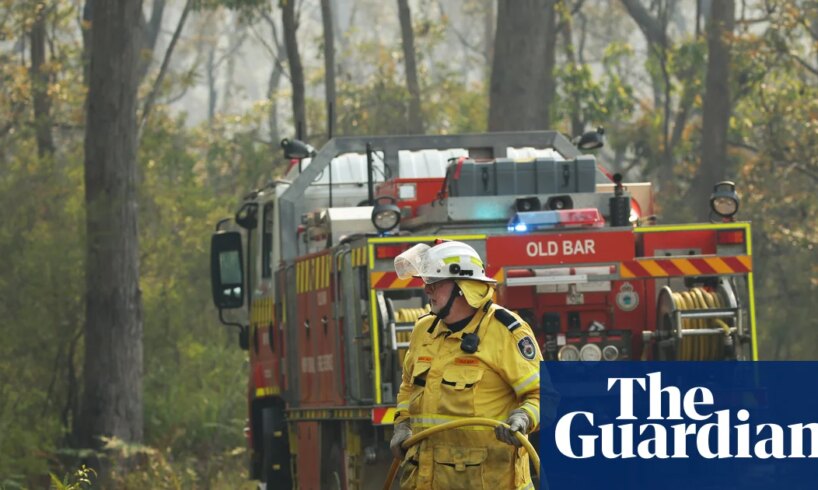
NSW Rural Fire Service at Myall Lakes national park in Nerong, NSW. Photograph: Simone De Peak/The Guardian
The continued crawl of the urban fringe into bush and parklands has added another risk.
Sonia Donaghy has started a fundraiser to thank the firefighters for their recent efforts with bushfires at Redhead. Photograph: Simone De Peak/The Guardian
“On bad fire days quick, short, sharp fires can occur in bush areas within the suburbs, including parks, golf courses and grasslands,” says the chief executive of Natural Hazards Research Australia, Andrew Gissing. “The fire doesn’t need to be big to affect you.”
According to Forest Fire Management Victoria, high bushfire‑risk zones are typically around forested hills or semi‑rural fringes where houses are next to bush, including the central Victorian towns of Bendigo, Castlemaine, Wedderburn and Inglewood.
Similarly, bushfire risk mapping service Groundsure identifies the Blue Mountains national park and its surrounding suburbs as the most at risk of bushfires in NSW.
Back in Redhead, local pharmacy owner Sonia Donaghy has put on a fundraiser for local firefighters and says the response has been overwhelming.
“Where I’m situated is between two streets that got notified to leave [at 3am],” she says. “You could hear the crackling of the fire … that’s when you know it’s so close, to wake up and all you can smell is that thick smoke.
“We’re all rattled. And we all want to support one another.”