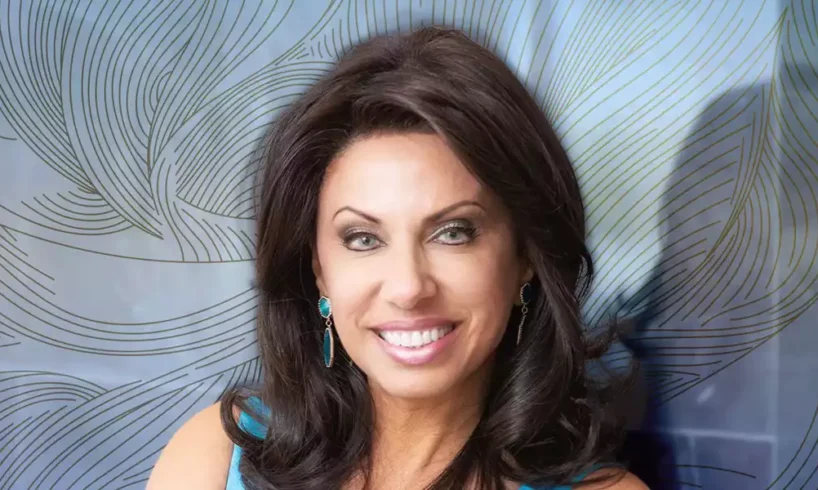
Place of birth: Lebanon. Formative experience: The civil wars of the 1970s. Childhood memory: Hatred toward the Jewish state. With opening data like these, one could have bet with closed eyes that Brigitte Gabriel would grow up to be yet another among the millions who hate Israel in her homeland and throughout the entire Middle East, while trying to survive in the chaos created in her country after years of battles between political groups willing to slaughter each other – not as a colorful metaphor, but as an actual deed.
However, in 1975, when she was 10 years old, her life was turned upside down. “The fear of dying shaped my worldview more than anything,” Gabriel, an American journalist and author, said in an exclusive interview. “My September 11 or October 7 happened when a combined force of Palestinians and Muslims bombed my family’s home. I was injured and hospitalized, and we found ourselves living in a shelter.
“I remember running to the shelter almost every night at the beginning of the Civil War, and the sounds of bombs around us. We expected death every day. We lived in constant fear. One day, we heard that our town was about to be attacked, and that our Christian militia would not hold the line. I remember putting on my burial clothes and waiting to be slaughtered. I wanted to look beautiful when I was dead, knowing that when they came to slaughter me, there would be no one to bury me. At this stage, I was 13, and I didn’t plan to go to college or think about any future, because I didn’t believe I would live to age 20.”
Brigitte Gabriel’s New York Times bestseller
Tragedy, ultimately, saved the Lebanese girl from additional, larger tragedies. Her mother was wounded in an attack, and Hanaan (who later changed her name to Brigitte) accompanied her when she was taken for medical treatment in Israel. The experience at Ziv Medical Center in Safed was formative for her. The Israeli doctors treated all the wounded with endless dedication, which profoundly affected her opinion and her values.
Later, she settled in the US, and after the September 11 attacks, she established the organization ACT for America there, designed to curb Islamic extremism. In other words, she survived a tangible danger in her country – and dedicated her life to an activity no less dangerous.
And today, in an era when many prefer to avoid confrontation with Islamic extremism and ignore the threats it poses to the free world, Brigitte Gabriel is a rare figure: a woman who does not hesitate to stick to uncompromising truth, even when it costs her dearly, in a stubborn and dangerous struggle for the freedom of democratic societies.
The enormous political influence of her activity includes, among other things, legislation, public campaigns, and exhausting work with the American Congress. Honesty, courage, and willingness to stand against political currents and cultural fashions have become her hallmarks. In a world that prefers political correctness and caresses, she is the loud and clear voice of the uncomfortable truth. A voice that does not hesitate to declare that “Israel is the pillar of light of freedom in the Middle East.”
When Gemayel wanted peace
As a daughter of a Christian family, she visited here for the first time even before her mother’s injury. “It was in 1979 or 1980,” she recalled. “We made contact with my father’s uncles in Haifa and joined them at the ‘Good Fence’ (the border crossing between Israel and Lebanon during the civil war). We lived with them for a week in Haifa, on Hagefen Street, at the foot of Stella Maris, near the French consulate. My parents were full of admiration for Israel, for its progress and its beauty, and I also fell in love with Israel and with what I saw in it: the order, the cleanliness, the equality between women and men, the respect of the leaders for the citizens. All this was very, very different from war-torn Lebanon that I knew.
“I remember the emergency room at Ziv Hospital, which was full of wounded from Lebanon – Muslims, Christians, and Druze – alongside Israeli soldiers. The doctors treated everyone according to the severity of the injury. They didn’t see political affiliation, religion, and not nationality. They saw human beings who needed help. I couldn’t believe my eyes. For my mother, it was a life-saving experience. For me, it was a life-changing experience.
“The stay at the hospital changed the way I listen to information, the way I see people, and my understanding of the conflict. I saw up close the love, the compassion, and the desperate desire for peace among the Jews toward their neighbors. Israelis from all over the country came to help the Lebanese wounded.”
Dr. Salman Zarka, director of Ziv Medical Center in Safed (L) and Brigitte Gabriel (R) (Photo: Ziv Medical Center in Safed)
She described all this in her book, a New York Times bestseller, “Because They Hate,” which she describes as “a must-read for anyone who wants to understand the conflict and its human impact.”
Q: As a daughter of a Christian family in Lebanon, did you understand the conflict in the country and its background?
“Yes. The Christians in Lebanon welcomed the Palestinians, gave them shelter and food, while no other Arab country wanted more refugees. Lebanon was the only country that absorbed a third wave of Palestinians. As a country with a Christian majority, we lived based on Judeo-Christian values of kindness, love, compassion, empathy, tolerance, and generosity – and what was the reward from the Palestinians? Massacre, hatred, killing, and intolerance.
“They wanted to use Lebanon as a base for attacks against Israel and to throw the Jews into the sea. And out of pure hatred, they were also willing to kill those who extended a loving hand to them. This is something we, Christians and Jews, don’t understand. It’s contrary to everything we believe in. Therefore, the Christians in Lebanon understood very well, and at a very early stage, what Israel is dealing with regarding the Palestinians. This is also the reason Lebanese Christians worked with Israel from 1975 until almost 2000, and why Bachir Gemayel, Lebanon’s president-elect, was assassinated. He sought to bring peace between Lebanon and Israel.”
Q: And what’s happening there today, after Israel’s war with Hezbollah? Does the possibility of an alliance with Lebanon’s Christians still exist?
“Yes, but action must be taken quickly. My generation, the one that experienced the war before Hezbollah’s brainwashing, which began in 2000, wants peace with Israel. Christians in Lebanon have much more in common with Israel than with other Arab countries. We share the same Judeo-Christian values.
“Many Christians aged 50 and above remember the friendship between Israel and Lebanon in the ’70s and ’80s. Many of them were also trained in Israel or by Israel. They remember how Israel stood by their side in the civil war, and their beloved president-elect, Bachir Gemayel, who wanted peace with Israel. Unfortunately, today Christians are led by fear of assassination, threats to their families’ lives, and therefore they’re afraid to speak.
“After Israel crushed Hezbollah and killed Nasrallah, I reached out to Lebanon’s president-elect through a mutual friend, and proposed holding a private and secret meeting at my home in the US with an Israeli official, to begin drafting a peace agreement between Lebanon and Israel. I said that even if Lebanon isn’t ready now, secret talks could begin and a framework could be prepared to be presented in two or three years. The answer was a big ‘no.’ They were afraid even to consider it. I hope that now, as they see what President Trump is doing with other Arab countries, they’ll dare to move forward.”
Q: As someone who fled civil war and persecution, do you also feel identification with the Palestinians?
“Palestinians, like Jews who were scattered across the world following persecution, live today in different countries with different passports. These people are not refugees – they are citizens of those countries. Children born and raised in those countries are not Palestinian refugees, and must not be viewed as such.
“Jews were expelled from Arab lands and dispersed throughout the world, including to Israel. There are more than one million Jewish refugees from Arab countries, and they live today in different countries and hold different citizenships. Their children are Americans, French, Canadians – not Yemenites, Egyptians or Iraqis. While they still celebrate their culture and cook their foods, they are proud citizens of the countries they live in. Palestinians, on the other hand, still call themselves refugees after four generations – even though they have lived in the West for decades, and their children and grandchildren are no longer connected to the land of Judea and Samaria or Gaza.”
Convert or die
Since October 7, Gabriel has felt that Israel is losing the public relations battle, and offers explanations: “Jews try to speak for Israel using legal language and historical facts, and Palestinians use emotion to distort facts. Israel’s spokespeople are usually middle-aged men with heavy Israeli accents, who go on air and start talking about this or that clause in UN Resolution 242. They present a logical argument.
“Palestinians, in contrast, talk about the suffering of children, and paint the conflict in graphic words. The moment people start to feel the child’s pain, emotion takes over, and they stop listening to logic. This is why Israel loses the PR war. Israel needs more fluent women, speaking perfect English, who will tell stories about children in trauma.”
Bachir Gemayel
Q: There are quite a few Jews today in international media, and yet Israel’s side is barely heard. How do you explain this?
“They want to show both sides to prove they are decent people. Therefore, they invite their enemies on air and give them 50% of the time to present their claims. Palestinians, in contrast, play on one team –Q: the Palestinian team. They will never give a platform to their enemies. Their time is dedicated 100% to Palestinian propaganda, and in addition, they receive another 50% of others’ media time. I can’t count how many times I was prevented from appearing on programs because of Jewish journalists who feared I was ‘too tough’ on Palestinians, and wanted someone ‘less controversial.'”
Q: What, in your opinion, don’t people in the West understand about Israel’s struggle against terror?
“They simply don’t perceive terrorists as terrorists. Western media calls them ‘freedom fighters’, ‘an oppressed people fighting for freedom.’ They don’t understand the depth of hatred and the thirst for revenge in the Islamic world. The Muslim Middle East views Jews as ‘najis’, impurity according to the Quran, and requires them to convert to Islam or die. This is an idea so foreign to Western ears that they simply don’t know how to deal with it. They don’t understand why Israel ‘kills and oppresses’ people who supposedly ‘just want freedom.’
“Israel is fighting extremist Islamist terrorists who hate Jews, Christians, and non-Muslims. Islam divided the world in two: ‘Dar al-Islam’ – the House of Islam (the Islamic nation and land), and ‘Dar al-Harb’ – the House of War (the land and peoples not yet conquered by Islam). ISIS, al-Qaida, al-Shabab, the Houthis, Boko Haram, Hamas, or any other name you choose for terror organizations – they all share the same ideology of hatred and intolerance toward everything non-Muslim. Israel holds the line in the Middle East, and helps us with intelligence and everything we need to defend ourselves and Western civilization from these jihadists.”
Gabriel identifies the problem also among circles and figures from the conservative side in the US, like Tucker Carlson and his ilk. “People around the world tend to see reality through their own experience,” she explains. “They’re incapable of understanding that Palestinian mothers educate their children to die just to kill those they hate. That parents put an explosive belt on a child, send him to blow himself up at a checkpoint, and when he dies, they celebrate and name streets after him.
“Today even conservative voices in the US are turning their backs on Israel, because they pity ‘innocent Palestinian women and children’, and accuse Israel of ‘genocide.’ This is why our work in educating conservatives is so important. The good news is that American conservatives understand that Israel and the US share a common enemy – Islamic extremists.”
Toxic algorithm
Q: You’ve been warning for years about the penetration of Islamist ideology into Western societies. Does it seem to you that the West has already awakened to the danger, or does denial still prevail?
“The West is beginning to wake up, especially after October 7. The pro-Palestinian and pro-Hamas demonstrations, in which protesters in various Western countries tore their country’s flag while waving PLO flags, shocked many. People in the West are now worried about Islamic penetration and the open expression of resentment toward the culture and host countries.
“Crime, lawlessness, property destruction, and demonstrations of resentment toward Western countries – all these are happening today in every major Western city, from Sydney to London, from New York to Paris. Muslim immigrants are not assimilating – they organize within their communities, create enclaves, and threaten the local way of life and the authorities.”
Q: Do you identify a similarity between today’s radical Islam and movements in Lebanon in the ’70s and ’80s?
“There is nothing new under the sun. In the ’70s, Palestinians massacred Christians, slit throats, severed limbs, and stuffed them into mouths, tore children in half, and cut open the bellies of pregnant women. They did this in Turkey against the Armenians in the 19th century, in Lebanon, and two years ago in Israel. When I said this 25 years ago, people in the West didn’t want to believe it and accused me of exaggeration. Now you in Israel understand it, because you lost family members and friends – and still, the world doesn’t believe Palestinians are capable of such acts.”
Brigitte Gabriel on ACT For America’s YouTube channel (Screenshot: ACT For America)
“One of the reasons for this is social media, which spreads propaganda. Most young Americans have no knowledge of the world. They don’t know the history of their own country, much less the history of another country. People today get their news from Instagram, and not from reading newspapers or articles that explain the conflict. Everything is driven by emotion and fake images, which spread faster than truth, and the algorithm, of course, plays a central role in shaping consciousness, by feeding them only one point of view, and showing them more of what they want to hear – without exposing them to opposing opinion.”
Q: You criticize the idea of multiculturalism when it becomes cultural relativism. What’s the alternative you propose?
“The West must control immigration policy better. In the past, there were immigrants who chose to come to the West to be educated, build new lives, and assimilate into the new land. Today, they import people who didn’t really want to immigrate to France or America because they were impressed by the culture, but also because of the benefits these countries offer.
“We have a new wave of immigrants arriving with a sense of entitlement. They don’t just feel they have a right to enjoy our tax money – they demand that we adapt ourselves to their culture, to their way of life, to their way of thinking. They try to transform Western countries and the freedoms that enabled our prosperity into the same hellish countries they fled from. They demand that we limit our freedom of expression and our exchange of ideas so we don’t offend them.
“So yes, we need fresh blood in our countries – it’s good, it renews and brings ideas – but we must be selective about who enters and how we assimilate them, for everyone’s benefit. Europeans ignored this problem for too long, and Europe has become Eurabia. They tried to silence everyone who warned. For years, people like me and othershave warned against importing an ideology that completely clashes with Judeo-Christian values and with Western freedoms. The West’s problem is that we project our Western values onto evil people who don’t share them with us.”
Q: Why, in your opinion, do many Western feminists remain silent about the oppression of women in Islamist societies?
“They’re silent because if they speak, they’ll have to criticize Islam as an oppressive religion. They’ll have to discuss, for example, the marriage age, which is 9. In our culture, this is considered pedophilia. In Islam, the Prophet Muhammad married a 6-year-old girl and had sexual relations with her at age 9, and he is considered the perfect person whom every Muslim man tries to emulate. According to Islam, women are property of men, as stated in the Quran and hadith. If Western feminists want to talk about beating, rape, and oppression of women in Islamic countries, they need to look at the Quran and at the ideology driving such cultures, but they’re incapable of doing this and connecting Islam to anything negative.”
Q: Is there hope for reformist and moderate voices within Islam?
“Yes, there is hope, but many such voices are needed, and they need to speak about real reform – adapting the religion to the 21st century. The problem is that many of them don’t truly understand the religion, and they’re ‘reformers’ only in their imagination. Therefore, when radicals and moderates argue, the radicals win, because the law is on their side. While we view ISIS as something evil, they are actually implementing Islam as Muhammad himself did, including beheadings and throwing homosexuals off buildings.”
Power brings respect
The October 7 massacre returned her to the horrors of childhood and triggered the post-traumatic stress disorder she has carried with her since then. She was in complete shock for five days. Only on October 12, while sitting in her hotel room, did she gather the strength to watch the news, and broke down.
“I knew I had to do something,” Gabriel recalled. “I immediately posted my first video from the hotel. I wanted to come volunteer in Israel, but I understood I could help more through the media and my platforms. I reach 8 to 10 million people per day through them, and in the first two months of the war, my videos reached 50 million views. People copied and shared them. I did every possible interview. There were days when I did 14 interviews in a row, from 7 in the morning until 11 at night.”
She was not surprised by the wave of pro-Hamas demonstrations after October 7. According to her, the massacre awakened the hidden antisemitism in the West, and Jews (in the diaspora) were more surprised by the demonstrations than other people. “Jews lived in denial. They thought that if they showed understanding to the enemy and neglected their own people, then the enemy, meaning Palestinians and Muslims, would love them and see how ‘nice’ they are. After October 7, they were forced to understand that they had very few friends outside the Jewish community – and people like me, whom the Jewish mainstream sought to distance, were the only ones trying to help.”
Now, with Zohran Mamdani’s victory in the New York City mayoral election (and following support from a Jewish governor and 30% of Jewish voters), Gabriel’s thesis gains reinforcement. She predicts that Mamdani’s win will be a disaster, and notes that the man is surrounded by Palestinian activists of the worst kind, like Linda Sarsour, who will serve in senior positions on his team.
Q: What message would you like to convey to Israelis who feel quite isolated in the world today?
“You will never be alone. There are good people in the world who will stand by your side, fight for you, and with you. There are those who see the truth clearly – and are willing to pay a personal price to defend you and your right to live in your Jewish state. Because of my uncompromising support for Israel, I lost my Lebanese community, I can’t visit Lebanon, and I live with death threats against my family and me. I paid a heavy price, but I would do it again, because it’s the right thing to do. This is how I was raised: to stand by good and fight evil.”