Open this photo in gallery:
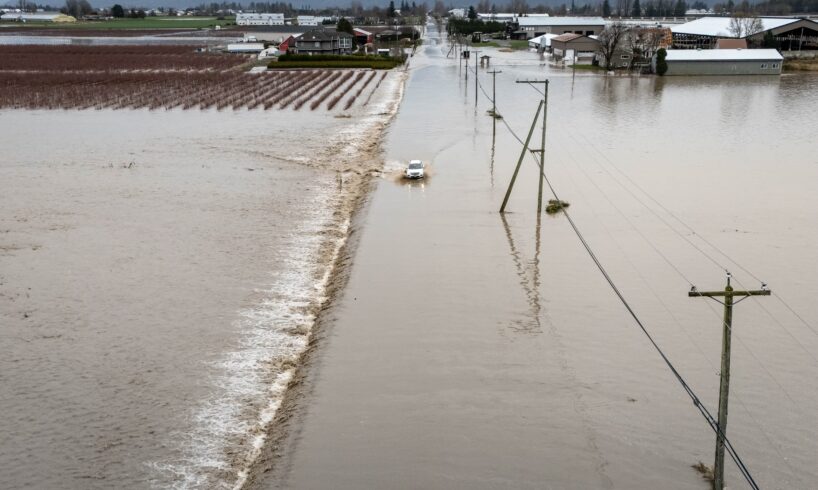
A car crosses a flooded street in Abbotsford B.C., on Dec. 11.ETHAN CAIRNS/The Canadian Press
The mayor of flood-struck Abbotsford, B.C., says he is disappointed and frustrated with the federal government over what he calls “inaction” on cross-border flooding that has repeatedly inundated his city.
Ross Siemens said he had not been contacted by the federal government about this week’s flooding, which has forced hundreds of households to evacuate, inundated poultry barns and forced livestock relocations.
Siemens told a news briefing Friday he was pleading for flood mitigation to be addressed, that authorities across the border in Washington state needed to “wake up,” and for the issue to be part of an international treaty.
Washington State flooding puts cross-border planning under spotlight
Flooding can result in the Fraser Valley when the Nooksack River in Washington overflows its banks, as it did Wednesday, sending water pouring north and potentially inundating the farmlands of the Sumas Prairie.
That happened in 2021, during floods that caused billions in damages north of the border, and again this week, although to a lesser extent.
Siemens said he wanted money for a pump station on the Sumas River to mitigate the outflows.
“That is the primary issue that we need right now – that we need to move the water through quicker,” he said.
He said that failure to address the situation puts residents, food security and the economy at risk.
“To say we are disappointed and frustrated is an understatement,” he said.
“We don’t need empty promises from the federal government that they have our back. In fact, the federal government has not even reached out to me during this event.”
Siemens said that within six months of the 2021 disaster, the city came up with a flood mitigation plan, and it needed to be implemented with federal help.
He said that didn’t happen.
Public Safety Canada said minister Eleanor Olszewski was in close contact with B.C. Emergency Management Minister Kelly Greene, and that the federal government was “actively engaged with provincial officials should they require assistance.”
It said in a statement Olszewski would speak to Siemens Friday about his proposals.
The mechanism for sharing federal disaster-recovery funds had been modernized last year, it added, and included a specific stream that would focus on long-term mitigation.
Siemens also said changes need to be made to the way Nooksack outflows are split at Everson, in Washington state.
Greene told the briefing any mitigation measures had to take into consideration “unintended consequences.”
“Any solutions need to be comprehensive for the region. There’s no one thing that will solve all the problems that we are facing here,” she said, and water diverted from one area could harm another.
Farmers in B.C. flood zone frustrated that politicians failed to learn from last disaster
David Campbell with the B.C. River Forecast Centre said floodwaters that poured across the border from the Nooksack have started to recede.
He said the process of draining the Sumas Prairie would take days, and more rain was on the way for the Fraser Valley.
Environment Canada said in a special weather statement Friday that light rain was expected to intensify overnight. It said up to 40 millimetres is possible, before another system moves in Saturday night, followed by a “potentially significant” push of rain for Monday and beyond.
At 1st Avenue in Abbotsford, within sight of the border crossing, floodwater had been pouring in on Thursday afternoon, but by Friday morning had receded, leaving behind clumps of mud.
Abbotsford resident Dennis Krins said the flooding forced his family to evacuate twice this week – first from his home on 2nd Avenue on Wednesday and then again Thursday night from a hotel on Highway 1.
He said they have since been relocated to a second hotel.
He said he had been surveying the situation Thursday night via home video cameras, but decided to return Friday to take a look in person.
“We just kept monitoring it all night,” he said, calling himself “lucky” – although water had spread to his deck, his house remained dry.
Elsewhere in Abbotsford, just north of Highway 1, Delair Park remained flooded, with water spilling onto Delair Road as police managed traffic, while fields south of the highway looking like lakes.
B.C. Agriculture Minister Lana Popham told Friday’s briefing a couple of poultry barns had been lost and flocks in other barns were being relocated, as was stock on some hog farms.
She said a small number of cattle had also been relocated, but the dairy industry was in “pretty good shape.”
However, she said the emotional toll on farmers was “really tough.”
Popham said 68 farms had been ordered evacuated and 98 put on evacuation alert, while Greene said 450 properties of all kinds across B.C. had been ordered evacuated, and 1,700 put on alert. Most are in Abbotsford.
The extent of infrastructure damage caused by a series of atmospheric river weather events that drenched both sides of the border this week was meanwhile becoming clearer, with the Transport Ministry saying Highway 3 connecting Hope to Alberta had been “severely undermined.”
DriveBC said Friday that Highway 3 was closed for about 130 kilometres between Exit 177 and Mountain Rd, with debris on the roadway and no estimated time of reopening.
An engineering assessment was under way after about 23 sites on the highway suffered damage from rockfalls, debris and culvert undermining.
Highway 1 was shut at Abbotsford and east of Highway 9, with the Sumas border crossing also closed by flooding.
Kyle Beauregard, whose 14-year-old son plays baseball with the Abbotsford Cardinals, was looking over the team’s field covered with more than 60 centimetres of water.
“It looks exactly like four years ago, which is surprising,” he said. The flooding was a blow to the team, who “train all year round, so they need this facility.”
Beauregard said the team had been asking the city for help “so the equipment inside stops getting destroyed.”
“It’s tough. This whole area, they know it’s prone to this, but this is obviously new, the last four years,” he said.