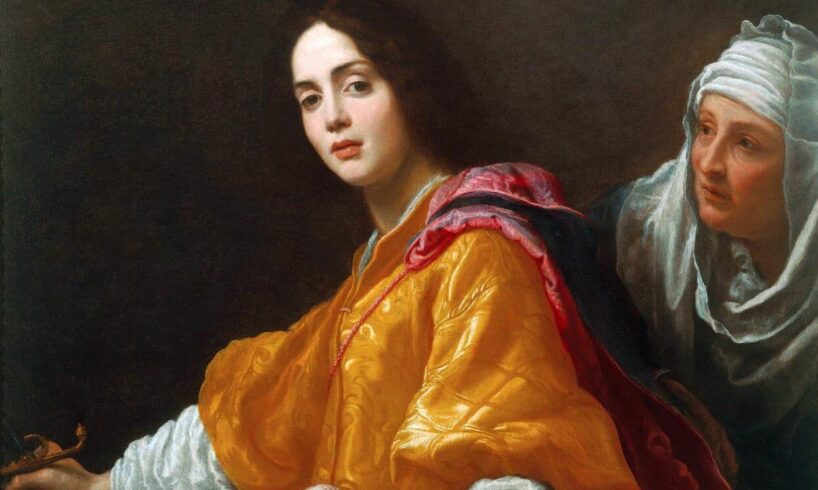
She went into the enemy camp with a wheel of cheese and a jug of wine, and left with a man’s head in a bag.
Her name was Judith, a determined widow who refused to watch her town, Bethulia, fall. Nebuchadnezzar’s army was sweeping through every town along the road to Jerusalem. Bethulia, protecting the main approach to the Holy City, stood in the way. Nebuchadnezzar appointed a Greek general, Holofernes, to lead the invasion.
A town under siege
The enemy encamped around the town like a tightening ring. Standing on their rooftops, the people of Bethulia watched and smelled the campfires burning by the town walls, heard soldiers’ hoarse shouts and bursts of laughter, and watched them exercising their horses and sharpening their weapons. Holofernes’ tent was easy to spot: it was the largest, the one men ran in and out of all day, awaiting orders.
“The Siege of Bethulia” by Jacob van Swanenburg
There had been a parley. Holofernes had come, heavily guarded, to negotiate with the elders of Bethulia. During that meeting, he caught sight of the beautiful Jewish widow, Judith. Intrigued and captivated, he made a shocking proposal: he would spare Bethulia a brutal conquest and promised a peaceful surrender if the elders handed over the woman he desired. When the Jews refused to “trade” Judith for peace, Holofernes decided to starve them out. If he could not have her freely, he would make the entire town pay.
Holofernes ordered his soldiers to block the springs that fed the town’s wells and cut off all food supplies from entering. It was summer, the dry season. There would be no rain to refill empty cisterns. Soon, the Jews’ food stores would run out, then the water. When desperation set in, the people of Bethulia would have no choice but to give in.
For a while, the Jews held on, digging up herbs and wild plants. and killing pigeons for food. But when the water was almost gone, the heads of households begged the elders to capitulate.
Judith’s daring plan
Uzziah, who led the defense of the town, asked the community to hold out for five more days; five more days to pray for a miracle. Everyone went home to pray, wondering how they could survive another day with so little water and food, let alone five. But Judith was thinking of a different kind of miracle. She would kill Holofernes.
She knew how to kill beasts. In those times, women sometimes slaughtered chickens, and Judith had watched the shochet, the ritual slaughterer, cut the throats of goats, sheep, and once, a cow. But she wasn’t a soldier with a sword or armor. Her weapons were different: her beauty, wit, and courage.
“Judith with the Head of Holophernes” by Simon Vouet
Taking her maid with her, she went to the elders, who were sitting with Uzziah. Judith carried a sack holding a wheel of salty goat’s cheese and the last loaves of bread in her house. Her maid carried a clay jug of strong wine. That was all they had and all they needed.
“I know that Holofernes desires me,” Judith said. “Let me leave the town at dark, that I may go to his tent and promise him what he wants. I believe that God will save me, and save all of us.”
The elders were horrified and forbade her. But Uzziah listened. He thought that any desperate gamble might be worth taking, because unless the miracle they were praying for arrived very soon, everyone in Bethulia was going to die of thirst, starvation, or be killed when the city fell.
He took Judith and her maid to the town gate, where guards were keeping watch. With a heavy heart, he ordered the gate opened and allowed the two women to slip out into the night.
“Pray for us,” Judith told him somberly. “And be ready when God delivers Holofernes into our hands.”
The veiled women walked down the rocky path toward the enemy camp. Sentries stopped them, but Judith showed that she carried no weapons, only food and wine. She spoke softly, persuasively, until their suspicion gave way to curiosity.
“I’m a poor widow, and I’m tired of defying Holofernes,” she said. “Take me to him. I will tell him secret ways he can bring men into Bethulia and quickly conquer all. I hope that in return, he’ll be merciful and spare our lives. See, I’ve brought the last of my food and wine to prove my good intentions.”
Intrigued, the soldiers let her pass and led her deeper into the heart of the camp, toward Holofernes’ tent.
“Judith tenant la tête d’Holopherne” by Lorenzo Lippi
The night Judith changed history
Judith stood in the general’s tent and removed her veil. Holofernes was dazzled, seeing up close the woman he had so long desired. Judith entertained him with clever stories and flattery, feeding his ego as carefully as she fed him food. Judith coyly placed cubes of salty cheese in his mouth while the maid poured more and more strong wine in his cup to relieve his thirst.
“Judith Decapitates Holofernes” by Artemisia Gentileschi
It didn’t take long for Holofernes to grow flushed, unsteady, and then completely drunk. His words slurred, his eyes drooped, and eventually he collapsed onto his bed and lay there, snoring. It was deep into the night, and most of the soldiers were asleep or on distant watch. Inside the tent, Judith and her maid exchanged a solemn look.
This was the moment.
Judith stepped toward the bed and drew Holofernes’ sword from its sheath. Calling on all her strength and all the faith she had, she brought the sword down on his neck.
Together, the women lifted the severed, bloody head and placed it into the cheese bag. The maid hid the bag under her robe, arranging her garments so that no curious eye could see the gruesome weight she carried.
Stopped by a sleepy sentry at the camp’s entrance, they explained that Holofernes had so much enjoyed the cheese that he’d commanded them to bring back more.
“We’ll be back tomorrow night,” they said.
The women hurried through the dark fields back to Bethulia’s gate. Uzziah was there, waiting for news. Judith put the bag with Holofernes’ head in his hands and told him what he had to do.
“Go organize your men for a dawn attack,” she said. “The enemy does not know yet that their commander is dead.”
“Judith Returns to Bethulia,” 1860 woodcut by Julius Schnorr von Karolsfeld
And so it happened. As the first light of morning touched the sky, the Jews of Bethulia poured out of their gates and attacked. Holofernes’ men ran to his tent to receive orders, only to find his headless body and an empty wine jug. Terror seized them. Without leadership or direction, the soldiers panicked, broke ranks, and fled. The camp dissolved into chaos, and Bethulia was saved.
What’s in the Book of Judith, anyway?
The story of heroic Judith and how she saved Bethulia is shrouded in mystery. We don’t know who wrote the Book of Judith or exactly when it was written. The original Hebrew or Aramaic text has been lost; what we have today are translations into Greek and Latin. It’s traditionally regarded as one of the sifarim hitzonim — “outside books” that relate to biblical events but were not included in the five books of the Torah.
These sefarim hitzonim include 1 and 2 Maccabim (Maccabees), which relate the story of Hanukkah, another powerful story of Jewish resistance and triumph over oppression.
“Judith Beheading Holofernes” by Caravaggio
The Book of Judith centers on the invasion of Jerusalem under Nabuchadnezzar, which we know from other sources did eventually happen and led to the fall of Solomon’s Temple. Maccabim 1 and 2 tell of the later desecration of the Second Temple by the Syrian-Greeks, its rededication, and the recovery of Jewish sovereignty in Israel.
During the Middle Ages, both stories were especially beloved. Over time, they were wound together in the popular mind and often told side by side, especially on Shabbat Hanukkah, as a paired celebration of courage, faith, and Jewish survival..
Why the story of Judith still matters (and how we should honor it)
But what can we, living centuries later, draw from Judith’s story?
Like the courage of the Maccabees, or Esther and Mordechai, Judith’s act was one of audacious Jewish resistance. Her story reminds us that enemies rise up against the Jewish people in every generation, yet it also points to something deeper: despite two millennia of exile and oppression in other nations’ lands, Jewish presence and sovereignty in Israel were restored, more than once. Judith’s tale is small in scale, just a flicker in the vast sweep of Jewish history, but its ancient light still shines in our collective memory.
For centuries, Jews commemorated heroic Judith and her bag of salty cheese with a dairy meal on the Shabbat of Hanukkah. Cheese dishes, milky desserts, and rich dairy foods were a way of keeping her story at the table. Today, few study the Book of Judith. The custom is almost forgotten.
But it’s an easy tradition to revive. Blintzes, anyone? Or go authentic and serve a big salad dotted with salty feta cheese. I recommend a chilled rosé or light red wine to go with it.
Because there must be wine, of course. Raise a l’chaim to the enduring Jewish spirit, and to the memory of beautiful, brave Judith.