
(function(w,q){w[q]=w[q]||[];w[q].push([“_mgc.load”])})(window,”_mgq”);
Belarus released 123 political prisoners on 13 December, including Nobel Peace Prize laureate Ales Bialiatski and opposition leader Maria Kalesnikava, hours after the United States agreed to lift sanctions on Belarusian potash, according to state news agency Belta. The mass release followed two days of negotiations between Belarusian self-proclaimed President Aliaksandr Lukashenka and John Coale, Donald Trump’s special envoy.
This marks the largest prisoner release since Trump’s administration began engaging Lukashenka earlier this year—a strategy US officials described to Reuters as an effort to weaken Putin’s grip on his closest ally. All were jailed after opposing Lukashenka’s manifestly rigged 2020 election, which sparked the largest protests in Belarusian history; now the dictator is trading them for sanctions relief as he tries to ease Western isolation.
Belarus has faced international condemnation not only for its crackdown on democracy but for allowing Russia to use its territory to launch the 2022 invasion of Ukraine — and continues supporting Moscow’s war effort.
“I drove through all of Belarus blindfolded,” Bialiatski told journalists in Vilnius. He thanked American diplomats for his release but emphasized he did not ask for pardon.
Who walked free
Among the most prominent names: Viktar Babaryka, the former banker arrested in 2020 while preparing to challenge Lukashenka for president, was serving a 14-year sentence on fraud charges he denies, according to the Moscow Times. Lawyer Maksim Znak, who represented opposition figures, had been sentenced to 10 years. Both had been held incommunicado for extended periods.
Bialiatski, 63, founded the Viasna human rights center that documented political persecution in Belarus for decades — until he became a political prisoner himself in July 2021. He shared the 2022 Nobel Peace Prize with Russia’s Memorial and Ukraine’s Center for Civil Liberties while behind bars, then was sentenced to 10 years in 2023 on politically motivated charges.
He’d been imprisoned at a penal colony in Gorki notorious for beatings and hard labor; his wife said his health was deteriorating with multiple chronic illnesses, Reuters reported.
Viasna human rights center founder, Lukashenka’s regime political prisoner, and Nobel laureate Ales Bialiatski gives first comments in Vilnius after being released from prison on 13 December 2025. Screenshot from broadcast
Kalesnikava, 43, spent over a year and a half in complete isolation. According to Belarusian independent outlet Nasha Niva, authorities recently moved her from a penal colony to a pre-trial detention facility to “feed her up” and make her more presentable before release.
The professional flautist became a symbol of resistance when Belarusian authorities tried to deport her in September 2020—she tore up her passport at the border and walked back into Belarus. She had been serving an 11-year sentence for allegedly conspiring to seize power after becoming the face of mass anti-Lukashenka protests in 2020.
Tsapkala, Tsikhanouskaya, and Kalesnikava during a rally in support of Tsikhanouskaya held prior to elections. Photo: tut.by
“She is free! I cannot describe my happiness!” Kalesnikava’s sister Tatsiana Khomich wrote on X after speaking with her by video. Kalesnikava herself was “very happy to be freed” and “thankful to the USA and Trump for their efforts,” Khomich told Reuters.
Ukraine receives 114 civilians
Separately, Ukraine’s Coordination Headquarters for POW Treatment announced it received 114 civilians from Belarus — five of them Ukrainians accused of working for Ukrainian intelligence, plus over 100 Belarusian political prisoners. Ukraine’s military intelligence chief Kyrylo Budanov personally coordinated the operation.
The youngest Ukrainian freed is 25 years old. His wife was returned during a previous exchange. Among the Belarusians transiting through Ukraine were Kalesnikava, Babaryka, and former TUT.by editor-in-chief Maryna Zalatava, who was serving a 12-year sentence. After receiving medical care, the Belarusian citizens will be transported to Poland or Lithuania at their request.
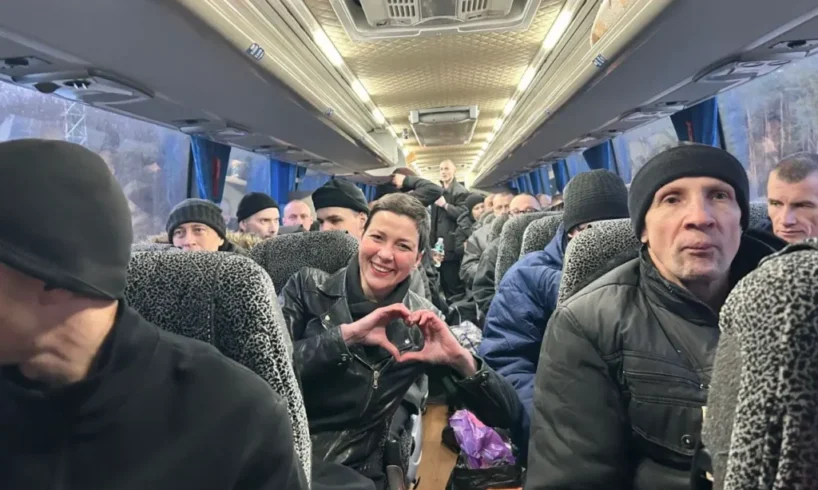
Belarusian opposition figures, civilians, and Ukrainians in Belarusian jails, released after the US agreed to ease sanctions on Lukahshenka’s regime, en route through Ukraine on 13 December 2025. Photo: Ukraine’s Main Intelligence Directorate
Belarusian opposition figures, civilians, and Ukrainians in Belarusian jails, released after the US agreed to ease sanctions on Lukahshenka’s regime, en route through Ukraine on 13 December 2025. Photo: Ukraine’s Main Intelligence Directorate
Belarusian opposition figures, civilians, and Ukrainians in Belarusian jails, released after the US agreed to ease sanctions on Lukahshenka’s regime, en route through Ukraine on 13 December 2025. Photo: Ukraine’s Main Intelligence Directorate
The price: sanctions relief
The deal came at a cost. “Per the instructions of President Trump, we, the United States, will be lifting sanctions on potash,” Coale told reporters in Minsk. Belarus is one of the world’s leading potash producers, and the sanctions had significantly constrained its export revenues.
This follows a pattern: in June, Trump’s envoy Keith Kellogg secured the release of 14 political prisoners including opposition figure Siarhei Tsikhanouski. In September, Washington lifted sanctions on Belarus’s national airline after 52 prisoners were freed.
The Belarusian opposition has viewed Trump’s outreach with deep skepticism.
Syarhey Tsikhanouski and Svyatlana Tsikhanouskaya meet with Belarusians in Warsaw on June 26, days after Tsikhanouski’s release from a prison in Belarus. Photo: RFE/RL
“But let’s not be naive: Lukashenka hasn’t changed his policies, his crackdown continues, and he keeps on supporting Russia’s war against Ukraine,” exiled opposition leader Sviatlana Tsikhanouskaya told the AP. “That’s why we need to be extremely cautious with any talk of sanctions relief, so that we don’t reinforce Russia’s war machine and encourage continued repressions.”
Explore further
Five years in exile, Belarus opposition grinds for European support as Lukashenka woos Trump
Over 1,000 remain imprisoned
Despite the releases, human rights group Viasna counted 1,227 political prisoners as of 12 December — the eve of the releases. Since the disputed 2020 election, 4,288 people have been recognized as political prisoners. Lukashenka’s crackdown following the vote jailed nearly all visible opposition and crushed independent media.
All released prisoners have now left Belarus, according to Franak Viacorka, an adviser to Tsikhanouskaya, cited by CNN. Bialiatski was transported to Lithuania; most Belarusian political prisoners will proceed to Poland or Lithuania after receiving medical care.
Explore further
On Trump’s request, Belarus releases 14 political prisoners charged for opposing government and its support for Russia’s war
(function(w,q){w[q]=w[q]||[];w[q].push([“_mgc.load”])})(window,”_mgq”);