Listen to this article
Estimated 5 minutes
The audio version of this article is generated by AI-based technology. Mispronunciations can occur. We are working with our partners to continually review and improve the results.
Fighting raged Saturday morning along the border of Thailand and Cambodia, even after U.S. President Donald Trump, acting as a mediator, declared that he had won agreement from both countries for a new ceasefire.
Thai officials said they did not agree to a ceasefire. Cambodia has not commented directly on Trump’s claim, but its Defence Ministry said Thai jets carried out airstrikes Saturday morning.
Thai Foreign Minister Sihasak Phuangketkeow said Saturday that some of Trump’s remarks didn’t “reflect an accurate understanding of the situation.”
He said Trump’s characterization of a landmine explosion that wounded Thai soldiers as a “roadside accident” was inaccurate, and did not reflect Thailand’s position that it was a deliberate act of aggression.
Sihasak said that Trump’s willingness to credit what may be “information from sources that deliberately distorted the facts” instead of believing Thailand hurt the feelings of the Thai people “because we consider ourselves — we are proud, in fact — to be the oldest treaty ally of the United States in the region.”
The latest large-scale fighting was set off by a skirmish on Dec. 7 that wounded two Thai soldiers and derailed a ceasefire promoted by Trump that ended five days of earlier combat in July over long-standing territorial disputes.
Evacuees eat lunch as they take refuge in Banteay Menchey provincial town in Cambodia on Saturday after fleeing from home following fighting between Thailand and Cambodia. (Heng Sinith/The Associated Press)
The July ceasefire was brokered by Malaysia and pushed through by pressure from Trump, who threatened to withhold trade privileges unless Thailand and Cambodia agreed. It was formalized in more detail in October at a regional meeting in Malaysia that Trump attended.
Over half a million displaced by fighting
More than two dozen people on both sides of the border have officially been reported killed in this past week’s fighting, while more than half a million have been displaced.
The Thai military acknowledged 15 of its troops died during the fighting and estimated earlier this week that there have been 165 fatalities among Cambodian soldiers. Cambodia has not announced military casualties, but has said at least 11 civilians have been killed and more than six dozen wounded.
Trump, after speaking to Thai Prime Minister Anutin Charnvirakul and Cambodian Prime Minister Hun Manet, announced on Friday an agreement to restart the ceasefire.
“They have agreed to CEASE all shooting effective this evening, and go back to the original Peace Accord made with me, and them, with the help of the Great Prime Minister of Malaysia, Anwar Ibrahim,” Trump wrote in his Truth Social post.
Trump’s claim came after midnight in Bangkok. After his call with Trump, Anutin said he had explained Thailand’s reasons for fighting and said peace would depend on Cambodia ceasing its attacks first.
The Thai Foreign Ministry later explicitly disputed Trump’s claim that a ceasefire had been reached. Anutin’s busy day on Friday included dissolving parliament, so new elections could be held early next year.
Cambodia’s prime minister, in comments posted early Saturday morning, also made no mention of a ceasefire.
Leaders spoke with Trump Friday night
Hun Manet said he held phone conversations on Friday night with Trump, and a night earlier with Malaysia’s prime minister, and thanked both “for their continuous efforts to achieve a long-lasting peace between Cambodia and Thailand.”
“Cambodia is ready to co-operate in any way that is needed,” Hun Manet wrote.
Anwar later posted on social media that he was urging the two sides to implement a ceasefire on Saturday night.
WATCH | Latest violence part of long conflict:
What’s happening between Thailand and Cambodia?
The latest violence between Thailand and Cambodia is part of a long conflict over territory near their shared border. This week’s clashes threaten a fragile ceasefire that was brokered back in October. CBC’s Salimah Shivji explains how we got here.
Cambodia’s prime minister, also posting online, endorsed the initiative, which included having Malaysia and the United States help monitor it. However, Anutin denied that his country was even in negotiations over the proposal.
Thailand has been carrying out airstrikes on what it says are strictly military targets, while Cambodia has been firing thousands of medium-range BM-21 rockets that have caused havoc but relatively few casualties.
BM-21 rocket launchers can fire up to 40 rockets at a time with a range of 30-40 kilometres. These rockets cannot be precisely targeted and have landed largely in areas away from where most people have already been evacuated.
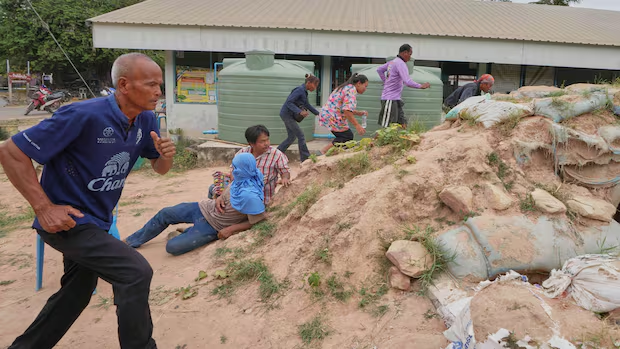
However, the Thai army announced Saturday that BM-21 rockets had hit a civilian area in Sisaket province, seriously injuring two civilians who had heard warning sirens and had been running toward a bunker for safety.
Thailand’s navy was also reported by both sides’ militaries to have joined the fighting on Saturday morning, with a warship in the Gulf of Thailand shelling Cambodia’s southwestern province of Koh Kong. Each side said the other opened fire first.