The latest draft of the U.S. peace plan does not bar Ukraine from joining NATO, foresees no amnesty, media reports say. Ukraine risks receiving the smallest military aid allocations since the invasion, the Kiel Institute warns. Ukraine continues to move toward the EU accession despite the Hungarian veto.
Latest draft of U.S. peace plan does not bar Ukraine from joining NATO, foresees no amnesty, media reports say
The latest draft of the U.S. peace plan for ending Russia’s war in Ukraine contains four documents: a 20-point agreement between Ukraine, Russia, the U.S. and Europe; three-point framework security assurances for Ukraine; four-point U.S. guarantees that NATO will not expand further and a 12-point agreement between the U.S. and Russia, Ukrainian news site Dzerkalo Tyzhnya (Mirror of the Week) said Thursday. Unlike the previous draft peace plan consisting of 28 points, a new set of documents seen by the journalists has no mention of international recognition of a demilitarized zone in Donetsk region as part of Russia and does not bar Ukraine from acceding to NATO.
The new draft preserves the points that do not favor Ukraine, except the one offering amnesty for wartime actions to both sides, Dzerkalo Tyzhnya said.
Territory remains the most problematic issue, the journalists said. The 20-point agreement that is part of the package suggests recognizing Russia’s control of Crimea, Luhansk and Donetsk regions. The status of these territories can only change through diplomacy in the future, not by force.
The peace proposal sets the size of the “neutral demilitarized buffer zone” in Donetsk region at 30 per cent, Dzerkalo Tyzhnya said. Ukrainian and Russian troops will be stationed behind the administrative lines that are yet to be drawn. They will not be allowed to enter the demilitarized zone. It remains unclear who will guarantee that Russia will not cross into the area. The plan suggests freezing the actual line of contact in the regions of Zaporizhzhia and Kherson. Russia has to withdraw from other territories it controls beyond the above five regions.
Ukraine and Russia must commit to not violating the territorial agreements by force. The clauses on the territories are to be signed by the presidents.
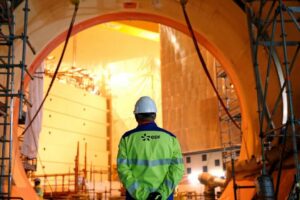
The U.S., not the International Atomic Energy Agency will oversee the relaunch of the Zaporizhzhia nuclear power plant. Fifty per cent of the energy produced by the plant will power Ukraine. The document stays silent on where the other half will go. A previous draft stated it will be given to Russia.
The latest draft does not bar Ukraine from becoming a NATO member and puts forward no demands for amending Ukraine’s Constitution or the bloc’s charter accordingly. But the U.S. states in a separate document that is part of the package that NATO will not expand further and will not invite Ukraine to join the alliance. These statements are repeated in the first point of the bilateral U.S.-Russia deal. Its second point states that the U.S. will “moderate” a dialogue between the leaders of Russia and NATO to remove all concerns. The dialogue aims at “de-escalation” and “guaranteeing global security.” The U.S. will oppose the deployment of “any NATO troops” to Ukraine.
The Ukrainian military will be capped at 800,000 in peacetime, not at 600,000 as a previous draft suggested.
The proposal offers Ukraine security guarantees similar to NATO’s Article 5. They should be provided by the U.S., NATO and European countries. The clauses on the guarantees remain almost unchanged from the previous version, Dzerkalo Tyzhnya said. The U.S says it expects a compensation for providing guarantees without specifying details. The framework security assurances are not legally binding and need not be ratified by the countries’ parliaments.
The plan states that Ukraine will become an EU member by January 1, 2027. The EU’s position on the clause is not known.
The proposal also demands that the country go to the polls. A previous version said the elections should happen in 100 days, the new draft says a vote should be held “as soon as possible” after the deal is signed.
The U.S. seeks to profit from Ukraine’s mineral resources, gas infrastructure, including pipelines and storage sites, and other infrastructure facilities. The U.S. and Europe will create a 200-billion-dollar equity fund to invest in Ukraine’s reconstruction. The U.S. will unfreeze Russian assets and send part of them for Ukraine’s recovery.
A document in the package that lists Ukraine’s commitments will be legally binding. The so-called “peace council” will oversee the implementation of the agreement. It will be chaired by U.S. President Donald Trump. It is unclear who will succeed him after his term in office ends. The document does not mention the measures that should be taken if the agreement is violated, Dzerkalo Tyzhnya concludes.
Ukraine risks receiving smallest military aid allocations since invasion, Kiel Institute warns
New military aid allocations to Ukraine in 2025 might drop to their lowest level since the start of Russia’s full-scale invasion in 2022, the Kiel Institute said Wednesday.
“Europe allocated only about EUR 4.2 billion in new military aid to Ukraine—far too little to offset the halt in US support. At the same time, the disparities within Europe widened,” it said.
“France, Germany, and the United Kingdom increased their allocations substantially but remained below the levels seen in the Nordic countries in relative terms. Italy and Spain contributed very little,” it added.
After a record-high first half of 2025, military aid had already fallen sharply over the summer—a trend that has now continued into September and October. At the current rate, military aid allocations fall short of what would be needed to replace missing US support, the Kiel Institute said. While annual allocations averaged roughly EUR 41.6 billion in 2022–2024 (including Europe, the US, and other donors), only EUR 32.5 billion in aid has been allocated so far this year, according to the Ukraine Support Tracker released on Wednesday. To reach previous levels, an additional EUR 9.1 billion would need to be allocated by year-end, requiring a monthly allocation rate more than twice as high as in recent months.
“Based on the data available through October, Europe has not been able to sustain the momentum of the first half of 2025,” says Professor Christoph Trebesch, head of the Ukraine Support Tracker. “The recent slowdown makes it difficult for Europe to fully offset the absence of US military aid in 2025. If this slower pace continues in the remaining months, 2025 will become the year with the lowest level of new aid allocations ever for Ukraine since the outbreak of the full-scale invasion in 2022.”
Ukraine continues to move toward EU accession despite Hungarian veto
Ukraine and the EU reached an agreement to allow for the country’s technical progress toward accession while formal negotiations remain blocked by Hungary, Taras Kachka, Deputy Prime Minister of Ukraine for European and Euro-Atlantic Integration told reporters after an informal meeting of European Affairs Ministers in Lviv on Thursday.
“I would like to congratulate [our efforts] that we found a way to ensure that the enlargement process continues in the same tempo despite the fact that we lack the formal unanimity [to open the clusters]. But we clearly have 26 member states vocally stating their support for the opening of the clusters. We have success on the frontloading as a technical but legally sound concept to ensure that the European Commission and Ukraine know the view of the member states on the modalities of negotiations over the clusters 1, 2 and 6,” Kachka said.
“We also hear from the Cyprus presidency that they will continue with this project so that by the end of the year all the chapters and clusters will be under consideration of the Council, it means that technically we are ready for opening of all of the six clusters once the political momentum will come,” he added.
Marie Bjerre, Denmark’s Minister for European Affairs, explained the technicalities of the solution.
“It is a disappointment for many of us that we have not been able to formally open cluster 1, but I am very proud that we have now managed with a more technical approach — frontloading. That means that the enlargement process with Ukraine is not at a standstill, it is moving forward. We have confirmed today this new approach and the next presidency, the Cyprus presidency, will be able to continue this approach,” Bjerre said.
“The enlargement procedures require unanimity to open negotiation clusters. (…) We have not been able to lift that blockage, but we have taken another approach. (…) Even though it’s formally still blocked, Ukraine is still able to move on with all the technical work that needs to be done. And then when the blockade is lifted, and I’m quite confident that it will be, then we can very speedily open these negotiation clusters and close them again,” Bjerre said.
EU Enlargement Commissioner Marta Kos said the member states had set a clear direction and provided guidance for the country on “which reform objectives they expect Ukraine to achieve in order to move the process forward.” The rule of law, democratic institutions, internal market and external relations are among the targets. “Reforms are at the center of this process and nobody can veto Ukraine from doing these reforms,” Kos said.