Last year, Hallmark released “Leah’s Perfect Gift,” which centered on Leah, a Jewish woman, celebrating Christmas with her non-Jewish boyfriend’s family for the first time. Throughout the film, she struggles to understand and adapt to their bizarrely rigid Christmas traditions, all while her boyfriend’s mother relentlessly highlights her missteps. Instead of offering a story about two traditions coming together, the movie ended up feeling like Leah was being pressured to abandon her identity and her traditions to fit into this new family.
Jake Epstein and Brooke D’Orsay (Hallmark)
In “Oy to the World,” Hallmark seems to be trying again, this time aiming to showcase interfaith unity through a sort of “Chrismukkah.” The film follows Nikki (Brooke D’Orsay) and Jake (Jake Epstein), former childhood friends turned small-town rivals. Now, as adults, Jake lives in New York City, chasing his dream of being a professional musician, while Nikki is still in their hometown and directs the choir at her father’s Episcopal church. When a pipe bursts in Jake’s family’s synagogue and causes his grandmother to fall, the congregation is temporarily displaced. The Hanukkah festivities are moved to Nikki’s church (which just so happens to be right across the street), forcing the two to put aside their differences and figure out how to share space, traditions, and holiday spirit.
A Chrismukkah in a small town
At first, the film feels like it’s trying too hard to paint a portrait of an authentic Jewish family. Jake’s mother is portrayed as the stereotypical and self-denigrating Jewish mother. When Jake flies home to see his family after bubbe’s fall, she immediately greets him with, “You’re not eating,” fussing over him and hovering in his personal space. Jake’s grandmother, determined to play her part, insists on getting up to make him a kugel despite her recent injury. Later, when Nikki joins them, Jake’s mom and bubbe grab her face, gush over her skin, and ask invasive questions about her dating life, to which Nikki responds, “This has been great. I’m gonna go drink some poison.”
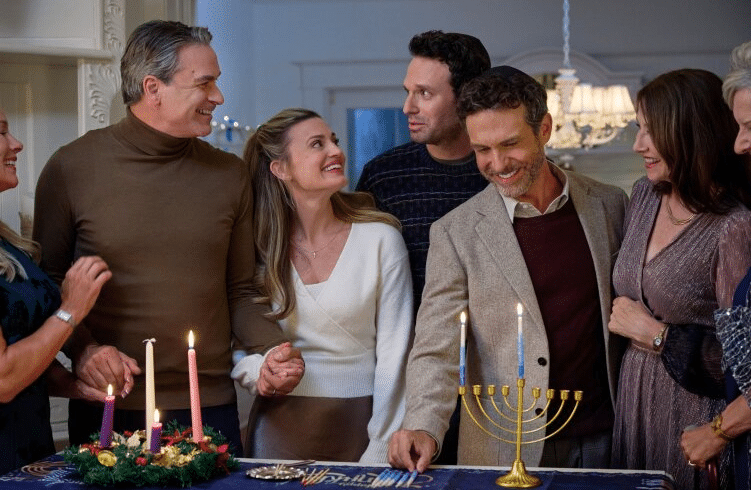
Nonetheless, the bond between both Jake and Nikki’s families is genuinely beautiful to watch. The friendship between Jake’s father, a rabbi, and Nikki’s father, a reverend, showcases powerful allyship and mutual respect. Meanwhile, the dynamic between Jake and Nikki’s mothers would put the in-laws of “Nobody Wants This” to shame for how unabashedly thrilled they are about the idea of their kids getting together. Both families come together outside of formal services to celebrate the first night of Hanukkah and the Christian tradition of lighting the third candle of Advent. A festival of lights for all.
Nikki and Jake’s families come together for the holidays (Hallmark)
For Jake and Nikki, on the other hand, the path to unity is much bumpier. After his grandma’s fall, Jake ends up filling in as director of her synagogue choir. When rehearsals are moved to Nikki’s church in a room across from her chorus, the two slip back into childhood rivalry, competing to see who can be the loudest. Eventually, the rabbi and the reverend force the two to come to a compromise: combine the choirs for an interfaith holiday concert.
At first, Nikki and Jake hate this idea, and their clashing personalities don’t help. Nikki likes to focus more on structure and doing everything perfectly, but struggles to let loose and have fun and enjoy the music. In the process, she ends up alienating one of the kids in her choir (there were only four to begin with, so this is a big blow). She refuses to sing herself, paralyzed by stage fright stemming from a childhood incident where she froze on stage at a talent show.
Jake, on the other hand, is her total opposite. He prioritizes having fun and struggles to concentrate on the responsibilities in front of him, like writing a song for the combined chorus to perform together for the concert. His dream to be a musician has already led him to sacrifice seeing his family during the holidays in favor of gigs and career opportunities.
Brooke D’Orsay in “Oy to the World” (Hallmark)
Nevertheless, the two complement each other and learn to use competition healthily to push one another to grow. At a family bowling night, Jake challenges Nikki to sing publicly, turning it into a bet: if she loses, she has to perform. But when he sees how terrified she is, he intentionally lets her win. It’s a small but meaningful moment that shows him loosening his grip on his competitive streak and revealing how much he genuinely cares about her.
Later, when Jake hits a wall trying to write the song for the combined choir, Nikki takes him out to a bar to brainstorm and soak in some inspiration (this bar also happens to have an open mic, and the two perform a duet, helping Nikki to overcome her fears). Despite their very different approaches to life and music, Nikki and Jake demonstrate how coming together in an interfaith partnership can make them both better. This plot point, about them writing an interfaith holiday song that blends both of their traditions, was really lovely to watch and actually made me wonder why we don’t have more songs that intentionally combine Christmas, Hanukkah, and even Kwanzaa.
Where the film falls short
From a technical standpoint, though, the film struggles with a lack of sustained drama and conflict. Nikki and Jake’s competitive history isn’t truly as serious as they make it out to be, and the film lacks enough evidence to prove their entrenched competitive history. In one scene, the two recount how they went from being good childhood friends to pure enemies in ninth grade, when Nikki claimed that Jake won a debate by bribing the moderator with money he received for Hanukkah, and Jake asked four times for a recount when Nikki won student council. But aside from a flashback in the beginning, where Nikki chokes during the talent show, and Jake brags to his mother that she’s “going down,” we don’t get a sense of a severe, long-standing rivalry that would justify how intensely they clash as adults.
Nikki and Jake’s dads (Hallmark)
Nikki’s character arc ends up being so much more compelling to watch than Jake’s. Her vulnerability is anchored in a clear, specific fear: singing in public. That anxiety shapes her choices, her relationship to music and even how she relates to her choir, giving her a strong emotional throughline. D’orsay brings a lot of warmth, care and nuance to her role.
But for Jake, it doesn’t seem as clear what he is afraid of and what he’s running from, which makes him a slightly less engaging character to follow. As an avid “Degrassi” fan, I was hyped to see Epstein back onscreen in a role where he plays a musician, a shared trait with his character Craig from the teen drama. As Jake, he brings the same sarcasm and charm to more light-hearted material. But admittedly, I found myself getting bored toward the end until Jake and his band are offered a meeting with a manager, and he has to leave the choir the day of the performance. It’s finally a moment of real tension as Jake chooses his career over his family, before coming back to eventually perform with Nikki.
Overall, “Oy to the World” feels like a sincere attempt to make amends for the sins of “Leah’s Perfect Gift,” offering a film where all differences aren’t erased but embraced. It tells a story of inclusivity and love amid a holiday season that can sometimes divide us. It’s a sweet reminder about how coming together can give us an even greater holiday season filled with light, love, and yes, plenty of good food (gingerbread rugelach anyone?).