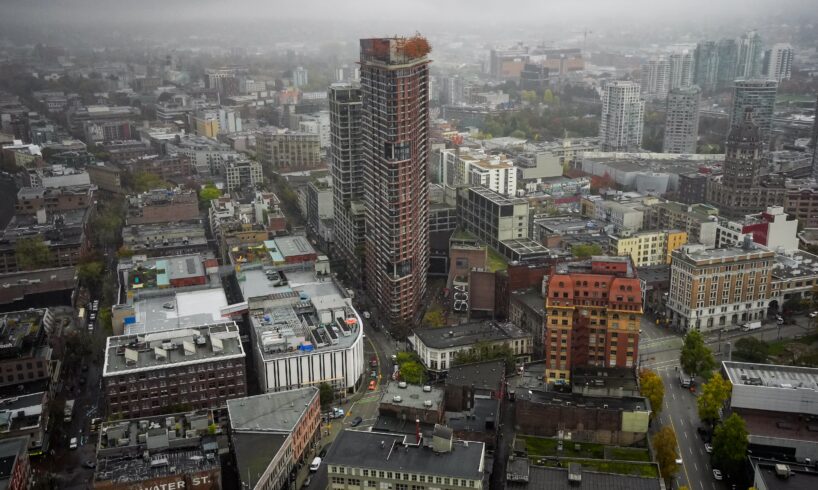
Open this photo in gallery:
Gastown and the Downtown Eastside in Vancouver in October. New changes by the city’s council aim to reduce the cost of building in order to kick-start the construction industry.DARRYL DYCK/The Canadian Press
For 30 years, the development industry in Vancouver was so flush with profit and momentum that government planners seemed to assume that it would be willing to pay for whatever the city asked for.
New parks. Daycares and school sites. Restoration of heritage buildings. More stringent building-code requirements. More energy efficiency. Public art. More room in underground garages for bike parking and car shares.
In the post-Expo ’86 boom, developers ponied up, grumbling occasionally, because they were making loads of money as domestic and offshore investors piled into the market, joining the rush of regular people looking for a home. The price of condos and, later, rents, appeared to be on a permanent uphill trajectory.
“In a rising market, it seemed like the city could get anything it wanted,” said Michael Mortensen, a former Vancouver city planner who went on to work for a large private developer and now has his own consulting firm that is at work on several major projects in the region.
“Now, it’s the big reckoning.”
The party noticeably ended this week.
In Vancouver, planners say it takes a village to grow a city
Amid a crash in the condo market, halted projects, tariffs and escalating construction costs, Vancouver City Council approved a package of changes aimed at offering developers some relief, especially for multiunit projects.
Among them: new, higher rent ceilings for apartments that were supposed to be at below-market rates; a temporary 20-per-cent reduction in development fees; a break on contributions for public art; the elimination of a requirement to provide community benefits by sourcing 10 per cent of materials and labour locally; and a temporary halt to requirements for alternatives to car parking.
Those, and more, are aimed at reducing the cost of building in order to kick-start a construction industry that has been almost paralyzed the past two years by expenditures that outpace what they can get for selling or renting homes.
Several cities across Canada have also lowered development fees and made other changes to the way they handle proposed projects.
But Vancouver’s rollback is a marked change in a city that once embraced its ability to get developers to pay for a raft of city amenities.
Even during the global financial crisis of 2008, Vancouver barely adjusted its policies as its continuing bull real estate market experienced only a relatively small dip in construction activity.
Developer fees could add more than $100,000 to price of new homes, CMHC finds
“For a long period of time, we lived through a very buoyant market. But what we’re seeing is a widening gap between costs to construct and sale and rent prices,” said Vancouver chief planner Josh White as he went through the proposed changes this week with council.
“Costs need to commensurately go down. Now, we need to instill a kind of discipline. I believe we’d be the first to undertake a program like this.”
He told councillors that the reduction in development fees will likely not cost the city any extra money, since it’s losing revenue regularly from projects that had been approved but aren’t proceeding because developers say it doesn’t currently make any financial sense to go ahead.
The changes that prompted the most concern from public speakers this week were to the community benefit program (CBA), which only applies to mega projects, and to bike and car-share requirements.
Several speakers involved with social-mission-focused organizations in the Downtown Eastside pleaded with council not to proceed on a one-year suspension of the CBA requirement, as staff had recommended.
“The impact of the CBA program is real and life-changing,” said Marcia Noziak, with EMBERS, an organization dedicated to finding employees for corporate “social-impact” programs.
Vancouver rental builders, facing slowing demand, say government support needed
“The CBA turned construction sites into engines of economic mobility. There are people who simply needed a chance.”
She noted that work on the new St. Paul’s Hospital alone has produced 121,000 hours of work and $2.52-million in wages for about 350 workers so far.
But to the surprise of many, the ABC council, following on a motion by its councillor Brian Montague, voted to end the requirement permanently and make it completely voluntary.
Mr. White’s report did not address the much more difficult city issue of community-amenity contributions.
Those contributions, a technique that Vancouver pioneered in the late 1980s, gives builders increased density in exchange for community benefits. They have accounted for hundreds of millions of dollars extracted from developers over the past three decades in what were called “voluntary” offers through negotiations.
Open this photo in gallery:
A crane is seen above a wood-frame condo project under construction in Vancouver in July.DARRYL DYCK/The Canadian Press
Those negotiations have been getting increasingly difficult as developers have argued that they are not making windfall profits from getting extra density, since the high cost of construction means that extra floors don’t necessarily add extra revenue to a project the way they used to.
Developers uniformly welcomed Vancouver’s new approach.
But former city planner Larry Beasley said he is concerned that Vancouver council, along with the province, are forgetting that big, new, urban density only works if it provides a good experience both inside and outside the building for new residents. Mr. Beasley once presided over some of the most intensive real estate development in the city’s history.
“I don’t think the new generation understands the philosophy we had before – facilitate development but make sure we have the quality and amenities,” he said. “The whole new drive has been just to facilitate development and nothing more.”
The Editorial Board: How cities are holding back home-building
Other cities in the region and elsewhere in Canada have been trimming some fees and requirements in order to get developers building again.
Burnaby has reduced its requirement for below-market rental apartments in large developments from 20 per cent to 10 per cent of the total, and down to zero in the Edmonds area, said Mr. Mortensen.
Ontario cities such as Vaughan and Mississauga have dramatically reduced development fees, as an increasing amount of attention has been focused on the big increases that development fees have seen in recent years, according to a report from the law firm Miller Thomson.
Mississauga reduced its fees by 50 per cent earlier for projects started by November, 2026, which was calculated to reduce the construction cost for a single-family home by $28,000.
In Vaughan, a new policy in November, 2024, saw development charges reduced by 88 to 92 per cent, resulting in savings of up to $44,000 per home.