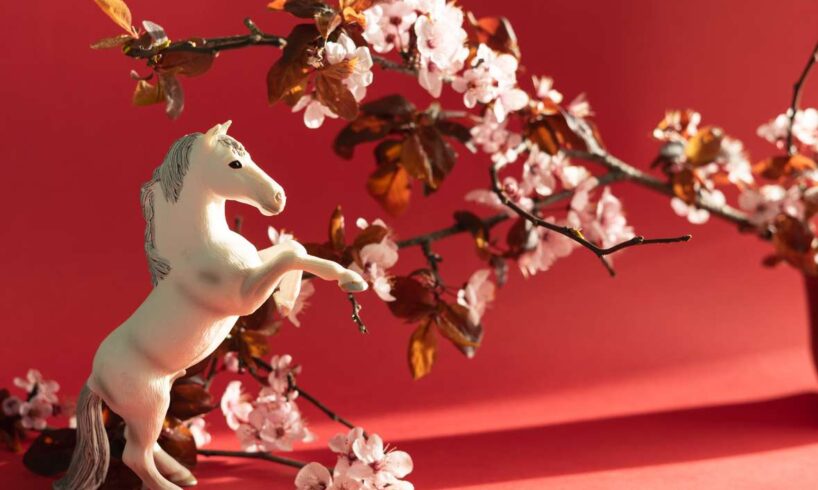
White horse with plum flowers around it, celebration of the Chinese New Year 2026
Chinese New Year in 2026 falls on: Tuesday, February 17, 2026
Year of the Horse
It isn’t certain exactly when or how the Chinese New Year began, though there are records of it, or similar festivities, being held thousands of years ago. Many myths and legends are related to the origins of the festivities, but the most prominent one centers on the mythical beast Nian.
On the eve of a New Year, the mythical beast would enter villages, destroying homes, eating livestock and sometimes even people. To stay on Nian’s good side, many would leave food out for him, until one year an old man discovered that Nian was scared of loud noises and the color red.
To keep Nian at bay, people wore red clothes, hung red scrolls and lanterns, and lit crackling bamboo (later fireworks) while beating drums to scare him away. From that point on Nian never returned.
Global Chinese New Year Traditions
Today, the Chinese New Year, or Lunar New Year, is also celebrated around the globe, including many countries in South East Asia as well as Australia, New Zealand, the U.S. and the UK. Sydney, London, and San Francisco all claim to hold the largest Chinese New Year celebrations outside of Asia.
As it is based on the traditional Chinese lunisolar calendar, which follows the phases of the moon, each year lands on the second new moon after the winter solstice on December 21.
The celebrations could land anywhere between January 21 and February 20. For 2026, Chinese New Year lands on Tuesday, February 17. The festivities across Tokyo will likely be held weeklong, so there is plenty of opportunity to get involved.
Japan’s Adaptation of the Chinese New Year
Much like how Japanese kanji originated from China, many cultural beliefs, religious practices, myths, and celebrations have made their way to, and have been adapted by Japan.
Chinese New Year is, to some extent, one of these. Before the Meiji Restoration, Japan used a version of the lunisolar calendar. But in 1873 it shifted to align itself with the Western Gregorian calendar.
You might also be interested in reading our guide to Timekeeping in Edo Period Japan.
Consequently, many of the nation’s traditions surrounding the Lunar New Year have died out, moving instead to January 1. Although it is one of the few East Asian countries that no longer hosts a national holiday for the Lunar New Year, the celebration lives on. It is especially so in the country’s many Chinatown districts.
The largest and most famous of these is located in Yokohama. Other areas include Kobe and Nagasaki’s chukagai as well as Ikebukuro’s growing Chinese district. You will find many festivities taking place this February across these areas.
Read our guide to Osaka’s Underground Chinatown here.
In previous years, there have been parades, illuminations, dancing dragons and lions, acrobats, and musical performances to ring in spring and the beginning of a New Year.
Spending Time with Loved Ones
For many who celebrate the Lunar New Year in Japan, this occasion is also marked by simply spending time with loved ones. Victor Jiacheng Leong, a Chinese Singaporean living in Tokyo, explains his experience. “In my sharehouse, we mark the new year by coming together and chatting over a comforting hotpot meal.”
His sharehouse contains nationals of Malaysia, Indonesia, Singapore and South Korea. They all join together and share the holiday, even with those who don’t usually celebrate it themselves.
Leong adds, “Visiting Chinatown for the festivities sounds delightful. The vibrant decorations and the chance to savor delicious food without the hassle of cooking would be wonderful. However, if anyone prefers to avoid crowds, celebrating at home amongst cherished company is equally appealing. Ultimately, it’s the company that truly makes the celebration special.”
The Chinese Zodiac Animal for 2026: The Year of the Horse
It’s true that the New Year is a time to celebrate with friends and family. But it is also a time to welcome the new zodiac animal.
The Chinese Zodiac is still a part of Japan’s New Year celebrations to this day. Despite changing to the Gregorian calendar, Japan celebrates the changing of the zodiac on January 1. It welcomes any of the 12 animals. Rat, ox, tiger, rabbit, dragon, snake, horse, goat, monkey, rooster, dog and pig.
In Japan, many shrines feature one, if not all, of the members of the zodiac. Many people go to pray at a shrine best suited to the zodiac for that year.
In 2026, the approaching Lunar New Year ushers in the Year of the Horse. It is especially fitting to visit shrines associated with horses and safe travel. One of the most symbolic options is Taga Taisha in Shiga. Here is known for its sacred horse statue and long-standing associations with protection, longevity, and good fortune for journeys.
You can also visit shrines with ema (wooden horse plaques) or dedicated horse guardians, such as Kifune Shrine in Kyoto, which historically offered horse blessings to ensure safe passage and favorable conditions.
So let’s don our finest red apparel, set off fireworks, watch dragons and lions dance, and welcome the Year of the Horse here in Japan!
Originally published February 2023, updated November 2025.