In 1954, an issue of Manhua, a state-sponsored satirical magazine in China, declared: “Some architects blindly worship the formalist styles of western bourgeois design. As a result, grotesque and reactionary buildings have appeared.”
Beneath the headline Ugly Architecture, humorous cartoons of weird buildings fill the page. There is a modernist cylinder with a neoclassical portico bolted on to the front. Another blobby building is framed by an arc of ice-cream cone-shaped columns. An experimental bus stop features a bench beneath an impractical cuboid canopy, “unable to protect you from wind, rain or sun”, as a passerby observes. “Why don’t these buildings adopt the Chinese national style?” asks another bewildered figure, as he cowers beneath a looming glass tower that bears all the hallmarks of the corrupt, capitalist west.
It was an unprecedented national campaign, rolled out at unparalleled speed
It is one of the many entertaining archival documents that feature in How Modern, a fascinating new exhibition at the Canadian Centre for Architecture (CCA) in Montreal, which explores the development of modern architecture in the first decades of communist China. The years after the foundation of the People’s Republic in 1949, to the period of reform and opening-up in the 1980s, are often seen as a time of drab monotony. In the cliched eyes of western historians, these decades in China are easily dismissed as a period when state-produced buildings, designed by national architecture institutes, were as homogeneous as the Mao jackets worn by the sprawling nation of suppressed automatons.
An interior of the Great Hall of the People, during the National People’s Congress, 2025. Photograph: Tingshu Wang/Reuters
This exhibition paints a very different picture. Curated by Shirley Surya from M+ museum in Hong Kong, with Li Hua, professor of architectural history at Southeast University in Nanjing, it draws on official archives as well as materials in private collections in Hong Kong, some of which were smuggled out of the country decades ago and have never been shown before. Together, they depict a surprisingly fertile period of invention, technological innovation and stylistic debate, at a time when architecture was being deployed in an instrument of socialist nation-building – shaping cities, rural life, industry and collective identity.
The story they tell also helps to explain the direction China is moving in today, under president Xi Jinping, as he doubles down on his ban on “weird buildings” imported from the west, and amplifies his pleas for distinctly “Chinese architectural styles” in new developments.
It opens with point zero, in the form of Beijing’s Tiananmen Square, a place that, under Xi’s reign, has become the most fortified and surveilled public space on the planet. It is surrounded by fences on all sides, with airport-style security checkpoints and access only by booking. Alongside his greatly expanded square, Mao launched a campaign for Ten Great Buildings, a series of gargantuan civic structures that would define the new aesthetic, “socialist in content, national in form”.
Adventurous times … the former Sino-Soviet Friendship Building in Shanghai, which features in the show. Photograph: © Wang Tuo
From the colossal Great Hall of the People (shown in stunning poster-sized photos of the interior), to the Beijing railway station, Cultural Palace of Nationalities and Workers’ Stadium (depicted in striking blues and pinks on a commemorative mirror), these buildings experimented with a new hybrid style, fusing beaux-arts classicism with Soviet monumentality and modern functionalism, often crowned with traditional Chinese overhanging tiled roofs.
It was an unprecedented national campaign, rolled out at unparalleled speed. More than 1,000 architects and engineers across China were invited to take part in a month-long design workshop, while factories and construction workers were urged to build with “high quality, high artistic level, and high speed”, seeing the Ten Great Buildings completed in less than a year. By 1959, an exhibition of photographs at the RIBA in London marvelled at how a mind-boggling 350 million sq m of buildings had been completed in China in only a decade.
Not all of the architects involved were happy with the design direction, mandated from on high. “My father wanted the freedom to try out different things,” recalls Yung Ho Chang, speaking in one of the illuminating oral histories in the exhibition, which are shown alongside mediative films of key projects by video artist Wang Tuo. Chang’s father, Zhang Kaiji, was one of the chief architects at the state-led Beijing Institute of Architectural Design, author of numerous leading projects of the period. “But he was given the big roof as a standard design model. He didn’t like that.”
Kaiji’s project for the Sanlihe government office in Beijing, begun in 1952, reveals his struggle to adopt the official “big roof” style. It also shows how quickly the party’s design diktats would change, as the mandated ideology flipped back and forth in an Orwellian system of doublethink. Most of the blocks in the Sanlihe office courtyard complex are topped with traditional Chinese hip-and-gable roofs with sweeping eaves. But the largest central block, completed last, stands bare, stripped of its elaborate crown.
The reason? Partway through construction, after a speech by then Soviet leader Nikita Khrushchev, criticising the wastefulness of elaborate Stalinist architecture before him, China’s ministry of architectural engineering suddenly denounced the regressive cultural revivalism of the big roof style. The People’s Daily published a searing editorial, criticising the national architecture magazine, Jianzhu Xuebao, for “promoting erroneous architectural ideologies” and attacking the “severe wastefulness and formalist tendencies” of the national style.
The Sanlihe government office in Beijing, China, begun in 1952. Photograph: (awaiting credit)
By 1955, the year Sanlihe was completed, the new slogan for architects was: “Function, economy, and (when possible) beauty” – extraneous decoration be damned. The central, pared-back block at Sanlihe would for ever be known as the “big roof that lost its hat”.
By the 1960s, as Mao’s rule entered its most ruthless phase, it wasn’t just traditional styles that had become objects of suspicion; architects themselves were in the line of fire. In 1964, on the eve of the Cultural Revolution – which saw intellectuals sent to the countryside for brutal “re-education” – Mao launched the Design Revolution movement. An early attempt at mass proletarian participatory design, it saw technicians, manual workers and even farmers mobilised to collaborate in design and construction, with architects and their “bookism” sidelined.
The aim was to achieve “greater, faster, better, and more economical” construction by reducing investment, improving technology, and simplifying work procedures. But, just as Michael Gove found with his suspicion of “experts”, the exclusion of proficient professionals had exactly the opposite effect. The bleak reality of the period – a time of mass starvation, forced labour and state-endorsed violence – is barely mentioned in the exhibition, betraying the climate of self-censorship now prevalent in Hong Kong, and the sensitivities of working with a Chinese partner institution.
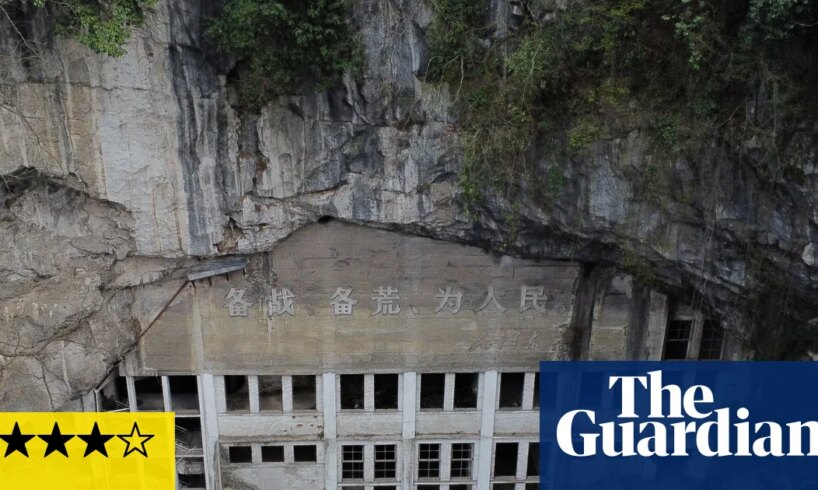
The somewhat propagandising tone notwithstanding, there are countless intriguing design stories to be discovered. One room showcases the infrastructural projects of the Third Front, a secretive government campaign to develop industrial and military facilities in the country’s interior in the 1960s and 70s. The Second Automobile Works in Hubei was dispersed across 27 different sites, each stealthily concealed in its own valley, like something from Tracy Island. Factory 544, which produced artillery fuses, was hidden inside a thrilling cave complex in Hunan, worthy of comrade Bruce Wayne.
A woodcut image of Third Front infrastructure. Photograph: (awaiting credit)
Beautiful traditional woodcut prints, produced in the late 1970s when the programme was finally made public, depict karst mountain formations, with heroic viaducts, pylons and tunnels slicing through them. “With self-reliance and hard work,” exhorted the slogan on the side of one aqueduct, “rearrange mountains and rivers” – a terraforming philosophy that continues to this day.
Other sections focus on standardised housing programmes and modular furniture production, while one room shows how widespread shortages of cement, steel and lumber spurred on experiments with industrial byproducts and local materials, from rammed earth to construction waste. Soot, slag, and fly ash were used to produce building blocks and wall panels for prefabricated housing and factories, while bamboo was widely employed as a substitute for steel for long-span structures, including the astonishing bamboo hall at East China Normal University.
As Hong Kong regulators misguidedly phase out the use of bamboo scaffolding, a move accelerated by a tragic recent fire (which saw flames spread by plastic netting more than bamboo), the authorities would do well to look back at this period – a time when scarcity of resources led to a period of lean, low-carbon innovation, by necessity.
How Modern: Biographies of Architecture in China 1949–1979 is at the Canadian Centre for Architecture, Montreal, until 5 April.