…Economists slam N’Assembly for poor oversight
The federal government’s 2026 budget outlook has exposed rare and widening divisions within the National Assembly, as lawmakers disagreed sharply over the revenue assumptions underpinning the 2026–2028 Medium Term Expenditure Framework (MTEF).
Experts warn that the proposed N54.46 trillion spending plan, which relies heavily on borrowing projected to exceed 30 percent of the 2026 budget, underscores persistent fiscal imbalances and weak legislative oversight of federal loans.
Economists warn that the proposed N54.46 trillion spending and financing plan may deepen the country’s debt trap, with borrowing projected to account for more than 30 percent of next year’s budget and legislative oversight of federal loans coming under renewed scrutiny.
Economists say the framework approved by the Senate reflects worsening fiscal conditions, driven by lower oil revenue expectations and entrenched deficits.
Under the MTEF/Fiscal Strategy Paper (FSP) passed on Tuesday, the oil price benchmarks were revised downward to $60 per barrel in 2026, $65 in 2027 and $70 in 2028, with crude production estimates ranging between 1.84 million barrels per day (bpd) and 1.92 million bpd.
Inflation is projected to moderate from 16.5 percent in 2026 to nine percent by 2028, while real gross domestic product (GDP) growth is forecast to rise to 7.9 percent, largely on the back of anticipated tax reforms.
The 2026 budget framework proposes total expenditure of N54.46 trillion against retained revenue of N34.33 trillion, leaving a deficit of more than N20 trillion. Planned new borrowing of N17.89 trillion, alongside debt servicing costs of about N15.9 trillion, highlights Nigeria’s growing dependence on debt financing.
Read also: Reps suspend consideration of budget planning documents as Lawmakers disagree over revenue assumptions
Heavy reliance on borrowing
Paul Alaje, chief economist at SPM Professionals, said the framework sends clear signals of shrinking oil revenue and heavier reliance on borrowing.
“The expected crude sales is 1.8 million barrels as against two million barrels that was expected for the current year,” he said, noting that the oil price assumption has also dropped sharply. “When you reduce both price and production assumptions, then your total revenue is expected to reduce.”
Alaje said the resulting gap would inevitably be filled through higher taxes or fresh debts. While government projections suggest optimism around tax reforms, he argued that Nigeria’s fiscal history points in a different direction.
“Perhaps, the government is expecting revenue to come from taxes next year, but if that is not the case, then the government may be borrowing to finance the rest,” he said.
He noted that the MTEF already shows borrowing accounting for more than 30 percent of financing for the 2026 budget, warning that the figure could be higher in practice.
According to him, successive budgets have consistently failed to meet revenue targets, making deficit financing through debt a recurring pattern.
“Over the years, we’ve never been able to meet our budgetary expectations. It’s a ritual,” he said, describing Nigeria’s fiscal pattern as one of repeated revenue shortfalls and rising debt.
Beyond borrowing, Alaje warned that capital expenditure could fall to its lowest level in recent years, further undermining growth prospects.
He argued that indications from the framework suggest capital spending could remain below 25 percent of total expenditure, limiting the economy’s capacity to generate future revenue.
The result, he said, is a self-reinforcing cycle in which debt grows faster than the economy, forcing either higher taxes or continued borrowing to stay afloat. “That means that we’ll constantly be sinking into debt. It simply means that the debt will be revolving,” he said.
While acknowledging the government’s hopes around new tax laws, Alaje urged caution, saying it would be premature to assume improved revenue performance.
“I will wait for the implementation to start,” he said, arguing that the first quarter (Q1) of 2026 would be critical in determining whether expectations are realistic or not.
Sherifeddeen Tella, a development economist, took a more critical view, questioning the logic of repeated borrowing when past budgets remain poorly implemented.
“They will run deficits and then be asking for loans,” he said. “Whereas last year’s budget was not even implemented, they were asking for loan upon loan.”
Tella said Nigeria is already paying heavily for loans borrowed years ago, with debt service crowding out development spending. “Money that would have gone for development is now used to service loans,” he said, warning that the burden is being shifted to future generations.
He argued that the country’s fiscal problem is rooted less in revenue shortages than in governance failures and leakages. “Our problem is not that we don’t have money. It’s a lot of leakage, a lot of corruption,” he said, stressing that repeated borrowing has produced little visible impact. According to him, Nigerians rarely see clear evidence of what loans are used for, even as the government continues to owe domestic contractors.
Tella was particularly critical of legislative oversight, saying the National Assembly has failed to interrogate loan requests adequately. “It’s unfortunate that the National Assembly members are passing loan requests without giving caution to the government that they should stop them,” he said, arguing that lawmakers should demand accountability for previously approved borrowings before granting new ones.
Senate, Reps split
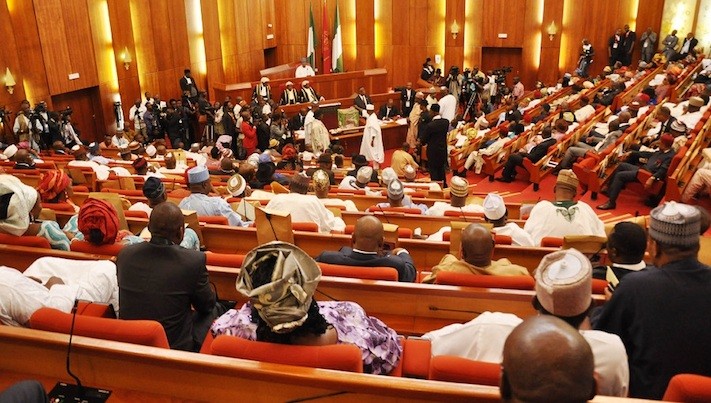
Divisions were also evident within the National Assembly itself.
In contrast to the Senate’s approval of the framework, the House of Representatives, on Wednesday, suspended consideration of the MTEF/FSP after lawmakers clashed over proposed changes to crude oil price assumptions and their implications for revenue and borrowing.
The disagreement emerged during plenary following the presentation of the report by the joint committees on finance and on national planning and economic development.
The committees recommended lowering the 2026 oil benchmark to $60 per barrel, a move that triggered concerns among lawmakers over the potential revenue impact. While the executive had projected benchmark prices of $64.85, $64.30 and $65.50 per barrel for 2026, 2027 and 2028 respectively, the committee recommended lowering the 2026 benchmark to $60 per barrel, while setting prices at $65 for 2027 and $70 for 2028.
The committee said the recommendation reflected heightened geopolitical tensions in Europe and the Middle East and continued volatility in global oil markets.
Tajudeen Abbas, speaker of the House of Reps, warned that lowering the benchmark would have far-reaching implications for revenue projections, borrowing needs and the overall size of the budget. He questioned how the government intends to cover the potential revenue shortfall.
James Faleke, chairman of the joint committees, defended the proposal, arguing that the MTEF and FSP are planning documents that still require legislative approval before the executive prepares the annual budget. He urged lawmakers to approve the framework to avoid disrupting the budget cycle.
Benjamin Kalu, deputy speaker, aligned with the speaker’s concerns, noting that while conservative oil benchmarks may be fiscally prudent, they would widen the revenue gap unless clear funding strategies are outlined.
Following a prolonged and inconclusive debate, the House stepped down consideration of the report and directed the committees to review the figures and return with a revised submission.