The woods surrounding the Highwood Pass, a mountain valley southwest of Calgary, are quiet. The traffic snarls of fall, which brought day trippers flocking to see lark trees pop yellow against the green hills, are gone. The road through the pass is closed until the spring.
Gone too is a temporary camp and barrier across a logging road, set up to protest in advance of clear-cut operations in this popular corner of Kananaskis Country along the rocky spine of southwestern Alberta. At least for now.
A valley in Kananaskis Country in southwestern Alberta, on the eastern edge of the Rockies, is threatened by West Fraser Timber’s plans to log the area. Activists are concerned the permitted logging will change the hydrology of the Highwood River, which runs alongside Highway 40 and provides habitat for threatened bull trout.
At first blush, it’s odd for protesters opposed to logging to leave the area before the logging starts, but that wasn’t really the point of the camp set up by a group called Defenders of the Eastern Slopes.
“Yes, we want to protect these valleys from the logging and protect the fish from the logging, but one of our goals is also to start the process of creating a culture of civil disobedience,” one of the organizers, Michael Sawyer, says.
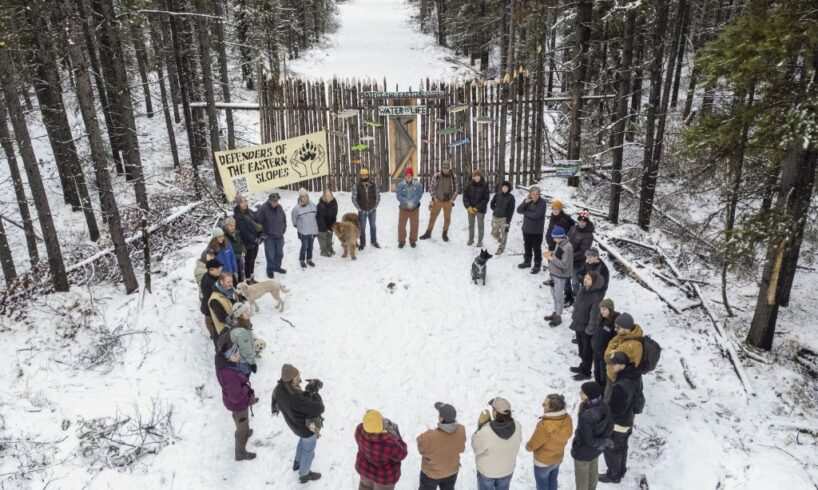
Defenders of the Eastern Slopes operated a camp in Kananaskis Country through the fall, and while the camp has since been shut down, protesters continue to oppose logging in the area.
It’s not something generally associated with Alberta and it’s not something Sawyer has always focused on. He’s spent decades fighting through more official/polite/formal channels: in courts, through letters, within environmental organizations and without. But in this time and place, he thinks a more direct approach is needed.
Michael Sawyer, one of the Kananaskis organizers, says a more direct approach is needed to protesting environmental destruction in Alberta. He has fought for years through more official channels, but believes part of his work now is ”creating a culture of civil disobedience.”
“Yes, we want to protect these valleys from the logging and protect the fish from the logging, but one of our goals is also to start the process of creating a culture of civil disobedience.”
The forest in Kananaskis Country is a diverse ecosystem populated by many different plants and animals. It’s also a popular destination for wilderness lovers drawn to the Rockies and their majestic beauty.
“I would argue that, given the politics in this province, and I would even say nationally, we need more and more citizens who are prepared to stand up against undemocratic and illegal activities by the government.”
So while the camp is gone and the woods are still, the group behind regular gatherings on the outskirts of the cutblock are ready to put their bodies on the line at the first sign of activity.
“We’re keeping an eye on things,” Colin Smith, another member of Defenders of the Eastern Slopes, says. “We’ve got eyes and ears out there.”
The area in question and why it matters
The area in question is surrounded by protected land in the multi-use area known as Kananaskis Country — a mishmash of parkland, recreational spaces and industrial activity along the eastern slopes of the Rocky Mountains.
It’s an area popular with residents of nearby Calgary, but has been set aside for logging since before Kananaskis was established. It’s also the headwaters for all of the creeks and rivers throughout southern Alberta and into the wider Prairies.
Kananaskis Country is a protected area that includes parkland, recreational spaces and industrial activity. The area in question has been earmarked for logging since before the area was even created.
In 2024, an earlier clear-cut plan covering 1,100 hectares, an area the size of over 2,000 football fields, was shelved after pushback and the sale of Spray Lake Sawmills to B.C.-based West Fraser Timber. Now, it’s been revived.
New permits have been issued by Fisheries and Oceans Canada for the construction of logging bridges across rivers and creeks in the valley. Those permits allow disruptions to habitat for endangered native trout species in the valley — a fact that frustrates the group.
In an emailed statement, West Fraser Timber said it understands “how important it is to protect bull trout and westslope cutthroat trout habitat in the Highwood” and that as part of its planning, the company will be “monitoring conditions before and after harvest to help inform responsible stewardship.”
The company said it paused Spray Lake’s earlier plans to “hear from people who live, work or recreate near our operations,” and added operations won’t start until its planning processes are complete. It did not say whether or not those operations would start this winter.
Logging bridges across the rivers and creeks of the Highwood Pass valley would threaten sensitive habitat for bull trout, a species native to the area.
But it’s not just logging the group is concerned about. The eastern slopes face multiple threats, from clear-cutting to the potential for new coal mines south of Kananaskis, all of which could impact the water that flows from these headwaters across the Prairies.
Denuded hills don’t hold on to water, which exacerbates the risk of flooding during rainfall and leaves the area more parched during droughts. Pollution from reopened mines would rush off the hills and into irrigation channels and drinking water.
The group of organizers is also concerned about the possibility of new coal mines opening south of Kananaskis, which, like the impacts from logging, could disrupt the water reserves in the area. The eastern slopes of the Rocky Mountains are the headwaters for all of the creeks and rivers that run through southern Alberta and provide important water reservoirs in times of drought.
Sawyer, who lives in nearby Nanton, says his tap water comes from these hills.
“We’re treating our foothills headwaters like they don’t matter from a water point of view, but they’re absolutely critical, and the government is just not paying attention to it,” Sawyer says.
Michael Sawyer, who lives in Nanton. Alta., is concerned about the impact logging and mining could have on the area.
West Fraser Timber said it will establish buffers of at least 30-metres around watercourses.
The office of the Minister of Forestry and Parks did not respond to an interview request prior to publication.
Shining a light in dark corners
The Narwhal’s reporters dig deep to uncover facts that politicians might prefer to keep hidden. We need to raise $200,000 this December to keep our investigative journalism going in 2026.
Will you join the 760 readers and counting who’ve already stepped up to give? Every dollar you donate will be matched!
Let’s make double the difference
The eastern slopes: ‘vital’ to ecosystems, water and more
The Rocky Mountain headwaters have been the subject of increasing concern to Albertans. The United Conservative government is working to reopen coal mining to the south of the pass, at the same time that reservoirs and rivers across the province have seen consecutive years of depletion due to droughts.
Mike Judd, another member of the Defenders of the Eastern Slopes, says the government and industry hold too much power, which allows them to enforce a narrative focused squarely on resource extraction.
Mike Judd, one of the camp organizers, helped set up the logging blockade at Kananaskis this fall. He believes the Alberta government sees the vital resources of the Rockies’ eastern slopes as a ”warehouse of treasures that keep the Alberta economy rolling.“
“They have the propaganda machinery to keep a constant conservative message out there, which is the eastern slopes are a warehouse of treasures that keep the Alberta economy rolling,” he says. In his mind, that’s a narrow definition of wealth.
“There’s not a thing in their message that’s about the eastern slopes being the vital water source for Alberta, about it being the vital place for so many different species of birds, fish and animals, and for being the vital place for so many people to have a recreational outlet.”
Finn Rosenegger, 15, one of the blockaders, climbs a wooden gate activists built along the logging road.
It’s another reason Judd and Sawyer believe civil disobedience is a necessary tool — to draw attention to their fight and, as Judd puts it, “rattle the chains” a little.
Starting in October, the defenders hosted weekend events nearby, to introduce people to the issues and the idea of civil disobedience. The community made art that could be hung on the barrier across the logging road.
Supporters came together in the fall to make art for the barrier along the logging road and to share resources and dialogue around civil disobedience.
Without any current logging or bridge building to oppose, there was no standoff or risk of arrest — yet.
“It’s just giving people who have been interested in doing something like this a place to show up and meet other people,” Smith says.
“This hopefully can be a catalyst to future actions.”
Supporters gather in a tent at the logging camp. Organizers hope the movement can provide an opportunity for community members to connect with each other.
Colin Smith helped organize weekend workshops to introduce people to the cause. ”This hopefully can be a catalyst to future actions,” he said.
Group hopes to ‘bridge political polarization’ over shared concern for headwaters
The Defenders of the Eastern Slopes isn’t solely focused on the Highwood Pass. The group might plan blockades in other areas of the vast stretch of woods and mountains that skirt the border of B.C. and Alberta, according to Smith.
“Water and land protection and stewardship can bridge political polarization — especially water,” Colin Smith says. “Most people can agree that we need clean water.”
He’s been contacted by the RCMP, who sent out a liaison officer and he’s heard the company doesn’t plan to start operations this winter, but there’s no confirmation as yet.
The RCMP did not response to a request for comment by publication time.
Smith says the threats to the region are a unifying force. He said that, while at the camp this fall, he had conversations with hunters and a coal worker that involved both disagreement, and finding common ground.
A view of Kananaskis Country near Longview, Alta., in November.
“Water and land protection and stewardship can bridge political polarization — especially water,” he says. “Most people can agree that we need clean water.”
— With files from Amber Bracken
Banner:
A group of activists who call themselves Defenders of the Eastern Slopes set up camp in Kananaskis Country, Alta., this fall. They were there to protest logging on the eastern slopes of the Rockies — and to encourage a culture of civil disobedience in the province.