Editor’s note: This is a developing story and is being updated.
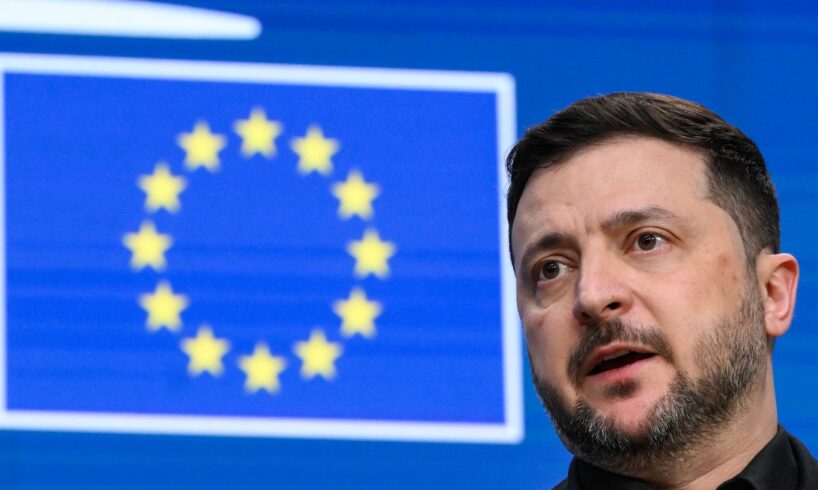
President Volodymyr Zelensky held talks with European leaders during an EU summit in Brussels on Dec. 18, where a major funding package for Kyiv is at the top of the agenda.
During the two-day summit on Dec. 18–19, EU leaders are expected to decide whether to proceed with a “reparations loan,” a plan to lend up to 210 billion euros ($250 billion) backed by frozen Russian assets to Ukraine. Without additional financing, Kyiv will likely run out of cash by spring next year.
Belgian Prime Minister Bart de Wever has expressed opposition to the plan, citing legal and financial risks. Belgium is home to Euroclear, the financial institution that holds most of the frozen assets.
Ahead of the event, De Wever said he was open to “compromises” but emphasized he cannot accept steps that would jeopardize Belgium’s financial security.
Zelensky said that he and De Wever had a “good” conversation on the sidelines of the summit, noting that the Belgian leader understands the necessity for supporting Ukraine.
Speaking at the press conference in Brussels, the Ukrainian president warned that without the next tranche of EU funding by spring, Ukraine’s ability to produce drones and conduct long-range strikes on Russian energy infrastructure would be significantly constrained.
He called upon EU leaders to adopt a decision by the end of this year and stressed that the status of the reparations loan should not be part of the peace talks, so that Moscow cannot use it to pressure Kyiv.
“We don’t want this instrument to end up in Russian hands. And we believe they’ll do all they can to block it,” the president said.
Earlier, Zelensky said that without the reparations loan, “Ukraine will face serious problems.”
If Ukraine does not receive the funds, Russian President Vladimir Putin will be emboldened to continue the war and “will not seek diplomacy or dialogue at all,” Zelensky said in comments for journalists en route to Brussels.
As the summit progressed, Polish Prime Minister Donald Tusk announced a “breakthrough” at the EU summit, saying that a “declaration that we all want to use Russian assets for Ukraine was made.”
The Polish leader added that “technical discussions” are still needed because “the countries which are the most at risk of Russian financial reprisals in the future, mainly Belgium, but not only, are looking for safeguards.”
Seeking to unlock funds for Ukraine, European leaders have sought to sway Belgium’s position, proposing additional guarantees while emphasizing the ramifications of failing to reach a consensus.
German Chancellor Friedrich Merz said on Dec. 15 that, if the reparations loan fails, “the European Union’s ability to act will be severely damaged for years, if not for much longer.“
“Now we have a simple choice: either money today, or blood tomorrow,” Tusk said ahead of the summit. “I’m not talking about Ukraine only, I’m talking about Europe.”
EU leaders have been discussing two options for long-term financing for Kyiv: the reparations loan and budget borrowing. Kaja Kallas, the bloc’s top diplomat, estimated the chances of a consensus on the reparations loan as “50/50.”
“We will never leave this Council without a final solution,” European Council President Antonio Costa vowed.
Joining the push, a bipartisan group of U.S. lawmakers appealed to Belgium to seek an agreement with the European Commission to unlock the funds.
“Leveraging these assets could enable Ukraine to purchase critical defensive systems, including through the Prioritized Ukraine Requirements List (PURL) initiative, and help Ukraine manage a looming fiscal shortfall,” read a letter addressed to Belgium’s ambassador in the U.S., Frederic Bernard, and dated Dec. 16.
“Providing additional financial support is of paramount importance for the sake of Ukraine, for a Europe that is whole and free, and one day at peace — and for the defense of democracy everywhere,” said the paper obtained by the Kyiv Independent.
Other EU members, including Italy, Malta, and Bulgaria, joined Belgium in voicing reservations about the reparations loan and called for alternative solutions.
Hungarian Prime Minister Viktor Orban, broadly seen as the most Kremlin-friendly EU leader, has staunchly opposed the plan, calling using Russian assets to fund Ukraine a “declaration of war.”
In turn, Andrej Babis, Czechia’s new prime minister, said he does not oppose using Russian assets to fund Ukraine but ruled out providing guarantees that would burden the national budget.
Russia has warned Europe of repercussions if the plan for the reparations loan proceeds. While the country’s central bank filed a $229 billion lawsuit against Euroclear, the Kremlin is reportedly exploring the seizure of remaining Western assets in Russia.
Ukraine warns of ‘catastrophe for every single European’ if Russian frozen asset plan fails