Key Points
The U.S. intelligence chief publicly accused the outgoing Obama White House of directing a “manufactured” Russia assessment meant to damage Trump before he took office.
She described a late-2016 sequence that, in her telling, turned a disputed theory into an official verdict: a pulled presidential brief, a rushed new assessment, and contested sourcing presented as “high confidence.”
The briefing also targeted legacy media, singling out the New York Times and the Washington Post and pointing to Pulitzer-winning coverage that officials said helped cement the narrative.
The Referee Steps Onto The Field
The Director of National Intelligence sits above America’s intelligence agencies and is meant to coordinate their work into one coherent picture for the president. In plain terms: the DNI is supposed to be the referee of the secret world, not another player on the pitch.
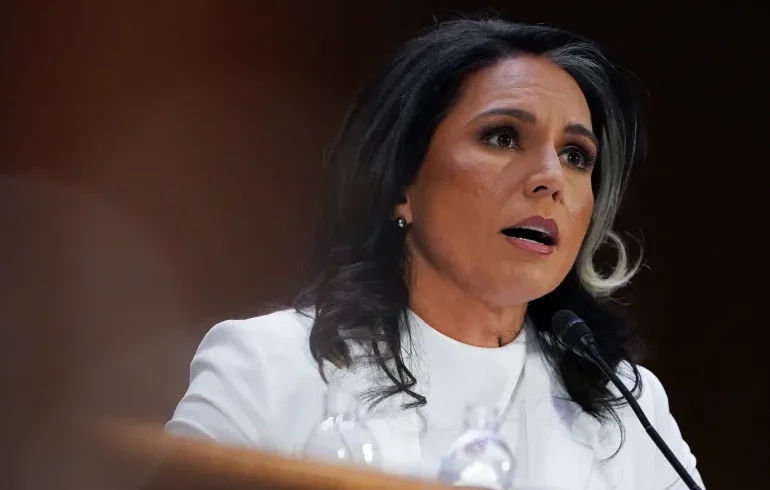
That is why this press conference hit like a rupture. The DNI, Tulsi Gabbard, stood at the podium and described the end of Barack Obama’s presidency as an operation to trap the incoming president inside suspicion.
She framed the declassification as a correction after nearly a decade of fallout: public distrust, political paralysis, and reputations shredded. The press secretary, backing her, described it as one of the biggest scandals in modern U.S. politics.
America’s Spy Chief Gabbard Says Obama Led A Plot Against Trump’s 2016 Win. (Photo Internet reproduction)
The Pivot That Turned Chaos Into “Help Trump”
Gabbard drew a clear line between two ideas. She said Russia sought to sow discord in the United States.
But she said the January 6, 2017 Intelligence Community Assessment went further by asserting Vladimir Putin “aspired to help” Trump’s election chances. She told reporters the declassified material shows no direct report in which Putin states that objective.
She also described intelligence that, in her telling, pointed in the opposite direction: Russia preparing for a Hillary Clinton victory and holding back damaging material to use after the election, to weaken what Moscow viewed as an inevitable Clinton presidency.
That, she suggested, made the pro-Trump “aspired to help” judgment not just questionable, but constructed.
The Paper Trail And The Human Cost
Gabbard then walked through a timeline designed to show how the narrative became official. She described a December 5, 2016 post-election briefing to the House Intelligence Committee in which the FBI and ODNI did not mention Putin trying to elect Trump.
She described a Presidential Daily Brief drafted on December 8 stating no Russian or criminal actors impacted vote counts, and said it was pulled hours before publication due to “new guidance.”
She pointed to a December 9 National Security Council meeting and, afterward, an email titled “POTUS tasking on Russia election meddling,” directing ODNI leaders to create a new assessment ordered by Obama.
She portrayed that assessment as unusually narrow and unusually driven: five analysts, one principal drafter, and heavy senior direction.
She described veteran objections, including a quoted line that the CIA did not have direct information Putin wanted Trump elected. Yet the final product still carried that judgment, she said, with the CIA and FBI at high confidence and the NSA at moderate confidence.
She also described the Steele dossier as being referenced and placed in an annex despite public denials at the time.
From there, she described the consequences as both political and personal: Trump’s allies, including his son Donald Trump Jr., were smeared as Russian assets, and the new administration spent years governing under a cloud that consumed oxygen, time, and legitimacy.
The Megaphone And The Legacy Fight
The briefing did not stop at government. Officials singled out the New York Times and the Washington Post as key amplifiers and said Pulitzer Prizes tied to the coverage should be reconsidered.
Obama’s office, as cited in the room, responded that Russia tried to influence the election but did not manipulate vote counts. Gabbard’s answer was that the scandal is not ballots.
It is whether an outgoing president used the authority of U.S. intelligence to set a trap for the next one—and whether “high confidence” was analysis, or power protecting itself.
This is the video