2025-12-20T08:45:51+00:00
font
Enable Reading Mode
A-
A
A+
Shafaq News – Baghdad
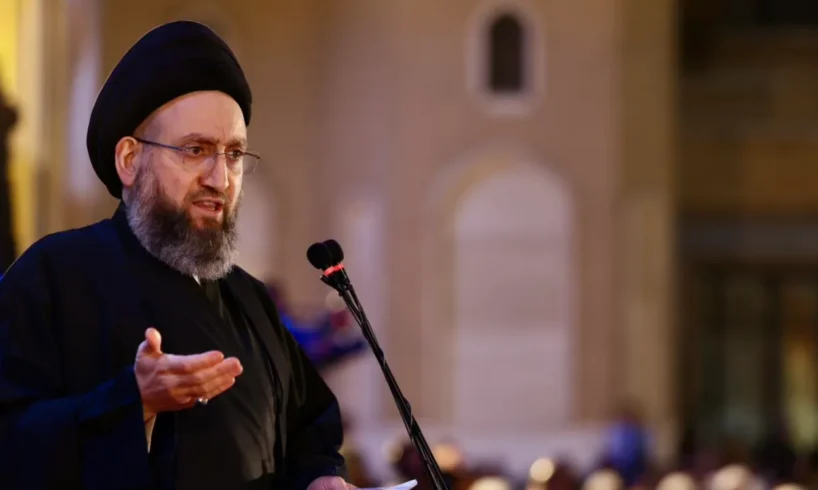
The head of the Al-Hikma Movement (Wisdom), Ammar al-Hakim, said Iraq
needs a strong, unified government and a balanced foreign policy that protects
national decision-making during a speech delivered at the official ceremony
marking Iraqi Martyr Day on Sunday.
Foreign Policy and Regional Positioning
Addressing regional and international developments, al-Hakim said Iraq
must pursue a “balanced, independent, and clearly defined” foreign policy.
“Iraq should not be an arena for conflict or a platform for settling scores,”
he said, calling for relations to be managed based on mutual respect and shared
interests.
He linked sovereignty to decision-making rather than isolation, saying,
“Sovereignty does not mean disengagement or rupture; it means owning the
decision and building balanced relations based on parity, not dependency.” He
added that “multiple centers of decision-making do not create strength but
drain the state from within,” a reference to the need for unified authority in
managing Iraq’s external relations.
Government Formation and Accountability
On domestic governance, al-Hakim highlighted the formation of a “strong
and aware” government as a national priority, calling for an administration in
which all political forces share responsibility. “The people are waiting for a
government that can translate the electoral mandate into real stability,
tangible services, job opportunities, and a productive economy,” he said.
He stressed that the strength of governments is not measured by slogans,
but by their “ability to deliver, institutional harmony, respect for the
constitution, and commitment to a clear, accountable program.”
Read more: Iraq begins 90-day countdown to form government
Roadmap for Reform and Development
Al-Hakim outlined a phased government program, beginning with a 100-day
period focused on urgent public needs, including electricity, water supply,
employment, service delivery, and anti-corruption measures. He said this would
be followed by a “year of reform” aimed at administrative and governance
improvements, and then a four-year phase focused on sustainable development
through job creation, investment attraction, infrastructure improvement, and
economic diversification.
Economy as the Primary National Priority
Describing the economy as Iraq’s central challenge, al-Hakim said future
domestic and foreign policies should be shaped by economic priorities. “The
next priority is an economic one,” he said, pointing out that it should guide
legislative activity, executive decisions, and Iraq’s regional and
international engagements.
He called on parliament and state institutions to pursue a “legislative
and legal transformation” to support federal and local governments in
implementing economic reforms, emphasizing coordination across executive,
legislative, and judicial authorities.
Dialogue and Political Responsibility
Al-Hakim reiterated his call for what he described as a “table of
courageous dialogue,” urging political actors to prioritize responsibility over
competition for positions. “Not to divide positions, but to share the burden of
the homeland,” he said, calling for difficult decisions to protect state
institutions and national cohesion.
National Unity and Political Stability
Al-Hakim emphasized internal cohesion as a foundation for state
stability, warning that political paralysis poses greater risks than
disagreement itself. “Political differences are not only legitimate, but they
are necessary,” he said, adding that “turning them into sharp divisions or
institutional paralysis weakens the state, erodes public trust, and opens the
door to external pressures.”
Referring to Iraq’s post-2003 political system, which is based on
power-sharing among diverse political, ethnic, and sectarian actors, he said
unity should be safeguarded through dialogue rather than exclusion, stressing
that “diversity should be a source of strength, not fragmentation.”