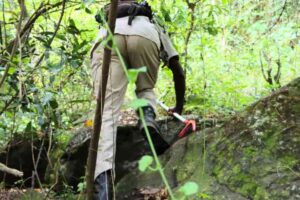
Nairobi — Farmers can now know and benefit from their contribution to climate change thanks to a formula that can be used to calculate the amount of carbon stored in fruit trees.
In a project dubbed Fruit Trees for Climate Change Mitigation and Adaptation in East Africa, the Jomo Kenyatta University of Agriculture and Technology (JKUAT), in collaboration with ICRAF developed a mathematical formula that can enable farmers to calculate and determine the amount of carbon that is stored by their fruit trees.
The formula involves using allometric equations, whereby a farmer inputs the tree’s diameter to get its biomass, which is then used to determine the amount of carbon in the tree. This project is intended to encourage farmers to plant more fruit trees to promote climate change mitigation.
The formula primarily targets avocado and mango trees, which are the most common type of fruit trees grown by farmers practicing agroforestry in Kenya.
Keep up with the latest headlines on WhatsApp | LinkedIn
Traditionally, trees have had to be cut down to determine the amount of carbon in them. Now a farmer can assess the amount of carbon stored in a tree by simply taking measurements and doing a small calculation instead of cutting it down.
With this knowledge, farmers are therefore able to stay informed about their contribution to climate change while maintaining their livelihood–it will also help them properly negotiate for carbon credits in the rapidly growing carbon trade market.
Farmlands Necessary for Climate Change Control
According to Shem Kuyah, the researcher behind the formula, carbon sequestration is primarily done by forests, but increased human population led to human activities that continuously cause the destruction and dwindling of forests. As a result, there was an urgent need for other alternatives for carbon absorption, and farmlands were considered as a conservation alternative through agroforestry.
Kuyah is a lecturer at JKUAT, in the department of agroforestry.
“One of the main goals of the project is to train and make farmers aware of the importance of planting trees for climate control,” said Kuyah.
Previously, the contribution to carbon sequestration and climate change mitigation was primarily associated with forests.
“However, with the increase in human population, forest reserves began to dwindle, despite the need for more trees to fight climate change. Farmlands were, therefore, considered to provide space for planting more trees through agroforestry,” Kuyah told IPS.
Farmers depend on their land and crops for income, so the project had to promote agroforestry by considering the most economically beneficial trees.
“We found out that the farmers preferred planting fruit trees and that mangoes and avocados were the most common tree species,” he said.
Benefiting from Carbon Trade Means Planting More Fruit Trees
Given the importance of fruit trees to a farmer’s livelihood, this project not only gave them a reason to grow fruit trees for climate change control, but it also provided them an additional financial incentive–tapping into the carbon credit trade.
Carbon credits are tradable certificates where one carbon credit represents one metric ton of CO₂ (or equivalent greenhouse gas) reduced or removed from the atmosphere.
They allow high-polluting companies and governments to offset their greenhouse gas emissions by funding projects that reduce or remove pollution, such as reforestation or renewable energy initiatives. Beyond their climate impacts, these projects often deliver additional co-benefits, like empowering communities, protecting biodiversity, or improving public health.
“We have two formulas that are used to determine the amount of carbon in trees. The general formula, which can be applied to any type of tree, and the species-specific formula, developed to meet the needs of farmers, determine the carbon amount in fruit trees. The latter is more accurate in carbon quantification, as it only allows for marginal error (about 5 percent) as compared to the general formula (up to 40 percent error), Kuyah explained.
Since farmers can determine the carbon quantity without cutting down their trees, the formula encourages them to plant more fruit trees, which benefits their livelihood through the carbon credit trade and contributes to climate change mitigation.
COP30 Agreements
Plants being a primary source of livelihood for farmers makes this project an important asset in climate change mitigation, especially now, a time when nations seem to differ on climate control measures.
Ten years have passed since the 2015 Paris Agreement, which aimed to limit global temperature rise to 1.5 degrees Celsius, with 2 degrees as the absolute maximum, achieve net zero carbon emissions by mid-century, and provide economic support to countries vulnerable to climate change. However, funding this effort has remained a challenge.
Many countries have missed their targets, and carbon emissions will be at a record high in 2024, according to the World Meteorological Society. World leaders are yet to reach an amicable agreement on the way forward in terms of measures and have put considerable emphasis on finding ways to finance mitigation.
At COP30, the full operationalization of the Paris Agreement Crediting Mechanism (PACM) that governs carbon markets was announced, and the Coalition to Grow Carbon Markets, launched in September by co-chairs from Singapore, the UK, and Kenya, received endorsements from 11 countries and support from others.
The coalition’s stated aims are to harmonize, integrate, and standardize them to mobilize increased funding for more rapid climate action and provide a consistent set of principles and safeguards required by business.
How Will the Fruit Tree Farmers Benefit
Kuya’s project not only addresses climate change measures but also fosters public participation and education by training farmers.
Since Kenya joined the carbon credit trade in 2023, a number of farmers and landowners have complained about being swindled or not being properly compensated for their contribution to carbon reduction.
In a recent documentary, Carbon Contract, by a local media outlet in Kenya, locals from northeastern Kenya complained of only receiving 20 percent of the total carbon sale from their lands in an agreement that was to see a carbon offset project use their land for up to 30 years. The residents complained that there was a lack of transparency in the project.
Sign up for free AllAfrica Newsletters
Get the latest in African news delivered straight to your inbox
Success!
Almost finished…
We need to confirm your email address.
To complete the process, please follow the instructions in the email we just sent you.
Error!
There was a problem processing your submission. Please try again later.
However, the Fruit Trees for Climate Change Mitigation project aims to train farmer Savings and Credit Cooperative Organizations (SACCOS) and extension officers on how to use the formula to calculate the amount of carbon in their trees, giving them an advantage when negotiating for carbon credits. The training also involves understanding what carbon trade is and how it works.
“Our formula can help farmers negotiate carbon credits from a point of awareness. Using a simple tape measure and calculator, farmers can determine the carbon value of their trees, so when programs related to carbon credit trading approach them, they will know exactly how much they should receive,” said Kuyah.
“We also tried to make our formula as simple to understand to the farmers as possible by only having them get the diameter of the tree and use it to calculate the amount of carbon on a calculator.”
“We’re developing an app/interface that will automatically generate the carbon amount after the farmer inputs the tree species and diameter. Currently, we have provided them with an Excel platform that does the calculations,” Kuyah said.
The farmer training program conducted by JKUAT and ICRAF may, therefore, be one of the many climate change solutions that were sought at the COP30 climate summit.
IPS UN Bureau Report
Follow @IPSNewsUNBureau