Historic Environment Scotland is exploring a controversial ‘hands off’ approach for some of the 300-plus properties in its care which fail to meet certain criteria for future upkeep.
Those deemed not to have scored highly enough on issues such as historic significance, economic and revenue potential, biodiversity and environment are at risk of being side-lined in favour of others considered to have better prospects.
It raises the potential of heritage ‘winners and losers’ with some much-loved historic properties branded too challenging to continuously repair being left to drift into decline, while money goes to improving others which might attract more visitors or with potential for alternative uses.
That could see certain high profile and more ‘valued’ properties undergoing profound changes to equip them for the future – from extra investment in Edinburgh Castle to improve the visitor experience, to constructing roofs over ruins such as Linlithgow Palace, or building walkways around Borders abbeys where decay has made public entry too risky.
The idea of constructing a roof over Linlithgow Palace was last suggested in 2013 after the 600-year-old ruin was fitted with a temporary glass roof for fashion brand Chanel’s Metiers d’Art collection by then creative director Karl Lagerfeld.
Linlithgow Palace – could a new roof protect it for future generations? (Image: PA)
It led to lively debate over whether such a move would cause further damage to the original structure, loss of cultural significance and the risk of fitting new additions in modern materials at odds with 16th century design.
While are no plans for any works of those sorts at the moment, a radical rethink of how Scotland’s historic properties are managed is likely to spark upset particularly in rural communities where historic properties naturally have lower footfall and less potential to earn revenue.
They also come in the wake of the Church of Scotland’s painful reconstruction of its property portfolio that saw treasured church buildings shut and, in some cases, sold.
According to HES Director of Cultural Assets Dr David Mitchell, the organisation’s structure means selling buildings is not on the cards.
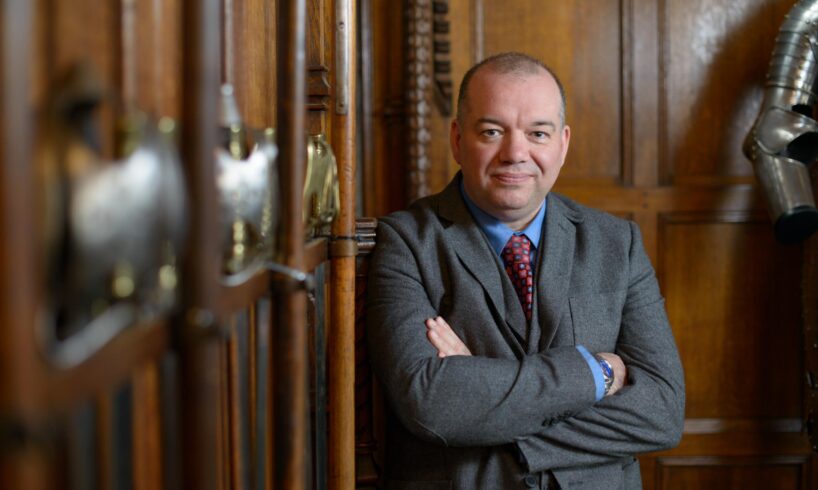
David Mitchell, Director of Cultural Assets at Historic Environment Scotland (Image: Santiago Arribas Pena)
However, he warns bold choices are needed to balance the triple hit of rapid climate change, the dearth of the traditional skills needed to cope with mounting repairs and soaring financial costs.
The Herald recently revealed that the government agency, currently in the grip of a stream of controversies over its management, is facing a repair and retrofitting bill of around £842 million for its historic properties.
“The days of us thinking very carefully about every single stone we have to replace has to change,” he says.
“We cannot do everything.
“So, we are going to focus on those places most culturally significant or those that can deliver the most benefit to a broader range and be quite transparent about that.”
Dozens of HES buildings were recently closed for months at time for repairs and assessments (Image: Doug McCullough)
He says it means parting company with traditional approaches of preserving historic properties and instead moving towards embracing natural decay and change.
“The historic approach was based on premise that you could preserve something in aspic. That stemmed from a museum approach where you put things in boxes and labelled them up.
“But it ignores the fact that everything decays.
“We live in a dynamic environment and it’s becoming more dynamic, so we need to respond to that in the way that we manage our assets.”
Read more:
The HES proposals are contained in its Properties and Collections Strategy, open for public consultation until the end of next month.
The process is being viewed with interest by heritage bodies across the United Kingdom, with the possibility that they may also adopt similar ‘hands off’ approaches.
A key issue, according to Dr Mitchell, has been the speed at which climate change has taken hold, confirmed by a major high level inspection of buildings which saw dozens shrouded in scaffolding and closed for up to two years.
“It’s shifting from ‘climate change is something that will happen down the line’, to being something that’s happening now,” he adds.
He says the task of caring for buildings in a climate emergency is made more challenging by some of the well-intentioned repairs and conservation work carried out generations ago using unsuitable materials.
That is the case at the likes of Tantallon Castle, where decades old work to cover up the walls to prevent water ingress have added to the problems, he says.
The 14th century fortress was closed for almost two years for remedial works, with some areas still sectioned off.
However, a major issue is the lack of heritage skills to carry out repairs and inspections.
And although the establishment of a new Scottish heritage skills centre of excellence at Lock 16 in Falkirk, being developed by HES with Scottish Canals, is underway, the gap is said to be huge.
Although Scotland is constructed mostly of stone, it has just 300 trained stonemasons, of which just 80 are employed by HES.
Dr Mitchell says that means difficult choices over whether to call ‘time’ on some sites and focus energy and finance on boosting the potential of others.
He points to Cadzow Castle near Hamilton, built in the 1530s and where Mary, Queen of Scots once took refuge after her escape from Loch Leven.
“The site has been surrounded by security fence for a long time because it is really unsafe,” he says.
“Bits could be preserved as a traditional ancient monument, but it’s so unsafe: it’s on the edge of a gorge.
“Do you spend money at a site like Cadzow?
“Or do we look at somewhere like Doune Castle, where we know visitor footfall has gone through the roof and we need to protect archaeology?”
Outlander has boosted visitors to Doune Castle in Stirlingshire (Image: James Minchin)
The Stirlingshire castle, which has seen visitor numbers soar on the back of the Outlander series, has been used by the agency as a model for its assessment framework.
“You look through the framework and assess the environment potential, historic significance, the economic potential, revenue potential, community asset potential, and it gives a graphic picture of that site,” he continues.
Read more:
“We know in terms of nature and biodiversity Doune is one of the best sites we have. We also know that there’s a redundant building that used to be a watermill.
“It’s a roofless ruin and the community are interested in doing something with it. We know vehicle access is difficult and that visitor numbers have gone up significantly, starting with Monty Python up to Game of Thrones.
“That enables us to say what the plan for that site is for the next 20 to 30 years.”
It’s led to new village parking intended to drive visitors towards local businesses, a new bridge for better access and focus on developing the ruined mill, one of around 100 properties in the HES portfolio which has no roof.
“We’re going to have to make some decisions on putting roofs back on structures because the reality is that a building without a roof is not functioning as it was designed to do,” he adds.
Costs mean only a few significant properties might be considered but, he adds: “The investment required to sustain Linlithgow Palace in the way that has been done for the past 60 or 70 years is beyond us now.
“We can either pretend that’s okay, or we can make a major investment and then cut down on ongoing maintenance costs which then means potentially the site doesn’t suffer from site closures because we have less issues with falling masonry.”
Linlithgow Palace was found to have the highest number of defects during the agency’s recent High Level Assessment programme. It closed for two years to enable works to be completed, with areas still shut.
null (Image: Jane Barlow)
While some properties may lose out, others could benefit from the change of direction, with a new lease of life through fresh community use and investment to make them more attractive to visitors, he adds.
“One of my favourites is Claypots Castle, a tiny little castle just outside Dundee.
“It is wind and watertight, it has a roof and it’s the loveliest wee thing – probably not much bigger than a domestic house.
“I feel a property like that should have a purpose beyond looking pretty.
“Could we put it back into use and yet still conserve what’s important and protect that but actually give that building life again?
“We think a lot of properties could be doing more but that requires us to look at them differently.”
He points to Stanley Mills in Perthshire, where part of the Victorian mill has been taken over by a Men’s Shed, giving it fresh purpose and enhancing the site with new orchards.
“It’s moving from the ‘do not touch, keep off the grass, Ministry of Works’ approach and not just seeing these places as monuments sat within a landscape,” he adds.
“In places like Ring of Brodgar or Callanish – iconic places – we will be very ‘hands off’ but still managing the consequences of climate change.
“Then there are places where we think there’s potential to do a bit more.
“And there are some that we will just take a very conservationist approach – ‘end of’.”
Following the public consultation, the Properties and Collections Strategy will be reviewed and an implementation plan produced before it is presented to Scottish Ministers.
Dr Mitchell says there’s an awareness future decisions involving individual properties will be met with a strong emotional response.
“We all have these emotional attachments to places but we are at a point where we need to step back a wee bit and understand things in the future can’t be as they were in the past.
“The quicker we get to that realisation the quicker we can move on.
“It’s just not viable going forward.”
HES Properties and Collections Strategy is open for public consultation until January 23, 2026.