In 2022, Canada hosted a pivotal UN nature summit in Montreal, where the Liberal government led a diplomatic push for a global deal on protecting ecosystems.
Countries agreed to conserve 30 per cent of the world’s lands and oceans. Canada pledged to reach that target by 2030 with a plan to more than double the current amount of protected spaces.
Three years later, the landscape is very different. Steven Guilbeault, the former environmental minister who helped land that deal in Montreal, has quit cabinet over new moves to expand oil and gas resource development. Prime Minister Mark Carney’s first budget barely mentions nature and his government is focused instead on major resource projects.
Now, environmental groups and others are concerned that the apparent pivot from the Carney government will reverse years of progress made on nature conservation.
Among the initiatives now facing uncertainty: new national parks and protected areas, as well as federal support for the “win-win” Indigenous guardians program, which trains and employs people from Indigenous communities to carry out conservation and research work in their traditional lands.
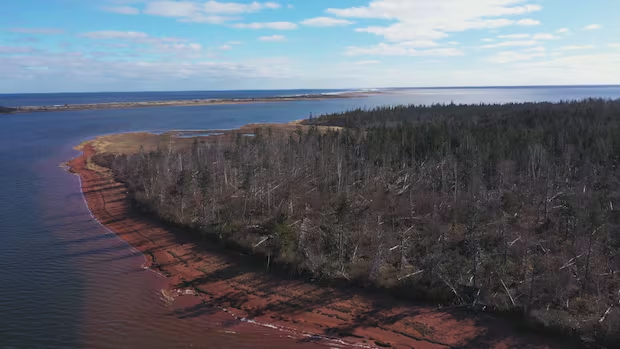
The Seal River watershed, a vast area in northwestern Manitoba, also proposed as a protected area and managed by local Indigenous communities. (Seal River Watershed Alliance)
“I think there is a very real concern that biodiversity is not being brought forward as a priority in the decision making related to new infrastructure,” said James Snider, vice president of science, knowledge and innovation for WWF-Canada.
“And we risk repeating the mistakes of the past rather than envisioning a future where environment and economy go hand in hand.”
What’s at stake?
Canada is only about halfway to its 30 per cent lands and oceans protection goal, meaning it has to double the amount of protected space in country in just five years.
Carney’s Liberals promised during the federal election campaign earlier this year that they would boost conservation efforts to reach the goals, including establishing 10 new national parks, 15 new urban parks and expanding the Indigenous guardians program, whose funding will run out by March.
WATCH | Mark Carney says nature strategy coming soon:
Carney says he’s committed to Paris climate targets, gains Green budget vote
In an uncommon exchange in the House of Commons on the day of a crucial vote, Prime Minister Mark Carney took a question from Green Party Leader Elizabeth May. He said Canada remains committed to its climate targets as determined by the Paris agreement.
But in contrast to those campaign pledges, the federal budget does not explicitly commit new funding. Speaking in the House of Commons a few weeks ago, Carney said the government would release a new nature strategy, but no details are available yet on what the strategy will include.
Advocates for the environment are watching.
“As the government is looking to make investments into what they’ve termed once-in-a-generation investments in economic development, there’s also a need to recognize the economic benefits that nature provides as well,” said Sandra Schwartz, national executive director for the Canadian Parks and Wilderness Society.
Then-environment minister Steven Guilbeault holds up an agreement to establish a new protected area in northwest Manitoba at an event with the Manitoba premier and others in 2024. Guilbeault has since quit the federal cabinet. (John Woods/The Canadian Press)
Several high-profile and vast protected areas are currently in the pipeline, including the Seal River watershed in the northwest of Manitoba, a new national park in the South Okanagan in B.C., and the Peel River watershed in Yukon which has completed its feasibility assessment. The projects have included years of surveying and planning work, a lot of it carried out by local Indigenous communities.
“It’s similar to a stranded asset. These projects need funds and they can’t just be coming through philanthropic dollars,” Schwartz said.
Schwartz said that ongoing conservation projects could be left in the lurch — research, community consultations, surveying and other activities that need to happen before parks and conservation areas can be established, which take years of work.
“Canada has an opportunity to be a beacon to demonstrate what it looks like to do these things right and to provide that leadership globally,” said Valérie Courtois, the executive director of the Indigenous Leadership Initiative, a national group advocating for Indigenous-led conservation. She is a member of the Innu community of Mashteuiatsh, located on the shore of Peikuakami or Lac-St-Jean in eastern Quebec.
WATCH | Indigenous guardians at work in Manitoba:
Poplar River’s lands guardian works to protect pristine wilderness
A 23-year-old resident of Poplar River First Nation recently became the community’s lands guardian. Owen Bear is now tasked with protecting the land that’s known as Pimachiowin Aki, which in Anishinaabemowin translates to “the land that gives life.”
‘I remain hopeful’
Courtois has long been an advocate for Indigenous guardians programs, where she has seen the benefits of involving community members in conservation work. She said it has helped young people especially connect with community and retain and learn the language as they work on the land.
“I’m a registered professional forester by trade. When I look at a forest management plan, we’ve been taught to ask how we can optimize, maximize the economic return on investment and value from forest lands,” Courtois said.
“When you’re an Indigenous person, the question you’re asking [instead] is what needs to stay for these landscapes to maintain and for me to be continue to be Innu?”
Valérie Courtois, right, leading a panel about Guardians and nationhood at the First Nations’ National Guardians Gathering. (Chantelle Bellrichard/CBC )
The national guardians program was first introduced by the federal government as a pilot project in 2017, and then extended in 2021 with $100 million in funding. Courtois said that funding ends by March 31 next year, and there hasn’t been any word yet from the government about an extension
“We know from government that the guardians initiative is seen very, very positively. They recognize that this is a good investment, but I know they’re managing their own fiscal pressures,” Courtois said.
“We haven’t heard anything specific on that, but I remain hopeful.”
When asked for a response, Environment and Climate Change Canada did not specifically address support for Indigenous-led programs and conservation work.
“The Government of Canada has built the foundation for continued success towards achieving Canada’s conservation targets, and we will continue to partner with Indigenous peoples, provinces and territories, environmental non-government organizations, private sector and philanthropic organizations to advance this goal,” the department said in a statement.