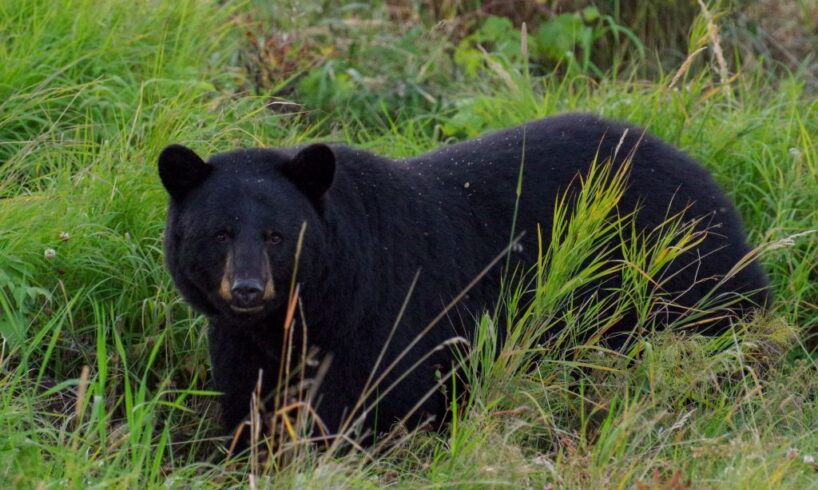
My dad was known as “the bear guy” in Peace River. He often got the call to advise on what to do with “problem bears” reported by the public. Now and then they’d get a call from a farmer about a grizzly bear, but for the most part the culprit was a black bear that had wandered into town or was nosing through somebody’s trash bins. “Problem bear” or “nuisance bear” were the terms commonly used by wildlife managers to describe bears that showed no fear of people, fed on anthropogenic food sources and edged close enough to threaten a person’s perception of safety. Perception being the key word there, my dad would later grumble. It was a tricky thing to assess and manage, because everyone’s perception of risk was different. Some people tolerated a bear wandering through their backyard. Others viewed the bear as a threat to their children’s safety. For everyone, the distance or threshold between the bear and their circle of comfort, the perception of a situation going from harmless to dangerous, could be markedly different. There was no clear line, no border drawn in the sand, that signalled to bears: You shall not pass.
Reports of problem bears were most frequent from late April, when bears crawled out of hibernation, through the spring and summer months, and into October, when they entered hyperphagia, a state of extreme hunger. Most of the calls to conservation officers about “problem bears” were regarding black bears, hands-down, owing to the fact that the grizzly population in northwestern Alberta was significantly less and, for the most part, tended to avoid people. The expression “problem bear” almost always refers to a black bear, even today.
“There’s a goddamned bear breaking into my shed!”
“There’s a bear prowling the riverbank. I’m scared for the safety of my kids.”
“There’s a bear up in a tree behind my house. I threw rocks at it, but it won’t budge.”
“Human safety is always our number one concern,” my dad would say. “But it’s about keeping the bear safe, too.”
One evening, our community made the national news when a black bear waltzed right through the automatic doors of the IGA grocery store and beelined for the bakery. Brendan and I laughed when we watched the footage captured by the store’s security camera: the bear strolling through those doors as if he’d done it a thousand times before, eventually chased out by the store manager with an industrial broom. The story made for a comedic segment on the six o’clock news, as no one was harmed, the bear included. My brother and I were excited, even proud, that the news of the bear had put our small town on the map. Maybe it was a problem bear, but it was our problem bear. For my dad, it was just business as usual.
Another day, another nuisance bear.
Black Bear details journalist Trina Moyles’s abiding fascination with the bears she grew up in close proximity to, and traces her relationship to these animals, the natural world of Canada’s North and her brother, an oilsands worker. Photo: Supplied by Trina Moyles
In the 1990s, wildlife managers relied on a bear management concept called “mutual avoidance,” a term that was coined and popularized by Stephen Herrero, a behavioural ecologist and author of Bear Attacks: Their Causes and Avoidance, a book published in 1985 that became, and remains today, widely influential. “Mutual avoidance is a desirable end state,” Herrero wrote in Bear Attacks. He called for a “standoff between bears and people rather than the petting, feeding and garbage eating that have characterized the past.” Herrero argued that a century of tolerating, and in some cases even encouraging, bears feeding on anthropogenic food sources had created a legacy of food-conditioned and habituated bears. Bear Attacks was one of the first books to draw a connection between food habituation and fatal maulings, arguing that a food- habituated bear is a dangerous bear. His logic was sound: Close the garbage dumps, clean up unmanaged food sources, and scare away food-habituated bears through persistent negative, or adverse, conditioning. My dad agreed.
“While we’d been trained to deter problem bears, and to protect ourselves against predatory wildlife attacks, there were quiet, embedded risks to growing up in northern Alberta. There were other predatory forces we wouldn’t see coming — and no soundtrack to indicate an incoming threat.”
He and his colleagues used negative conditioning to send problem bears a message, loud and clear: You aren’t welcome here. Mostly, they’d rely on non-lethal methods, driving bears off by vehicle, honking the horn or turning on a loud siren. They’d fire off a round of cracker shells at the bear, or shoot them with rubber bullets.
“We aim for the fat on the bear’s rump,” my dad told me. “The rubber slug will certainly sting and send them a message, but it won’t cause any harm to the bear.”
Some of the problem bears would be captured in culvert traps, a live bear trap designed like an open culvert: long enough for a bear to worm in, pull on bait at the back of the trap — typically a beaver carcass or roadkill — and trigger the door to slam behind them. Biologists would tranquilize the bear and take its physiological measurements: body weight, length, sex and general health. They’d age the bear by examining its teeth, the wear on its canines and incisors, looking for the presence of yellow dentine, which would indicate an older bear. Sometimes my dad would extract a tooth with pliers and send it for analysis in Edmonton. Under a microscope, a lab technician would count the number of rings on a tooth root, like the growth rings on a tree stump, to determine the bear’s age. The problem bear would receive a bright yellow or orange ID ear tag. Some would get a radio collar, so biologists could follow its whereabouts like a prisoner released on parole. The problem bears entered the system as numbers, so repeat offenders could be identified.
Most wildlife managers had a three-strikes-you’re-out policy. For bears that didn’t get the memo on mutual avoidance, their story ended with a lead bullet. “Put down” was the common expression, or “cull,” like kill made soft, or “euthanized,” as though the bear were akin to our family’s dog, Sage, whom we said goodbye to on the operating table at the veterinary clinic. “Destroyed” was another word used by wildlife managers, and as a child I imagined them blowing up the bear into ten thousand tiny pieces the same way they detonated the Death Star in Star Wars.
Bears that remained afraid of people and avoided areas used by humans would have the best chance at survival, my dad reminded us.
The calls from the public about problem bears wore on him, however.
“Who’s really the problem here — bears or people?” he’d complain.
”Problem bears” are what wildlife managers call bears who have grown habituated to people through anthropogenic (human-supplied) food sources. In the town where Trina Moyles grew up, these bears were occasionally grizzlies, but mostly black bears. Photo: Trina Moyles
Bears were just being bears, he’d say, drawn by their noses to unmanaged food sources, including unsecured garbage bins, or cooking oil dumped behind a restaurant in town, or an apple tree, or raspberry bushes in somebody’s backyard. Or maybe someone left their barbecue wide open, or forgot a bag of dog food out on the front steps of their house. Or perhaps it was a bear just passing through town, using the paved walking trail as a corridor to travel. In cases where bears would refuse to budge from people’s backyards, sometimes they’d discover small cubs clinging to the upper branches of nearby trees, which the mothers guarded from below.
At the root of every problem bear, my dad would say, is a human problem. The idea of a “bad bear” was solely a human construct. The bear was just trying to pack on enough pounds to survive the winter. If it discovered a human-made food source, that was our fault, not the bear’s.
But for all the resources that went into dealing with these so-called problem bears in town, the bears that actually killed people seemingly appeared out of thin air, like a sleight of hand. Their victims never saw it coming. These black bear attacks, although incredibly rare, mostly happened in remote areas where human activity encroached on their habitat.
‘When they get into predatory mode, it’s like the flick of a switch’
When I was in Grade 10, my forestry class was preparing for a two-week field course outside Swan Hills, Alta., an area located to the south of Peace River where there’s a high density of grizzly bears and black bears. My dad came to my high school to give a presentation on bear safety, specifically, how to protect ourselves from or avoid bear attacks. I’d grown up listening to these cautionary stories and instructions, but somehow the repeated telling felt as visceral as the first. He told us a story about 63-year-old Cree trapper Bella Twin, who, in 1953, encountered and defended herself against one of the world’s largest recorded grizzly bears in this same region and astonishingly put down the bear with a .22 rifle, a firearm meant for hunting small game like grouse and rabbits. I shivered in awe of Bella’s bravery, and my classmates’ eyes were wide with admiration. Even the boys nodded with respect. I was proud of my father, standing in front of our class like a bear guru of sorts.
We were instructed to respond differently in a close encounter with a grizzly bear versus a black bear. The two species had, behaviourally speaking, evolved differently. Whereas black bears evolved in trees, often fleeing and climbing to safety in frightening encounters, grizzly bears evolved on treeless plains where they had to stand their ground and fight back in defence situations. If it was a defensive grizzly bear attack, a mother protecting her cubs, for example, he advised us to play dead, which would potentially defuse the attack. “You’ve got to convince her that you’re not a threat,” he said. Often, in defensive grizzly attacks, bears would eventually leave after initially wounding or impairing a person.
“Cover the back of your neck with your hands,” he told us. “Try to stay on your stomach. The bear will likely try to flip you over, but if you can, stay on your stomach and protect your vital organs.”
If it was a black bear attack, he said, “you’ve gotta fight with everything you’ve got.”
Grizzly bears and black bears evolved differently and protect themselves differently in conflict situations. Moyles was instructed to play dead or to lie on her stomach to protect her organs if confronted with a grizzly attack. With a black bear, her father told her she should “fight with everything you’ve got.” Photo: Trina Moyles
We learned of a 10-year-old girl from Williams Lake, B.C., who fought off a black bear with an axe and a pot of boiling water, which she flung in the bear’s face.
Black bear attacks in North America occur more frequently than grizzly bear attacks, he explained, but when grizzlies do attack, it often results in serious injury or death. There were other key differences between grizzly bears and black bears.
He pointed to research from Herrero’s Bear Attacks that found the majority of fatal grizzly bear attacks occurred in national parks, where bears had become food-habituated and accustomed to people. On the flip side, nearly all the fatal black bear attacks took place in rural, remote areas — not so different from Peace River or the Swan Hills. Although these incidents were extremely rare, Herrero found that black bears would stalk and attack their victims in broad daylight, whereas the majority of grizzly bear attacks occurred at night. Perhaps that’s due to the fact that grizzly bears, as their habitat has shrunk in size and fragmented, have adapted to become more nocturnal. In over half the accounts, black bears preyed on people of smaller stature, their victims often women or children. There was an assumption that grizzlies were more dangerous than black bears, but just because black bears tended to be smaller didn’t mean they were any less deadly. “[Black bears] can bite through live trees thicker than a man’s arm,” Herrero wrote in Bear Attacks. “They can kill a full-grown steer with a bite to the neck.”
“If a black bear is stalking you, you’re probably not going to see it coming,” my dad told us. “When they get into predatory mode, it’s like the flick of a switch. They’re on. They’re focused.”
A collective hush fell over the room, all eyes glued to my father.
No doubt he was thinking of the tragic bear attacks that had occurred only a few years earlier at Liard River Hot Springs, a remote campground in northern British Columbia. On August 14, 1997, an adult black bear stalked a woman named Patti McConnell and her 13-year-old son, Kelly, near the upper hot springs pool. The bear attacked McConnell and then turned on her son, who had attempted to beat the bear off his mother with a stick. When Ray Kitchen, a 56-year-old trucker, heard their screams, he went running to intervene, but the bear charged and knocked him over. As people heard the attacks, they fled from the hot springs for the parking lot, and in the ensuing panic the bear mauled a fourth victim, a 28-year-old man. Eventually, two bystanders came running with rifles. They shot the bear, but both Patti McConnell and Kitchen died from their wounds.
Though there‘s a perception that grizzly bears are more dangerous than black bears, there are more attacks by black bears in North America than grizzlies, and black bears will often stalk their prey in daylight. Photo: Trina Moyles
My classmates and I had learned about the gruesome attacks, right down to the goriest details, on the television news. It made the front page of the newspapers with headlines that read: DEADLIEST ATTACK IN NORTH AMERICAN HISTORY. Reader’s Digest published a story called “Rogue Bear on the Rampage” that depicted the 13-year-old boy watching the bear “engulf his mother’s almost naked body.” The story read like a thriller novel; it was impossible to tear your eyes away from the sensational account. “[Kelly’s mother] lay beside him, her skin ashen, her eyes open and unblinking,” the article read. “The animal’s foul, rancid breath made Kelly want to vomit. He closed his eyes. He knew he was about to die.”
There was something unsettling about the way people leaned in to the bear attack story, some kind of twisted desire to consume every last gruesome detail. We were drawn to the blood lust of bear attacks with a magnetic intensity. It was hard to look away from the onslaught of headlines, but then again, we were kids growing up in a culture obsessed with violence inflicted by predators of all kinds — from wrestlers bashing one another over the head with folding chairs to movies about serial killers and rapists. Bears were just another bad guy.
But when it comes to bears, a fatal, predatory attack is never personal. It’s not evil or malicious, or premeditated. It’s about the animal’s attempt to survive and evolve. The media’s obsession with bear attacks generates sales and dollars, but more often than not, it fails to bring us any closer to understanding them as a species.
The detail about the woman’s “almost naked body” reminded me of the opening scene in Spielberg’s cult classic Jaws, a movie we worshipped as kids, that opens with a young woman with long blond hair running along a beach, giggling and taking off her clothes. A drunken suitor follows behind, slurring, “What’s your name again?” “Chrissie!” she says. “Where are we going?” “Swimming!” she responds. As she pulls off her sweater, revealing her breasts, the man says with a laugh, “I’m definitely coming!” Chrissie swims elegantly out into the calm ocean waters as the guy drunkenly struggles out of his clothes and passes out on the beach.
The point of view changes to that of the great white shark, lurking beneath Chrissie, rising up toward her. The camera zooms in on her naked body, a perfect Barbie replica, and the theme music, the two single notes produced by a tuba that Jaws would become world-famous for — duh duh, duh duh, duh duh — warns us that she’s about to get attacked. The Reader’s Digest story about the Liard River Hot Springs bear attack used similar stylistic tactics, only the rogue predator on a killing spree was a black bear instead of a shark. And the “almost naked” woman was an actual human victim.
At the root of my discomfort about the sensationalized story was not only the conscious fear of being attacked by a wild predator, but an unconscious one too, which began to take up space in my body. The fear of what it meant to be a girl on the brink of adolescence in the North.
Learning survival strategies for a different kind of threat
Growing up, I wore my brother Brendan’s hand-me-down clothes — grunge jeans that hung off my sapling frame and baggy Nirvana T-shirts — with pride. I cut my long blond hair into a mushroom cut, a popular hairstyle in the early 1990s, just like he did. We rocked out to the same music: the Offspring, Pennywise, NOFX. I remember sitting with my brother in the back seat of our parents’ Dodge van, drumming on the back of the driver’s and passenger’s seats, Green Day full blast on the stereo, gleefully bellowing the lyrics: WELCOME TO PAR–A–DISE!
On the weekends, he played in hockey tournaments and I religiously attended, even travelling with the team to away games. The ice was my brother’s preferred habitat, the place where he seemed the happiest, where he came alive. My mom said she used to take him to the arena where they lived at the time, in Brooks, Alta., when he was a baby, and his eyes would follow the game, watching the players zip back and forth. By the time Brendan could walk, he could skate.
For me, the hockey arena was a different kind of wilderness. The other players’ younger siblings and I would scurry up and down the side ramps, chasing rogue pucks that flew over the glass, and search beneath the bleachers for sticky quarters to buy scorching hot Styrofoam cups of hot chocolate and bags of hickory sticks from the vending machines. They called us “rink rats.” We were scavengers of sorts, allowed to freely roam the arena. But when my brother set foot on the ice, I would rush back to the bleachers where my parents sat and watch him like a hawk. I’d perch behind his team in the players’ box, cheering until my lungs were hoarse. As they played, the scent of the boys’ damp, sweat-saturated hockey gear — gloves, pads, socks, uniforms — filtered up toward us. I secretly loved that smell, even when, after games, my brother grabbed me and playfully threatened to zip me up in his equipment bag.
Brendan’s dream — like many other boys’ dreams in Canadian towns and cities — was to play on a team for the National Hockey League. Somehow, when we were kids, it didn’t seem so far out of reach. We were of a generation force-fed those inspirational slogans printed on laminated posters tacked up on the walls: IF YOU CAN BELIEVE IT, YOU CAN ACHIEVE IT. Brendan was always one of the strongest players, and our family organized our lives around his great love and his dream of playing in the NHL.
While I had begun to struggle with a growing sense of my body as an object of appraisal, never quite measuring up, my brother had to contend with his own perceived shortcomings: He was always one of the smallest guys in his class and on his hockey team. Over the years of playing minor hockey in Peace River, coaches often told him, “Too bad you aren’t bigger.” That he wasn’t an “alpha male” — a term that seemed to imply being physically big and dominant-spirited — weighed on him.
Our coming of age in a resource town in northern Alberta would require different survival strategies. I would learn how to avoid getting unwanted attention from boys or men. I would learn how to fawn and please, but also how to physically fend off an attack and defuse threats — not only from bears, but from boys and men. Defensive tactics of a different kind. Even then I sensed that the cultural onus seemed to be on us, as girls, to protect ourselves from harm.
“I would learn how to fawn and please, but also how to physically fend off an attack and defuse threats,” writes Moyles of her early adolescent experiences in northern Alberta. ”Not only from bears, but from boys and men.” Photo: Markus Lenzin
And so, at 13, I signed up for a self-defence course. I learned how to hit an attacker in the “vital areas,” jabbing the eyes, striking the nose, jaw or temple. How to carry car keys between my knuckles when walking to my vehicle at night. I didn’t even have my learner’s permit yet, but that was a trick I’d carry with me long into adulthood.
When he was 15, Brendan started getting “fucking smashed,” as he liked to say, with his hockey teammates on the weekends. He tried to hide it from my parents; alcoholism ran on both sides of our family, our mother always warned us. She spoke often of her childhood, growing up with an alcoholic father whose own father, a Ukrainian immigrant, had struggled with substance abuse. But booze flowed like the river in the North. The only way to drink was to drink hard. Get blackout drunk. “If you can’t remember what happened, you know it was a good night,” the saying went.
Brendan gifted me with a mickey of lemon gin, hidden in a small wooden chest he’d made in his Grade 11 industrial arts class, the summer I was 14 years old. My first sip of alcohol triggered cringe and disgust, followed by a warmth that rocked my body like ocean swell. I tasted relief in alcohol. I swam in the sea of disembodiment. The fear and anxiety that was gradually accumulating in my girl body found release.
We drank religiously every weekend in the bleachers at Friday night hockey games, at bush parties, in gravel pits and next to the gravesite of Twelve Foot Davis, a legendary trapper who’d improbably struck it rich on a 12-foot-wide gold mining claim during the Klondike gold rush. We got high, standing atop a large cement pad where Twelve Foot’s remains were entombed, overlooking the Peace River Valley, the lights of town glittering down below. We gathered around stacks of burning pallets, Metallica’s “Enter Sandman” blasting out of one of the hockey gods’ vehicles. Boys on shrooms and cocaine dared one another to jump over the dancing flames. Someone emptied a jerry can of fuel on the fire and it exploded. We waterfall-chugged and drank until we couldn’t walk. We drank until the red and blue lights flickered through the bush and the RCMP extinguished the flames and shut down the party and everyone drove home drunk.
While we’d been trained to deter problem bears, and to protect ourselves against predatory wildlife attacks, there were quiet, embedded risks to growing up in northern Alberta. There were other predatory forces we wouldn’t see coming — and no soundtrack to indicate an incoming threat.
It was my intoxicated classmate at the bush party, stumbling into the back seat of one of the hockey gods’ trucks. The next week at school, they wouldn’t call her a victim, they’d call her a slut.
Don’t be a Chrissie — she had it coming.
“Bear spray is more effective than a gun,” my dad had informed my classmates and me in his presentation before our field trip to Swan Hills. “It’s faster and safer.”
How many of my female classmates were also thinking what I was thinking?
Maybe it could work on guys, too.
As teenagers, we had a significantly greater chance of dying from alcohol poisoning and drug overdose, or operating vehicles or ATVs while drunk, than of being mauled by a bear. Yet, in some ways, we were better equipped to fend off predatory wildlife than we were to cope with social pressures and substance abuse. As my brother and I began to prioritize partying on the weekends, we inherently spent less time with our family on the land, camping, canoeing and hunting. We were just teens in a small northern town, doing what teens do. Experimenting beyond the boundaries of our family culture, moving toward independent social behaviour. But there were consequences to our actions; too many of our peers died — far too young.
We toasted our lost friends like fallen comrades, pressed the bottle of Jack Daniel’s to our lip, and taunted one another on, drink, drink, drink, drink.
On that Grade 10 field trip to Swan Hills, we didn’t encounter a single bear.