Shafaq News
Iraq’s post-election political
landscape is being reshaped by a renewed push to restrict weapons to state
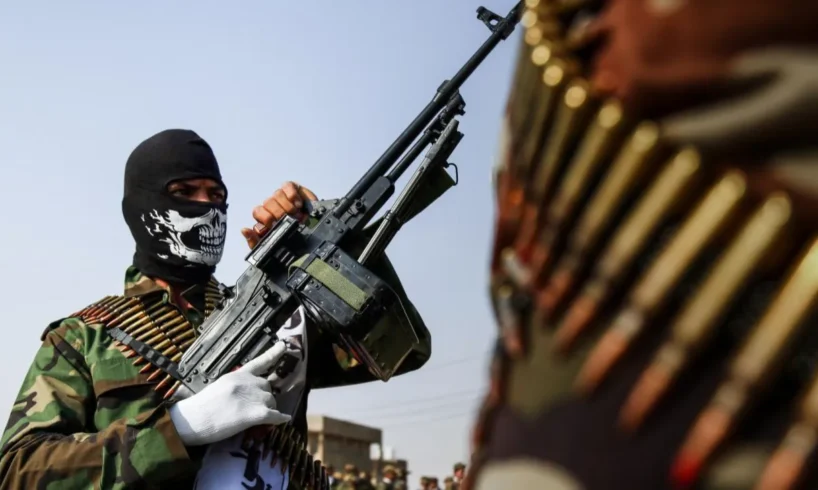
control, as armed factions split over disarmament under mounting international
and US pressure.
The political and security
landscape is witnessing an unprecedented movement, accompanied by divergent
positions among armed factions and within the Coordination Framework (CF), the
umbrella grouping of ruling Shiite political forces.
The issue of limiting arms to the
state has become a central file in negotiations to form the next government,
amid international warnings and growing, direct US demands to end the role of
weapons operating outside state authority.
Over the past hours, signs have
emerged of shifts within some armed factions, while others have maintained firm
opposition to disarmament, linking any such step to the achievement of what
they describe as “full sovereignty” for Iraq.
The Iraqi Challenge
Political analyst Imad
Al-Musafir, who is close to the Framework, said that some armed factions’
inclination toward restricting weapons to the state aligns with calls from the
religious authority and the judiciary, both of which have welcomed such a move.
Al-Musafir told Shafaq News that
political entities moving in this direction “believe they now represent the
state following the recent election results, which produced a Shiite bloc of
more than 90 lawmakers from Popular Mobilization Forces (PMF)-affiliated groups
in parliament.” These forces, he said, see no issue with weapons remaining in
the hands of a state they consider themselves to represent politically.
By contrast, Al-Musafir noted
that the two main factions rejecting disarmament—Kataib Hezbollah and Harakat
Al-Nujaba—tie their weapons to the realization of complete sovereignty over
Iraqi land and airspace, as well as full political and economic independence.
He added that the linkage of Iraqi funds to the US Federal Reserve is viewed by
these groups as another form of sovereignty violation, making their weapons,
from their perspective, connected to unresolved core issues.
Read more: Diverging views emergeon disarming Armed Factions in the Middle East
Diverging Faction Positions
Several armed factions have
announced their approval of calls to restrict weapons to the state, including
Kataib al-Imam Ali, Asaib Ahl al-Haq, Ansar Allah al-Awfiya, and Kataib Sayyid
Al-Shuhada.
In contrast, Kataib Hezbollah has
reiterated its rejection of disarmament, stating that sovereignty, security
control, and preventing foreign interference are prerequisites for discussing
weapons restrictions. Al-Nujaba Movement has also emphasized its “continued
resistance to the US presence.”
Earlier, Supreme Judicial Council
head Faiq Zaidan announced that armed factions had responded positively to the
principle of limiting weapons to the state, at a time when the United States
has intensified pressure on Baghdad to end the role of armed factions and
prevent their participation in the new government, following their significant
electoral gains.
Between Compliance and Escalation
Security and political expert Ali
Al-Maamari said the incidents after October 7, 2023, in Gaza altered the
balance of power in the Middle East, adding that “the dominance once enjoyed by
the axis linked to armed factions is no longer the same.”
Speaking to Shafaq News,
Al-Maamari said US pressure related to the formation of Iraq’s government has
become directly tied to the issue of factions that do not operate under the
authority of the commander-in-chief of the armed forces. He also noted
that “Kataib Hezbollah and Harakat
Al-Nujaba possess advanced military capabilities.”
According to Al-Maamari, all
Shiite blocs within the CF appear ready to meet US demands, provided they are
allowed to form the government in line with their political interests. What is
currently unfolding, he said, involves efforts to persuade factions—through
their political parties and fronts—to accept US requirements in exchange for
securing the premiership and key sovereign ministries.
He pointed out that the United
States has stated clearly that the three presidencies, sovereign ministries,
and even the governor of the Central Bank would fall within its sphere of
influence. These pressures, he said, “aim to force factions to disarm with the
consent of Shiite blocs themselves, within the framework of a comprehensive
settlement involving the United States, the factions, Iran, and the Iraqi
government.”
A Dual Crisis
Security expert and strategic
analyst Alaa Al-Nashou said the Iraqi government is currently unable to resolve
the issue of armed factions without direct international intervention led by
the United States and the Global Coalition.
Al-Nashou told Shafaq News that
“this stems from the factions’ superiority over Iraq’s regular forces in terms
of weaponry, influence, and control over political, economic, security, and
intelligence institutions,” adding that the factions possess advanced
cybersecurity systems and information networks not even available to the
Ministries of Defense and Interior.
He further argued that political,
security, and military decision-making is concentrated within Iran-aligned
factions, “supported by advisers and experts from the Islamic Revolutionary
Guard Corps and the Quds Force, under the direct supervision of the office of
Iran’s Supreme Leader.”
According to Al-Nashou, the next
government—still in the process of formation—is facing simultaneous US and
Iranian pressure, preventing it from taking an independent national decision,
while political parties seek to remain in power at any cost by aligning with
the strongest side.
“Factions now recognize they are
facing US, Israeli, and Western pressure that can no longer be confronted as
before, amid a new Middle East project taking shape,” he concluded.
Read more: “A Much DifferentPlace”: Trump’s tone reshapes Iraq’s political calculus
Divergent Paths Among Factions
Iraqi politician based in
Washington, Nizar Haidar, divided armed factions into two categories. The first
includes factions that have integrated into the political and electoral process
over multiple stages, most recently the latest parliamentary elections, and have
previously participated in governments with one or more ministers.
“These factions are seeking to
transition from armed groups outside state authority into components of state
institutions, which explains their current support for restricting weapons to
the state to gain international and regional acceptance, particularly from the
United States.”
The second category, Haidar
explained, consists of factions that do not yet see themselves fully within the
political process, despite participating in recent elections. “These groups
employ resistance rhetoric in an effort to secure the largest possible
political, financial, and security gains before fully integrating into the
state.”
Haidar told Shafaq News that
political forces and factions alike have begun to sense the seriousness of the
US position against engaging with a new government that includes armed
factions, noting that these factions “are now racing to demonstrate goodwill to
Washington ahead of the arrival of its special envoy in Baghdad.”
He warned that, from this point
forward, any armed faction that refuses to hand over its weapons and dismantle
its armed structures will face the judiciary, noting that the issue has now
become a formal state decision.
Written and edited by Shafaq News
staff.