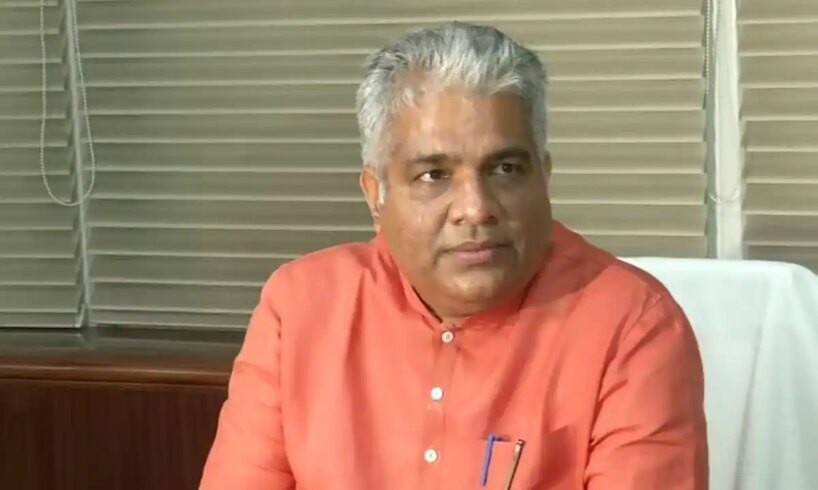
Union Minister of Environment, Forest and Climate Change Bhupinder Yadav, reacting to the “Save Aravalli” campaign following the Supreme Court’s acceptance of the Centre’s definition of the Aravalli hills, said that the process against illegal mining has been made stricter and that the Supreme Court has given this definition, with an intent to stop illegal mining.
In an interview with ANI, he further emphasised that mining activity in the Aravalli range will be allowed in only 0.19 per cent of the area, which is less than one per cent, and even in that area, no new mines have been opened. The Union Minister also asserted that nearly 90 per cent of the Aravalli region remains protected. The Union Minister also highlighted that, to conduct mining in these areas, a scientific management plan is required. He added that if any new approval comes, it should first be approved by the Indian Council of Forestry Research and Education (ICFRE).
“Mining activity in the Aravalli range will only be possible in 0.19 per cent of the area, which is less than one per cent, and even there, no new mines have been opened…There too it has been said that its management scientific plan should be made and if any new approval comes, then that new approval should first be allowed from ICFRE. … This process has been made stricter. The main problem in the Aravalli range is illegal mining. To stop illegal mining, the Supreme Court has given this definition, and a review is still pending before it. With this comprehensive definition and strict provisions, 90 per cent of the area is completely protected,” said Union Minister Bhupinder Yadav.
Add Zee News as a Preferred Source
The Minister emphasised that they have established 29 nurseries in the Aravalli range and plan to expand them to every district. “There can be no alternative; therefore, the Aravalli range needs protection. Just planting trees all around is not enough; this ecology, includes grass, shrubs, and medicinal plants, which are part of an ecological system and the International Big Cat Alliance created by our ministry. So, the Big Cat Alliance doesn’t just mean that we conserve tigers. But a tiger can only survive in a place if its prey and the entire ecological system supporting it are also present. And the deer and other animals will only survive if there is grass and other vegetation for them. That’s why we have established more than 29 nurseries, and we are planning to expand them to every district. We have studied the local flora of the entire Aravalli range, in every district, and the ecosystem includes everything from small grasses to large trees. That’s why I don’t just talk about trees; I talk about the entire ecology,” he said.
The Government clearly maintains that there is no imminent threat to the Aravallis’ ecology. Ongoing afforestation, eco-sensitive zone notifications, and strict monitoring of mining and urban activities ensure that the Aravallis continue to serve as a natural heritage and ecological shield for the nation.
In an interview with ANI, Union Environment Minister Bhupender Yadav, on Monday, highlighted the need for protection of the Aravalli mountain ranges, mentioning that “alternative cannot be there at all.” Underscoring the geological importance of the Aravallis and the way to maintain and safeguard them, Yadav said, “In Aravali, the oldest geological units are there, but to maintain its form, its protection wall is green fall. Not just planting trees all around. What nature is, is ecology. In nature, there is grass. In nature, there are shrubs. In nature, there is vegetation and medicines. It’s an ecological system.”
Furthermore, he reflected on the role of the International Black Cat Alliance, established by the Environment Ministry. “Big Cat Alliance does not mean that we only do tiger conservation. We do conservation, but a tiger can live in any place only when the prey below it, the ecological system below it. And the ecological system, deer etc., will survive only when there is grass, etc. for them,” Bhupender Yadav explained.
He added that, through the alliance, they have established more than 29 nurseries and aim to take them to every district in the country. Dismissing afforestation as a solution for the matter, the Minister said, “We have studied what the local vegetation of every district of the entire Aravali is, what the local trees are, and in trees and vegetation, from a small grass to a big tree, the whole ecosystem comes. That’s why I don’t just talk about trees, I talk about ecology.”
The Centre has said the Aravalli Hills will remain under robust ecological protection while balancing conservation with responsible development, amid the ongoing protests in multiple regions of northern India after the Supreme Court’s recent acceptance of the Union Environment Ministry’s definition of the Aravalli hills.
According to a press release by the government, “Under the approved framework, any landform rising 100 metres or more above local relief will be classified as an ‘Aravalli Hill’, including its supporting slopes and associated landforms. Further, two or more such hills located within 500 metres of each other will constitute an “Aravalli Range”, ensuring protection not only of prominent peaks but also of valleys, slopes, and smaller hillocks that form an integrated ecological system.
“Contrary to alarmist claims, there is no imminent threat to the Aravallis’ ecology. Ongoing afforestation, eco-sensitive zone notifications, and strict monitoring of mining and urban activities ensure that the Aravallis continue to serve as a natural heritage and ecological shield for the nation. India’s resolve is clear: the Aravallis will be safeguarded for present and future generations while balancing conservation with responsible development,” the statement said.
In a recent judgment delivered in November, the apex court endorsed the recommendations of a committee led by the Ministry of Environment, Forest and Climate Change (MoEFCC), constituted in May 2024 to frame a uniform policy definition of the Aravallis for mining regulation. The committee included forest department secretaries from Delhi, Haryana, Rajasthan and Gujarat, along with representatives from the Forest Survey of India, the Central Empowered Committee and the Geological Survey of India.
The Supreme Court reiterated the ecological significance of the Aravalli range as one of India’s oldest geological formations, highlighting its role in preventing desertification, recharging groundwater and sustaining biodiversity across northern and western India. It cautioned that unregulated mining poses a “grave threat to the ecology of the nation”.
The government said the definition builds on Rajasthan’s long-standing criterion in force since 2006, while introducing greater objectivity, transparency and conservation focus. All Aravalli hills and ranges will be mandatorily marked on Survey of India toposheets, core and inviolate areas will be clearly identified, and scientific criteria will guide decisions on permissible activities.
“The Supreme Court has accepted the committee’s recommendations to prohibit mining in core and inviolate areas, except for specified critical, strategic and atomic minerals under the Mines and Minerals (Development and Regulation) Act. It has also directed the MoEFCC to prepare a comprehensive Management Plan for Sustainable Mining (MPSM) for the entire Aravalli landscape through the Indian Council of Forestry Research and Education (ICFRE), on the lines of the Saranda forest mining plan,” the release said.
Crucially, the court has ordered an interim freeze on the grant of new mining leases in the Aravallis until the MPSM is finalised. Existing mines may continue operations only under strict compliance with sustainable mining norms and enhanced monitoring to curb illegal mining, it said. According to the government, the landscape-level approach will help preserve the Aravallis’ role as a natural barrier against the Thar Desert, protect groundwater recharge zones, conserve biodiversity corridors and safeguard the “green lungs” of the Delhi-NCR region.
Rejecting concerns of immediate ecological threat, the press release said afforestation drives, eco-sensitive zone notifications and robust enforcement mechanisms, including drones, CCTV surveillance and district task forces, are already in place. The government reaffirmed its commitment to balancing conservation with responsible development, stating that the Aravalli Hills will be protected for future generations through transparent, science-based regulation.
While addressing media in West Bengal’s South 24 Parganas on Sunday, Union Minister for Environment, Forest and Climate Change, Bhupendra Yadav also strongly rejected allegations that the Centre has diluted protections for the Aravalli hills, asserting that nearly 90 per cent of the Aravalli landscape will remain under the protected zone and mining will be allowed only in a very limited area under strict scrutiny of the Supreme Court.
While the Centre maintains that the order strengthens oversight and curbs illegal mining, the Congress insists the revised framework weakens long-term protection of the ancient Aravalli range and has vowed to continue its agitation both on the streets and in Parliament. Addressing a press briefing in Jaipur on Sunday, former Rajasthan CM Ashok Gehlot accused the BJP of attempting to “jeopardise the future of Rajasthan” by diluting protections for the Aravalli range, which he described as the state’s ecological lifeline. He alleged that the move was intended to benefit the mining mafia and was contrary to judicial orders and established government records.