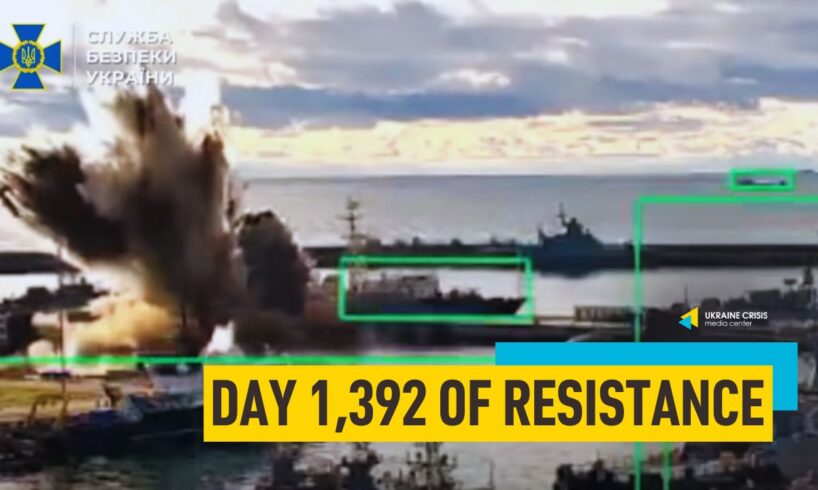
In a first, Ukraine strikes a Russian submarine with Sub Sea Baby underwater drones. Ukraine expects increased U.S. pressure on Russia if Putin rejects a peace proposal, Zelenskyi says. Russia rejects a Christmas truce proposal.
In a first, Ukraine strikes Russian submarine with Sub Sea Baby underwater drones
Ukraine’s Security Service said on Monday it had carried out the first-ever uncrewed underwater vehicle attack on a Russian submarine, damaging a Project 636.3 Varshavyanka class, or Improved Kilo class boat in the Black Sea port of Novorossiysk. The agency said the operation used Sub Sea Baby underwater drones.
“As a result of the explosion, the submarine suffered critical damage and was effectively put out of action,” the Security Service said.
It added that the submarine carried four launchers for Kalibr cruise missiles, which Russia uses to strike Ukrainian cities.
The agency also said that class of submarine costs around USD 400 million, adding that construction of a similar submarine under current sanctions could cost up to USD 500 million. It said the submarine is known as a “Black Hole” because of the hull’s ability to absorb sound and remain undetectable by sonar.
The submarine was one of many vessels that Russia was forced to move from Crimea’s Sevastopol Bay to the port of Novorossiysk after a series of Ukraine’s successful operations against the Russian fleet with the use of Sea Baby drones.
Ukraine’s Security Service said the strike was a joint operation conducted by the 13th Main Directorate of its Military Counterintelligence and the Ukrainian Navy.
On November 15, the Special Operations Center A of Ukraine’s Security Service destroyed four S-400 Triumph launchers and two radar systems in a drone strike on Novorossiysk.
Ukraine’s Security Service in cooperation with other branches of the Ukrainian military struck Novorossiysk with drones on November 25, damaging a Project 1171 landing ship, an oil terminal and S-300/S-400 air defense systems.
On November 29, Ukraine’s Security Service and the Ukrainian Navy struck two sanctioned oil tankers, Kairo and Vivat, belonging to Russia’s shadow fleet with Sea Baby naval drones. The vessels were heading to the port of Novorossiysk to load crude.
“This operation had many layers, from developing the strike weapon itself, to planning and excluding information leaks. Carrying out such an operation is a complex and rather difficult task,” spokesperson for the Ukrainian Navy, Captain Dmytro Pletenchuk said on national television.
He added that the Novorossiysk naval base is well-protected. Also, Russia now rarely keeps its vessels in the Black Sea following the attacks.
“[The ships] have to stay [in the port of Novorossiysk] and redeploy in case of danger. The vessels would move or leave the base not to get hit. This time, you see, they did not sense any danger,” Pletenchuk said.
Ukraine expects increased U.S. pressure on Russia if Putin rejects peace proposal, Zelenskyi says
Ukrainian President Volodymyr Zelenskyi said that if Russian leader Vladimir Putin rejects an end-of-war framework agreed during the talks between the U.S., EU and Ukraine, he expects increased U.S. pressure on Moscow.
“If Putin rejects everything, we will end up with exactly what we are experiencing on our plane right now — turbulence,” said Zelenskyi, recording the comments after his plane took off from Berlin for the Netherlands on Monday, according to media reports. “Yes, that turbulence is happening, but it’s nothing compared to the war, and certainly nothing compared to what would happen if Putin destroys all diplomatic possibilities from our, European and American sides.”
He added that in this case, he would expect tougher U.S. sanctions on Russia and additional military support to Ukraine.
“I believe the U.S. will pile pressure [on Russia] with more sanctions and provide us with more weapons if [Putin] rejects everything. I think that would be a fair request from us to the Americans. In my view, the logic is this: if the United States is ready to provide security guarantees to Ukraine and to apply strong guarantees if Putin violates the agreement, then tell me honestly — how is that different from a situation in which Putin does not want to end the war?” Zelenskyi said.
“It’s fair for me as president, and for some European leaders, to ask for at least some of these guarantees now so we can defend against Putin — with air defense systems and long-range weapons,” he added.
There are now five separate documents under discussion within the proposed peace deal — they include legally binding security guarantees that would be voted on by the U.S. Congress, as well as plans for funding Ukraine’s post-war recovery, Zelenskyi said. The work on security guarantees has “seriously moved forward,” he added.
Ukraine will not recognize Donbas as Russian, neither de jure nor de facto, Zelenskyi said.
U.S. administration officials told reporters Monday on the condition of anonymity that “literally 90 per cent” of the issues between Ukraine and Russia had been solved.
Russia rejects Christmas truce proposal
Asked about Germany’s Christmas truce proposal, Kremlin spokesperson Dmitry Peskov said Russia rejects it.
“We want peace — we don’t want a truce that would give Ukraine a respite and prepare for the continuation of the war,” he told reporters Tuesday. “We want to stop this war, achieve our goals, secure our interests, and guarantee peace in Europe for the future.”
On Monday, German Chancellor Friedrich Merz called on Putin to halt the fighting in Ukraine over Christmas.
Zelenskyi said both Ukraine and the U.S. support the proposal, yet much “depends on Russia’s political will.”
“Our position is that it is fair to stand where we stand — that is, on the contact line,” with the rest of the issues solved through diplomacy, Zelenskyi said ahead of the Berlin talks.
While Russia rejected the U.S. ceasefire proposal in spring, the unilateral ceasefire around the Victory Day celebration was the second short-term truce Putin announced in less than a month.
The Russian leader announced he instructed his troops to stop all military activity for some 30 hours on Easter. Ukraine accused Russia of breaching the truce, although it did say fighting had slowed along some parts of the front lines.