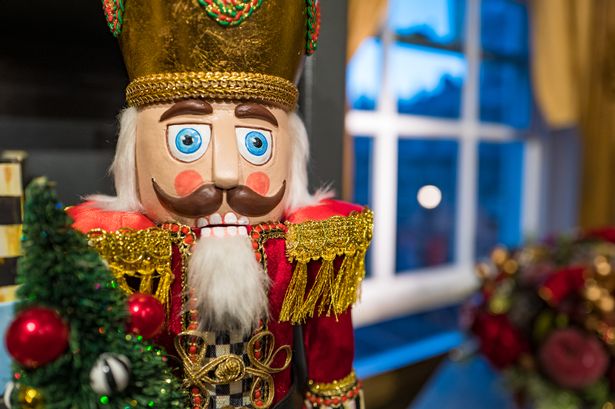
The UK has seen a massive surge in popularity for the Christmas decoration dubbed ‘Nutcrackercore’
Nutcracker dolls have become increasingly popular in recent years
You may well have noticed a certain Christmas decoration completely taking over the festive celebrations in recent years. I am, of course, talking about the nutcracker.
In recent years, it’s been impossible to escape seeing these rictus-grinning dolls dangling from Christmas trees, filling supermarket aisles, or supersized versions staring blankly from retailers’ festive displays.
As someone who had their formative childhood years in the 1980s, I don’t recall these curious dolls dominating Christmas quite like they do now. Back then, you were happy with a paper cracker and a bit of tinsel. So why are we now so overwhelmed by nutcracker decorations?
Well, like many traditions we now associate with Christmas, the nutcracker has its origins in Germany. The nutcracker soldier originated in the late 17th century in the Erzgebirge (Ore Mountains) region of Germany, near the Czech border.
The local population had relied on mining, but as resources dwindled, they turned to woodcarving to survive. But they weren’t just toys. As their name suggests, they were also used to crack nuts, with craftsmen often carving the figures to resemble authority figures they disliked, such as kings and soldiers.
Original nutcracker dolls from Nussknacker Museum in Neuhausen, Saxony(Image: René Röder, CC BY-SA 3.0)
By placing a hard nut in the figure’s mouth and cracking it, the common man could make these “authorities” do the menial work for them. They also became regarded as good luck and were believed to have the ability to ward off evil spirits.
In 1816, the German Romantic and Gothic horror author E.T.A. Hoffmann published the story “The Nutcracker and the Mouse King”. This dark fairytale, which featured a nutcracker doll that comes to life on Christmas Eve to fight a seven-headed Mouse King, helped link the doll with the magic of Christmas.
Christmas scene from King Nutcracker by Heinrich Hoffmann, 1853 (1956)
In 1872, Friedrich Wilhelm Füchtner, often called the “Father of the Nutcracker,” began the first mass production of these figures using a lathe in his workshop in Seiffen, cementing the iconic design we recognise today.
The Christmas connection
The figures became increasingly popular and were often sold at German Christmas markets as gifts for children. However, the most significant boost to its popularity came in 1892 when Pyotr Ilyich Tchaikovsky adapted the story into the ballet The Nutcracker. Although not an immediate hit, Tchaikovsky’s score became popular, and the ballet eventually became a global phenomenon, particularly around Christmas time.
The popularity of the wooden soldier in the UK is closely tied to the success of the ballet. The first complete performance of The Nutcracker outside of Russia took place in England in 1934, staged by Nicholas Sergeyev.
Since 1950, the English National Ballet has performed it every year, helping to establish the imagery of the soldier in the British public’s consciousness.
The surge in popularity for the Christmas decoration has been dubbed “Nutcrackercore”
Following World War Two, American soldiers stationed in Germany also helped spread the nutcracker beyond Germany, bringing the dolls home as souvenirs and Christmas presents.
In recent years, the UK has seen a massive surge in popularity for the decoration, dubbed “Nutcrackercore” by interior design magazines and retailers.
Nutcrackercore is part of a more recent movement away from the decorative minimalism of the 2010s toward “maximalism,” which incorporates ornate, theatrical, and nostalgic elements to evoke a sense of childhood magic and Christmases past.